Battery Chargers
The best battery chargers for multiple batteries
A household with a car, a bike and a mower has three charging problems. It does not necessarily need three chargers.

Disclosure: we earn a commission if you buy through the Amazon links on this page, at no extra cost to you. Commission never decides a verdict or a ranking position — read our editorial policy and affiliate disclosure.
How we assessed these: picks are selected from manufacturer specifications, current retailer listings and published owner feedback — not from hands-on testing of every unit. Where a manufacturer does not publish a figure, it is left out rather than estimated.
Short answer
For several batteries, buy one NOCO GENIUS10 and move it between vehicles. Its published 6 V and 12 V support and 40 Ah to 230 Ah capacity range covers a motorcycle battery and a deep-cycle bank with the same unit. Vehicles that sit for months are better served by a cheap maintainer left on each one permanently.
Quick picks
Tap any row to jump to the full write-up. Scoring criteria are published in full on our methodology page.
| # | Product | Best for | Our read | Price |
|---|---|---|---|---|
| 1 | 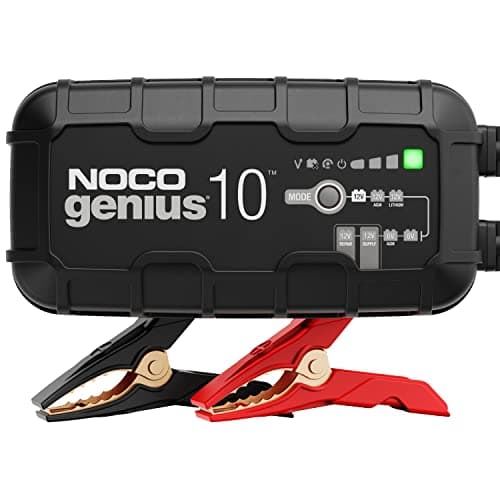 NOCO GENIUS10 Best one charger for a mixed fleet | Several vehicles or a deep-cycle bank | 10 A, 6 V and 12 V, 40 Ah bike to 230 Ah deep cycle | $99.95View on Amazon #ad Affiliate link · Price as of October 16, 2026 |
| 2 | 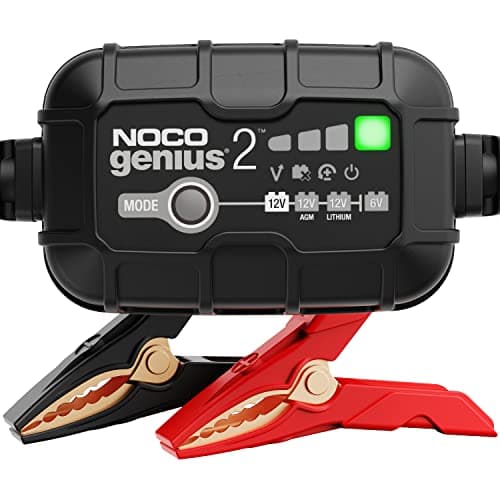 NOCO GENIUS2 Best per-vehicle maintainer for small batteries | Motorcycles, ATVs and lawn equipment | 2 A up to 40 Ah — right-sized for bikes and mowers | $49.95View on Amazon #ad Affiliate link · Price as of October 16, 2026 |
| 3 | 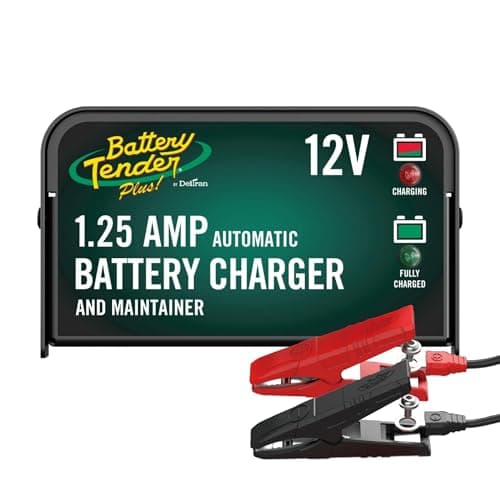 Battery Tender Plus 12V 1.25A Best set-and-forget unit per car | Long-term storage on a car battery | 1.25 A, 10-year warranty, flooded, AGM and gel | $58.95View on Amazon #ad Affiliate link · Price as of October 16, 2026 |
| 4 | 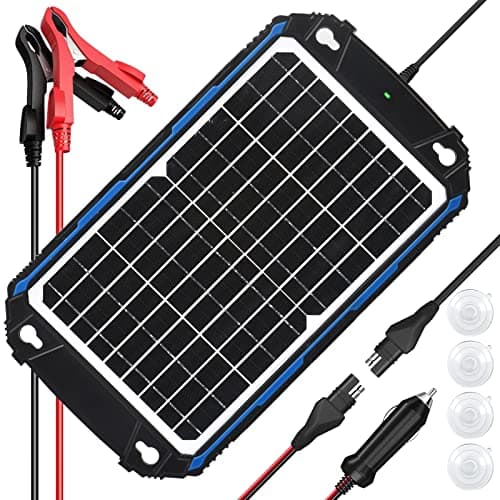 SUNER POWER 12W Solar Battery Maintainer Pro Best for the vehicle parked out of reach | Vehicles stored away from an outlet | No outlet needed; offsets drain rather than charging from flat | $59.99View on Amazon #ad Affiliate link · Price as of October 16, 2026 |
The question behind this search is almost always the same: there is a car, a second car or a truck, maybe a motorcycle, a mower, a boat or a camper, and the owner is tired of one of them being flat. There are two legitimate answers, and the right one depends not on how many batteries you have but on how often each vehicle moves.
One capable charger moved around suits vehicles that are driven, because what they occasionally need is a recovery charge. A maintainer left permanently connected suits vehicles that sit, because what they need is something fighting self-discharge and parasitic drain all year. Most households need one of each rather than four of either.
What a single charger has to cover
| Charger | Current | Capacity range | Voltages | Best role |
|---|---|---|---|---|
| NOCO GENIUS2 | 2 A | Up to 40 Ah | 6 V and 12 V | Maintainer on a bike, ATV or mower |
| NOCO GENIUS5 | 5 A | Up to 120 Ah | 6 V and 12 V | One car, charge and maintain |
| NOCO GENIUS10 | 10 A | Up to 230 Ah | 6 V and 12 V | A mixed fleet from one unit |
| Battery Tender Plus | 1.25 A | Automotive up to 80 Ah | 12 V | Left on a stored car all season |
All figures are each manufacturer's published specifications. Note that capacity range and current are different constraints: a charger can have enough current and still be outside its rated capacity range, which is the mistake that makes people think a charger is faulty.
The GENIUS10 is the pick for the roving-charger role for one reason that is easy to miss: its range runs from small batteries up to 230 Ah, and it does 6 volts as well as 12. That span is what lets one unit serve a classic with a 6-volt system, a modern car, and a deep-cycle camper battery. The GENIUS5 covers two of those three; the 2-amp GENIUS2 covers only the small end.
Where the GENIUS10 is the wrong answer is as a permanent maintainer on a small battery. NOCO's own published caution is that 10 amps is more current than a small motorcycle battery wants. For that job you want 1 to 2 amps, which is exactly what the GENIUS2 and the Battery Tender Plus are for.
One charger moved around, or one maintainer per vehicle
- Driven weekly, flat occasionally. One good charger, moved as needed. You are buying recovery capability, and you only need one of those at a time.
- Sits for a season. A maintainer left connected, one per vehicle. These are inexpensive, and the alternative is remembering to rotate a single charger around four vehicles every fortnight, which nobody does.
- Parked where there is no outlet. A solar maintainer, with the honest caveat that it offsets drain rather than recovering a flat battery, and it does nothing under snow.
- A mixed fleet with one 6-volt classic. The 6 V capability narrows the field immediately — it is the reason to buy a GENIUS rather than a 12-volt-only unit.
Battery charger versus maintainer is the full version of that distinction, and the best battery maintainers and trickle chargers is the field for the per-vehicle role.
The thing not to do: charging two batteries at once off one charger
The obvious shortcut is to wire two batteries together and charge the pair from a single port. Do not do this casually. Two batteries in parallel must be the same chemistry, the same nominal capacity and in similar states of health, or the stronger one dumps current into the weaker one, the charger reads a voltage that reflects neither accurately, and the weak battery ends up both under-charged and hot.
If you genuinely need two batteries charged simultaneously and independently — a starting battery and a house battery on a boat, for instance — the correct equipment is a multi-bank charger with separate isolated outputs, not one charger with a Y-lead. That is a different product class from anything on this page, and it is the honest answer rather than a workaround.
Sequence matters when you have a lot of them
How to work through a fleet with one charger
Start with the worst one
The deeply discharged battery is the one with a deadline, because sulfation starts immediately and becomes permanent. Read resting voltage on all of them first — see how to tell if a car battery is bad.
Match the chemistry setting every single time
It takes two seconds and it is the step people skip when they are doing four batteries in a row. Check the label on each battery as you connect it.
Let each one finish
A smart charger moves to a float or maintenance stage when the battery is full. Pulling it off at 90 percent and moving on means every battery in the fleet is permanently slightly short.
Put the ones that sit on their own maintainers
Once a vehicle has been identified as one that sits, stop rotating the charger to it and give it a 1 to 2 amp unit of its own. That is what ends the cycle.
The picks in full
1. Best one charger for a mixed fleet
NOCO GENIUS10
NOCO · Best for several vehicles or a deep-cycle bank
Twice the current of the GENIUS5 and nearly twice the capacity range — 10 amps up to 230 Ah, which is where RV, marine and multi-vehicle households land.
Published specifications
What works
- 10 A halves the charge time on a flat car battery against a 5 A unit
- The 230 Ah range covers deep-cycle RV and marine batteries the GENIUS5 cannot
- Same -4 °F cold rating and 3-year warranty as the smaller GENIUS units
What does not
- 10 A into a small motorcycle battery is more current than it wants — use a 1 A or 2 A unit there
- Heavier and pricier than a GENIUS5 for a household with one car
Skip it if
Not the right charger for a single motorcycle, ATV or lawn-tractor battery. Small batteries want small current.
#ad Affiliate link · Price as of October 16, 2026
Raw specifications: NOCO’s own page for the NOCO GENIUS10.
2. Best per-vehicle maintainer for small batteries
NOCO GENIUS2
NOCO · Best for motorcycles, atvs and lawn equipment
A 2-amp maintainer for the small batteries a car charger would cook: motorcycles, ATVs, mowers and anything that sits for months.
Published specifications
What works
- 2 A is the right order of magnitude for a 10-20 Ah powersports battery
- Safe to leave connected through a whole off-season
- Light and small enough to live on a shelf beside the bike
What does not
- The 40 Ah ceiling makes it a maintainer for a car battery, not a recovery charger
- Recharging a flat car battery at 2 A takes most of a weekend
Skip it if
Not the charger to buy if your actual problem is a flat car battery you need back tonight. That is a 5 A or 10 A job.
#ad Affiliate link · Price as of October 16, 2026
Raw specifications: NOCO’s own page for the NOCO GENIUS2.
3. Best set-and-forget unit per car
Battery Tender Plus 12V 1.25A
Battery Tender · Best for long-term storage on a car battery
The storage-maintainer benchmark: 1.25 amps, automotive batteries up to 80 Ah, a four-step program and a 10-year warranty behind it.
Published specifications
What works
- A 10-year warranty is the longest in this category by a wide margin
- 1.25 A is low enough to leave connected through a winter without heat build-up
- Covers flooded, AGM and gel without a chemistry switch to get wrong
What does not
- 1.25 A is a maintainer current — it will not revive a deeply flat battery quickly
- The 80 Ah ceiling rules out large truck and deep-cycle batteries
- No 6 V mode on the standard Plus; that is a different model in the line
Skip it if
Not the unit for recovering a flat battery on a deadline. Buy it for the car that sits, not the car that stranded you this morning.
#ad Affiliate link · Price as of October 16, 2026
Raw specifications: Battery Tender’s own page for the Battery Tender Plus 12V 1.25A.
4. Best for the vehicle parked out of reach
SUNER POWER 12W Solar Battery Maintainer Pro
SUNER POWER · Best for vehicles stored away from an outlet
For the boat, RV or seasonal vehicle parked where there is no power — a weatherproof 12-watt panel with its own MPPT charge controller, sized to offset parasitic drain rather than to charge from flat.
This manufacturer does not publish a full specification table for this model on its own site. Rather than repeat figures we cannot source, the assessment below is limited to what the product category and the retailer listing genuinely establish.
What works
- Needs no outlet, which is the entire point for a boat on a trailer or a car in long-term storage
- Offsets the parasitic draw that flattens a stored battery over months
- The charge controller is built in, so there is no separate regulator to buy or wire
- Nothing to plug in means nothing to forget
What does not
- Output depends on sun; a shaded or snow-covered panel does nothing
- It maintains a charged battery — it is not a way to recover a flat one
- 12 watts is a maintenance-scale panel, so it will not keep up with a parasitic fault
- The brand publishes no specification sheet of its own, so there are no manufacturer-sourced figures to put in a table
Skip it if
Not a replacement for a wall charger. If an outlet reaches the vehicle, a plug-in maintainer is more reliable and cheaper.
#ad Affiliate link · Price as of October 16, 2026
Key takeaways
- Buy one capable charger for recovery, plus a cheap maintainer for each vehicle that sits.
- The GENIUS10's 6 V and 12 V support and 40-230 Ah range is what lets one unit cover a mixed fleet.
- Ten amps is too much current for a permanent maintainer on a motorcycle battery.
- Never charge two batteries in parallel unless they match in chemistry, capacity and health.
- Two batteries that need simultaneous independent charging need a multi-bank charger.
- Set the chemistry on every battery, every time — it is the step that gets skipped in a row of four.
How we sourced this
Every figure on this page came from one of the following. Where a manufacturer or regulator does not publish a number, we say so rather than estimate it.
- NOCO GENIUS2 published specifications
- NOCO GENIUS5 published specifications
- NOCO GENIUS10 published specifications
- NOCO GENIUS10 product page — start-voltage sensor, Force Mode, pulse repair
- Battery Tender Plus 12V 1.25A product page
- ODYSSEY Battery — frequently asked questions (winter storage, parasitic drain, maintainer use)
Common questions
- Can one battery charger handle a car, a motorcycle and a mower?
- Yes, if its capacity range spans them. The NOCO GENIUS10 publishes a range up to 230 Ah with 6 V and 12 V support, so it can recover a car battery and a small powersports battery. For a battery left connected all season, step down to a 1 to 2 amp maintainer instead.
- Can you charge two batteries at the same time with one charger?
- Not safely as a general practice. Batteries wired in parallel must match in chemistry, capacity and state of health, or the stronger battery feeds the weaker one and the charger misreads both. If you need two charged independently, buy a multi-bank charger with isolated outputs.
- Is it cheaper to buy one big charger or several maintainers?
- It depends on how the vehicles are used, not on the count. Vehicles that get driven need occasional recovery, which one good charger covers. Vehicles that sit need something connected all season, and a small maintainer per vehicle is both cheaper and more reliable than rotating one unit.
- Does leaving a maintainer on every vehicle waste electricity?
- Very little. These are low-current devices — 1.25 to 2 amps at the top of their charge cycle, dropping to a float trickle once the battery is full. The cost of a replacement battery dwarfs the running cost of the maintainer that would have saved it.
More in Battery Chargers
A jump pack gets you moving. A charger is how you stop needing one. This is the home half of the problem.
Read next

Head to head
Charger vs Maintainer
The difference in one table, why the amp rating is the giveaway, and which one solves the problem you actually have.
Best Battery Maintainers
Best Maintainers
Low-current maintainers for seasonal and stored vehicles, including the solar option for anything parked away from an outlet.
Guide
What Amp Do I Need?
Charge current sizing by battery capacity, with the 10% guideline shown in full and manufacturer capacity ranges to verify against.
Best for marine batteries
Best for Marine Batteries
Published capacity ranges against real deep-cycle sizes, why the chemistry setting matters more here than on a car, and what to do when the boat is on a trailer with no power.
Found something out of date, or a figure you can source better than we did? Tell us — corrections get read first. Our methodology explains how picks are made, and contact is one click away.