Battery Chargers
Should you disconnect a car battery when storing a car?
Going away for a month? There is a better answer than pulling a terminal, and a worse one than doing nothing.
Disclosure: we earn a commission if you buy through the Amazon links on this page, at no extra cost to you. Commission never decides a verdict or a ranking position — read our editorial policy and affiliate disclosure.
How we assessed these: picks are selected from manufacturer specifications, current retailer listings and published owner feedback — not from hands-on testing of every unit. Where a manufacturer does not publish a figure, it is left out rather than estimated.
Short answer
Disconnect the battery only if no outlet reaches the car. A maintainer is the better answer whenever power is available: the battery stays full rather than merely stable, and the car keeps its clock, radio presets and learned engine and transmission settings. Disconnecting works because parasitic drain cannot reach a disconnected battery.
ODYSSEY's own guidance on winter storage puts the two options side by side: leave the battery on a maintainer-type charger, which fights against any current drains, or simply disconnect the battery cables, because current drains from the vehicle cannot damage a battery that is not connected. Both prevent the failure. They are not equally convenient.
What disconnecting actually solves, and what it does not
Disconnecting removes parasitic drain entirely — the alarm, the keyless receiver, the telematics unit, the module that keeps your seat memory. On a modern car that is most of the problem, and it is why a disconnected battery will sit for months where a connected one will not last six weeks.
What it does not remove is self-discharge. A lead-acid battery on a shelf still loses charge, slowly, because of its own internal chemistry. Over a winter that is a modest loss from a full battery and a serious one from a half-full battery, which leads to the single most important rule on this page: charge it fully before you disconnect it. Disconnecting a half-flat battery preserves the half-flat state, and a battery stored discharged sulfates whether it is connected to anything or not.
The costs of disconnecting, which are real but small
- Clock, trip computer and radio presets. These will reset. Annoying, trivial.
- Learned adaptations. Modern engine and transmission control units learn fuel trims and shift behavior over time. Some of that is lost, and the car may feel slightly rough or shift oddly for the first few dozen miles while it relearns.
- Window, roof and seat memory. Some vehicles need a relearn procedure for one-touch windows or a panoramic roof after power loss. The owner's manual covers it; it is usually a sequence of holding a switch.
- Alarm and immobilizer behavior. Some vehicles object to losing power and need a specific reconnection sequence. Check the manual before you pull the terminal, not after.
- Radio and infotainment security codes. Rarer than it used to be, but some systems still ask for a code after a power interruption.
None of those is a reason not to disconnect when disconnecting is the only option. All of them together are a good reason to prefer a maintainer when an outlet is available, which is the real recommendation of this page.
How to do it properly
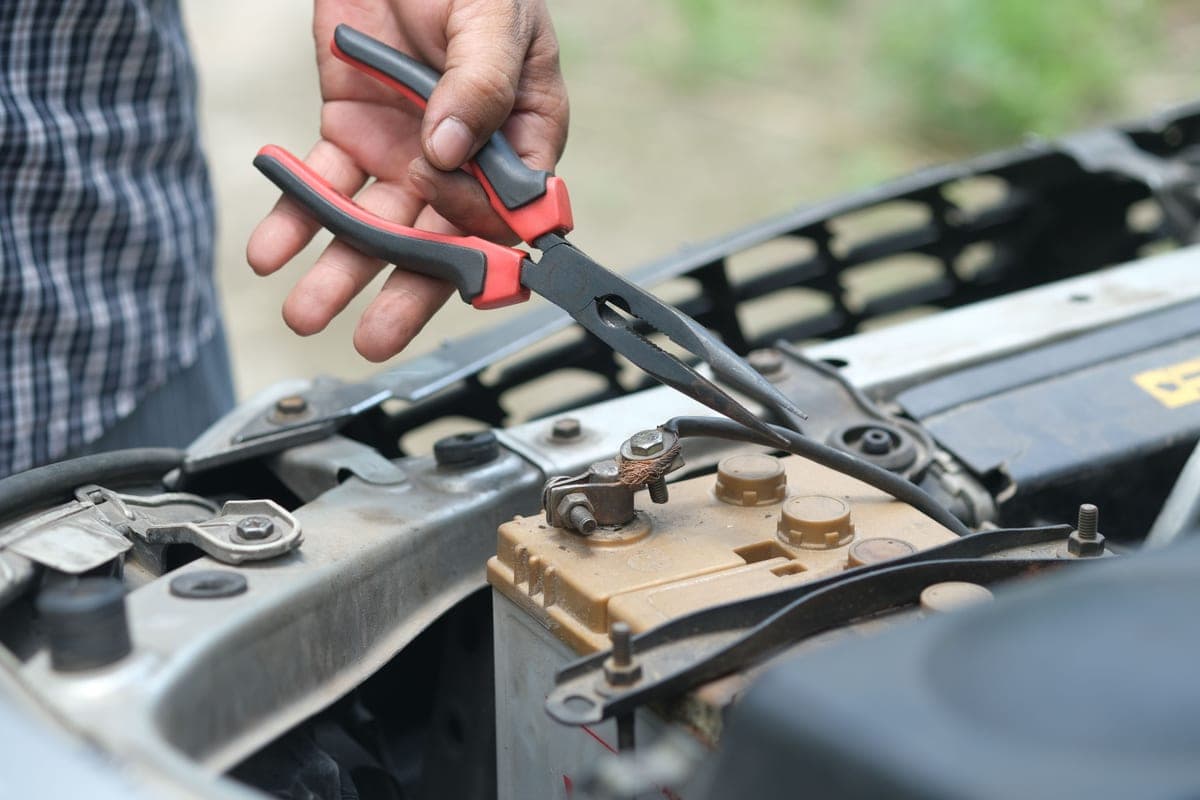
Disconnecting a battery for storage
Charge it to full first
Use a proper charger and let it finish. A smart charger will move to a float stage when the battery is genuinely full — that is the point to stop, not before.
Check the owner's manual for relearn procedures
Two minutes of reading now avoids an afternoon of confusion about why the sunroof will not close in one touch.
Negative terminal first, and only the negative
Loosen and remove the negative cable, then tuck it where it cannot fall back onto the post. Taking the negative off first means a slipped wrench touching bodywork is harmless.
Leave the battery in the car if it is warm enough
There is no benefit to carrying it indoors unless the car is stored somewhere that will go deeply below freezing. A full battery resists freezing well; a flat one does not.
Reconnect positive first, then negative
The reverse of removal, for the same reason. Then expect a few minutes of warning lights and a slightly uneven idle while the car reorients itself.
Why a maintainer is the better answer when you can use one
A maintainer leaves the car as a car. You come back, turn the key and drive, with the clock right and nothing to relearn. It also keeps the battery at full charge rather than slowly drifting down from full, and a battery held at full charge lasts materially longer than one that cycles between full and three-quarters all year.
The unit for this job is a low-current one — 1.25 to 2 amps — designed to be left connected indefinitely. The Battery Tender Plus is the long-standing choice at 1.25 amps with a 10-year warranty, and a NOCO GENIUS5 at 5 amps will both recover a battery and then hold it, which is useful if the car is already low when you park it. How long you can leave a battery maintainer on answers the obvious follow-up, and battery charger versus maintainer covers the distinction between the two product types.
The middle case: no outlet, but the car is outside
This is where a solar maintainer earns its place. It needs no outlet, which is the whole point for a car on a driveway, behind a shed, or at a second property. Its honest limitation is that it maintains rather than charges: it offsets parasitic drain on a battery that is already full, and it will not bring a flat one back. It also does nothing under snow, under leaves or in deep shade.
If that describes your situation and the storage period is long, the robust answer is both: charge the battery fully, disconnect it, and skip the solar panel entirely. Disconnection is free and it works. The best solar battery maintainers covers the solar route in detail, and how long a car can sit before the battery dies sets out the timeline you are working against.
What we would buy
1. Best alternative to disconnecting
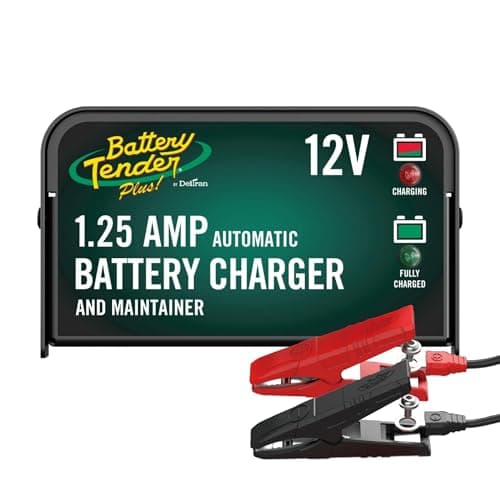
Battery Tender Plus 12V 1.25A
Battery Tender · Best for long-term storage on a car battery
The storage-maintainer benchmark: 1.25 amps, automotive batteries up to 80 Ah, a four-step program and a 10-year warranty behind it.
Published specifications
What works
- A 10-year warranty is the longest in this category by a wide margin
- 1.25 A is low enough to leave connected through a winter without heat build-up
- Covers flooded, AGM and gel without a chemistry switch to get wrong
What does not
- 1.25 A is a maintainer current — it will not revive a deeply flat battery quickly
- The 80 Ah ceiling rules out large truck and deep-cycle batteries
- No 6 V mode on the standard Plus; that is a different model in the line
Skip it if
Not the unit for recovering a flat battery on a deadline. Buy it for the car that sits, not the car that stranded you this morning.
#ad Affiliate link · Price as of October 16, 2026
Raw specifications: Battery Tender’s own page for the Battery Tender Plus 12V 1.25A.

2. Best if the car is stored flat
NOCO GENIUS5
NOCO · Best for one car, charging and maintaining
The single most useful charger for one vehicle: 5 amps, 6 V and 12 V, batteries up to 120 Ah, and it can be left connected indefinitely.
Published specifications
What works
- 5 A recharges a car battery overnight and then holds it — one unit does both jobs
- Rated down to -4 °F, so it works in an unheated garage
- The 77-inch cable reaches from a wall outlet to most engine bays without an extension
- 3-year warranty, against 1 year on the jump-starter line
What does not
- 5 A is slow for a deeply discharged large battery — a 100 Ah battery is an all-nighter
- The 120 Ah ceiling rules out larger deep-cycle banks
Skip it if
Not enough charger if you are reviving deep-cycle RV or marine batteries. Step up to the GENIUS10 and its 230 Ah range.
#ad Affiliate link · Price as of October 16, 2026
Raw specifications: NOCO’s own page for the NOCO GENIUS5.
3. Best when there is no outlet
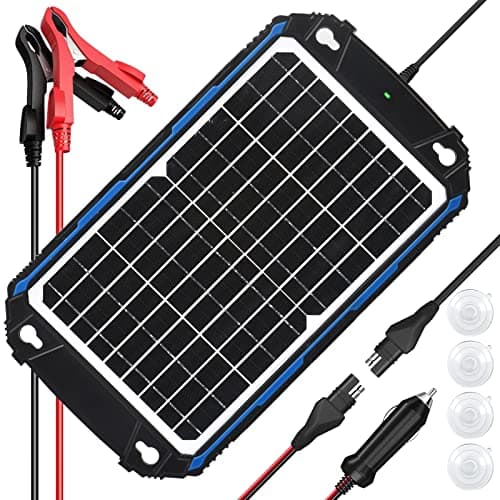
SUNER POWER 12W Solar Battery Maintainer Pro
SUNER POWER · Best for vehicles stored away from an outlet
For the boat, RV or seasonal vehicle parked where there is no power — a weatherproof 12-watt panel with its own MPPT charge controller, sized to offset parasitic drain rather than to charge from flat.
This manufacturer does not publish a full specification table for this model on its own site. Rather than repeat figures we cannot source, the assessment below is limited to what the product category and the retailer listing genuinely establish.
What works
- Needs no outlet, which is the entire point for a boat on a trailer or a car in long-term storage
- Offsets the parasitic draw that flattens a stored battery over months
- The charge controller is built in, so there is no separate regulator to buy or wire
- Nothing to plug in means nothing to forget
What does not
- Output depends on sun; a shaded or snow-covered panel does nothing
- It maintains a charged battery — it is not a way to recover a flat one
- 12 watts is a maintenance-scale panel, so it will not keep up with a parasitic fault
- The brand publishes no specification sheet of its own, so there are no manufacturer-sourced figures to put in a table
Skip it if
Not a replacement for a wall charger. If an outlet reaches the vehicle, a plug-in maintainer is more reliable and cheaper.
#ad Affiliate link · Price as of October 16, 2026
Key takeaways
- Use a maintainer whenever an outlet reaches the car; disconnect only when one does not.
- Disconnecting removes parasitic drain but not self-discharge, so charge it fully first.
- Expect to lose the clock, presets and some learned engine and transmission adaptations.
- Negative terminal off first, positive on first — the rule that keeps a slipped wrench harmless.
- A battery held at full charge by a maintainer lasts longer than one that drifts down all season.
- Solar holds a charged battery outdoors; it does not recover a flat one.
How we sourced this
Every figure on this page came from one of the following. Where a manufacturer or regulator does not publish a number, we say so rather than estimate it.
Common questions
- Should I disconnect my car battery if I am going away for a month?
- Only if no outlet reaches the car. A month is right at the edge of what a modern car's parasitic drain allows, so doing nothing is a gamble. A maintainer is the better fix because the car keeps its settings; disconnecting is the fallback when there is no power available.
- Which terminal do you disconnect first on a car battery?
- The negative one. With the negative cable off, the rest of the car's bodywork is no longer at a different potential from the tool in your hand, so a slipped wrench touching metal does nothing. Reconnect in the opposite order: positive first, negative last.
- What do you lose when you disconnect a car battery?
- The clock, trip computer and radio presets, and some learned engine and transmission adaptations which the car relearns over the following miles. Some vehicles also need a relearn procedure for one-touch windows or a sunroof. Check the owner's manual before disconnecting.
- Will a disconnected battery still go flat?
- Slowly, yes. Disconnecting stops parasitic drain but not the battery's own self-discharge. A fully charged battery will survive a winter disconnected; a half-charged one may not, which is why charging it to full before disconnecting is the step that matters.
- Is it bad to leave a battery maintainer connected for months?
- No, provided it is a maintainer rather than a plain charger. Units designed for this job hold the battery at a float voltage once it is full and are specified to be left connected indefinitely. A dumb trickle charger with no automatic cutoff is a different matter.
More in Battery Chargers
A jump pack gets you moving. A charger is how you stop needing one. This is the home half of the problem.
Read next
Guide
How Long a Car Can Sit
Why a modern car flattens its battery in weeks rather than months, how parasitic drain and self-discharge stack up, and the two fixes that actually work.
Guide
How Long Can You Leave It On?
Why modern maintainers are designed for permanent connection, what to check occasionally anyway, and the one kind of unit to never leave unattended.
Best Solar Maintainers
Best Solar Maintainers
Solar maintainers for vehicles stored away from an outlet, with a clear statement of what they cannot do and why a controller matters.
Head to head
Charger vs Maintainer
The difference in one table, why the amp rating is the giveaway, and which one solves the problem you actually have.
Found something out of date, or a figure you can source better than we did? Tell us — corrections get read first. Our methodology explains how picks are made, and contact is one click away.