Jump Starters
The best jump starters for V8 engines
Packs are rated in engine liters, not in cylinder counts. That is the whole trick to buying one for a V8.
Disclosure: we earn a commission if you buy through the Amazon links on this page, at no extra cost to you. Commission never decides a verdict or a ranking position — read our editorial policy and affiliate disclosure.
How we assessed these: picks are selected from manufacturer specifications, current retailer listings and published owner feedback — not from hands-on testing of every unit. Where a manufacturer does not publish a figure, it is left out rather than estimated.
Short answer
For a V8, buy the NOCO Boost Plus GB50. Its 1,500 peak amps and published 7.0-liter gas rating cover every V8 fitted to a passenger car, SUV or half-ton pickup with margin left for a cold morning, and it still weighs 2.71 lb. Big-block and diesel V8 owners should step up to the GB70.
Quick picks
Tap any row to jump to the full write-up. Scoring criteria are published in full on our methodology page.
| # | Product | Best for | Our read | Price |
|---|---|---|---|---|
| 1 | 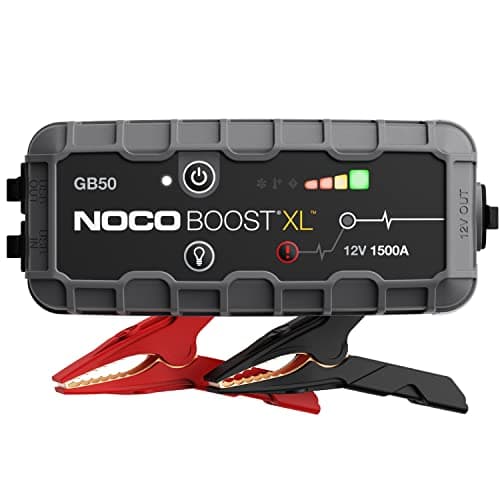 NOCO Boost Plus GB50 Best overall for a V8 | V6 and small V8 gas engines | 1,500 A, 7.0 L gas rating, still only 2.71 lb | $149.95View on Amazon #ad Affiliate link · Price as of October 16, 2026 |
| 2 | 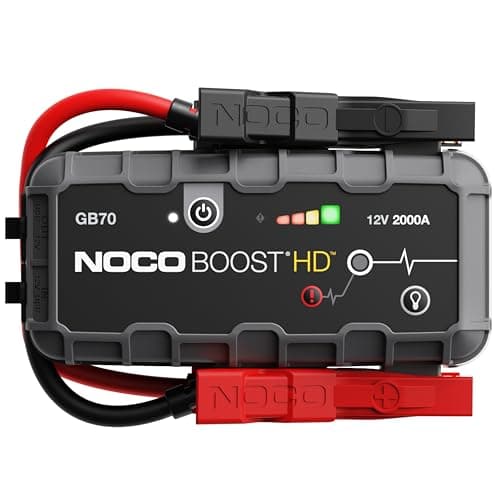 NOCO Boost HD GB70 Best for a big V8 or a loaded truck | Diesel pickups and big V8s | 2,000 A, 8.0 L gas and 6.0 L diesel, 12 V accessory output | $194.99View on Amazon #ad Affiliate link · Price as of October 16, 2026 |
| 3 | 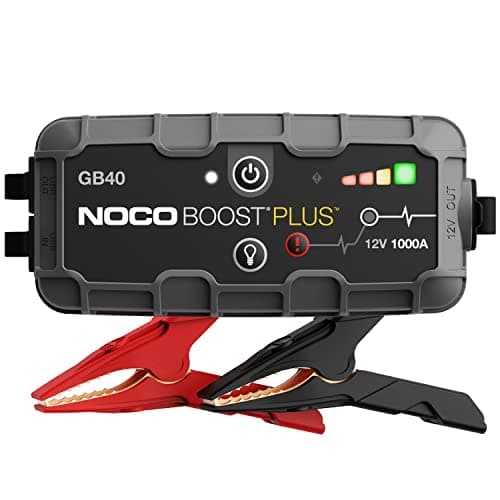 NOCO Boost Plus GB40 Smallest pack that still clears a small V8 | Most cars and small SUVs | 1,000 A, 6.0 L gas rating, no margin to spare | $99.95View on Amazon #ad Affiliate link · Price as of October 16, 2026 |
| 4 | 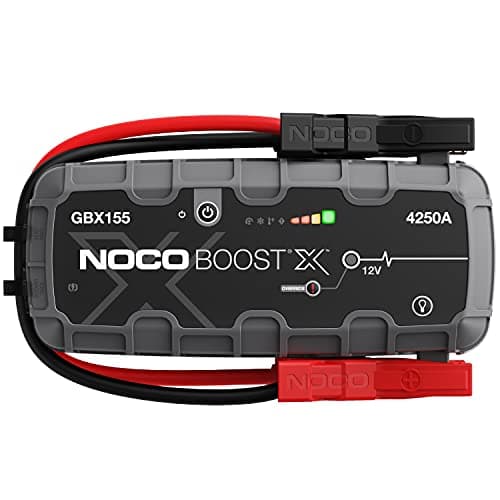 NOCO Boost X GBX155 Most reserve, and it charges a laptop | Doubling as a serious power bank | 4,250 A, 99 Wh, USB-C Power Delivery in and out | $369.95View on Amazon #ad Affiliate link · Price as of October 16, 2026 |
Nobody who makes a jump pack rates it for a number of cylinders. NOCO rates its packs in engine liters, with separate and deliberately lower figures for diesel, because what a starter motor actually asks of a pack is set by the displacement it has to turn over and the compression it has to turn it against. A 5.0-liter V8 and a 5.0-liter V10 ask almost the same thing. A 3.0-liter diesel four asks more than either.
So the honest way to shop for a V8 is to stop thinking about the badge and look up two numbers: the displacement of the engine you own, and the published gas rating of the pack you are considering. The table below does the second half for you.
NOCO's published ratings against real V8 displacements
| Pack | Peak amps | Gas rating | Diesel rating | Weight |
|---|---|---|---|---|
| NOCO GB40 | 1,000 A | Up to 6.0 L | Up to 3.0 L | 2.45 lb |
| NOCO GB50 | 1,500 A | Up to 7.0 L | Up to 4.5 L | 2.71 lb |
| NOCO GB70 | 2,000 A | Up to 8.0 L | Up to 6.0 L | 4.18 lb |
| NOCO GB150 | 3,000 A | Up to 9.0 L | Up to 7.0 L | 6.39 lb |
| NOCO GBX155 | 4,250 A | Up to 10 L | Up to 8.0 L | 5.82 lb |
Every figure here is NOCO's own published specification for that model — see the source list at the foot of the page. The reading we put on those figures against particular engines is ours, not NOCO's.
Line the common V8s up against that table and the picture is clear. A 4.6-liter, 5.0-liter or 5.3-liter V8 — the Mustang, the F-150 Coyote, half the GM truck fleet — sits inside the GB40's 6.0-liter rating on paper and comfortably inside the GB50's. A 5.7-liter HEMI or a 6.2-liter is inside the GB50 and well inside the GB70. A 6.6-liter or 7.3-liter big block needs the GB70 at least. A V8 diesel of any size is GB70 territory and arguably GB150 territory, because the diesel column is the one that bites.
Why we do not recommend the cheapest pack that clears the number
A manufacturer's rating is a ceiling measured under conditions that favor the pack: a healthy starter, clean terminals, a pack at full charge, a reasonable ambient temperature. The morning you actually need it will have none of those things in your favor. The battery will be flat, which means the pack is doing all the work rather than topping up a battery that still has something left; it may be below freezing, which costs a lithium cell real output; and the pack will not have been charged since spring.
That is why the sizing rule we use across the site is to buy one rung above the engine you own, and it is why the GB50 rather than the GB40 is the V8 answer even though the GB40's 6.0-liter figure technically covers a 5.3. What size jump starter do I need sets the rule out in full, and peak amps vs cranking amps explains why the headline amp figure on the box is the least useful number on it.
The weight argument, which is the one that decides ownership
The GB50 is 2.71 lb. The GB70 is 4.18 lb. On paper that is nothing; in practice it is the difference between a pack that lives under the rear seat of your truck permanently and a pack that lives on the garage shelf because it is a nuisance to carry. A pack on the garage shelf has started exactly zero engines on the side of a road.
This is the one place where the travel question and the V8 question meet. If the pack is going to ride in the vehicle year-round, the lighter unit that still clears your engine is the better buy. If it is going to live in a garage and come out for a project car, buy the bigger one — you are not carrying it anywhere. The best portable jump starters is the general-purpose version of this argument.
Three V8 cases that change the answer
- A diesel V8. Compression ignition holds peak current draw for longer, which is why NOCO's diesel ratings sit well below its gas ratings on the same hardware. A 6.7-liter diesel is a GB70 minimum and a GB150 if the truck lives outside. Jump starters for diesel trucks covers it properly.
- A V8 that lives outside in winter. Cold reduces the pack's usable output at the same moment it raises what the engine needs, so the margin you built in at purchase is the margin that gets eaten. Jump starters for cold weather has the detail, and buying up a rung is the right response.
- A V8 with accessories hung off it. Winches, light bars, inverters and aftermarket audio all raise the odds you will be jumping the vehicle rather than waiting for the alternator to catch up. If that describes your truck, the honest fix is a charger at home as well as a pack in the trunk — see the best car battery chargers.
When the GBX155 makes sense, and when it is just heavy
The GBX155 carries 99 watt-hours and 4,250 peak amps, which is more pack than any passenger V8 needs for the starting job alone. What you are really buying at that size is reserve and USB-C Power Delivery in both directions, which turns it into a power bank that happens to start engines. For someone who camps, tows or works out of the vehicle, that is a genuine second use. For someone who wants insurance in a sedan's trunk, it is 5.82 lb of overkill.
Note the 99 watt-hour figure specifically: it sits just under the 100 watt-hour airline carry-on threshold, which is not a coincidence. If you fly with tools, flying with a jump starter covers the rules that actually apply, and jump starter mAh vs watt-hours explains why the watt-hour figure is the one worth reading.
How to make the pack work on a V8 when it matters
The four things that decide whether it starts
Charge it on a schedule
Lithium packs self-discharge slowly and heat speeds it up. Every three months and after every use. How to charge a jump starter covers the specifics.
Get a real connection on the posts
A big engine means a big current, and a big current through a corroded or partly seated clamp turns into heat instead of cranking. Clean the posts, seat the clamps hard.
Give it a minute before you crank
Leaving the pack connected for a minute lets it put some charge into the battery, so the two work together rather than the pack working alone. How to use a jump starter has the full sequence.
Crank in short bursts, not long ones
Three to five seconds, then wait. Long cranks heat the starter and drain the pack, and on a big engine both of those matter more.
The picks in full
1. Best overall for a V8
NOCO Boost Plus GB50
NOCO · Best for v6 and small v8 gas engines
The middle rung: 1,500 peak amps and 35 watt-hours for a quarter-pound more than the GB40, which is the cheapest headroom in the range.
Published specifications
What works
- A full liter more gas headroom than the GB40 for 0.26 lb more weight
- 35 Wh still clears the 100 Wh carry-on limit with room to spare
- Doubles the flashlight output over the GB40 at 200 lumens
What does not
- Overlaps awkwardly with the GBX45, which is lighter and charges over USB-C
- Still short of the 6.0 L diesel rating a modern diesel pickup wants
Skip it if
Skip it if convenience matters more than amps — the GBX45 is lighter and takes USB-C Power Delivery, and the GB50's edge is raw current.
#ad Affiliate link · Price as of October 16, 2026
Raw specifications: NOCO’s own page for the NOCO Boost Plus GB50.
2. Best for a big V8 or a loaded truck
NOCO Boost HD GB70
NOCO · Best for diesel pickups and big v8s
The one to buy if you drive a diesel: 2,000 peak amps, a 6.0-liter diesel rating and 56 watt-hours, which is the smallest pack with real margin on a cold diesel.
Published specifications
What works
- The 6.0 L diesel rating covers the common 3.0 L and 6.7 L light-truck diesels with margin
- 56 Wh is still comfortably under the 100 Wh carry-on threshold, so it flies as hand luggage
- 12 V 15 A accessory output, and a 400-lumen light that is genuinely usable roadside
- 12 V / 3 A fast charge brings it back in about three hours
What does not
- 4.18 lb — noticeably heavier than the compact packs, and it wants a dedicated spot
- Overkill for a commuter four-cylinder; you are paying for headroom you will not use
Skip it if
Not the one to buy if you only ever start a four-cylinder commuter. Buy diesel headroom when you have a diesel.
#ad Affiliate link · Price as of October 16, 2026
Raw specifications: NOCO’s own page for the NOCO Boost HD GB70.
3. Smallest pack that still clears a small V8
NOCO Boost Plus GB40
NOCO · Best for most cars and small suvs
The default answer for a four- or six-cylinder car: 1,000 peak amps, 24 watt-hours, and light enough that it actually stays in the trunk.
Published specifications
What works
- 24 Wh sits far under the 100 Wh carry-on threshold, so flying with it needs no airline approval
- 2.45 lb and pocketable — the size that decides whether a tool is still in the trunk six months later
- IP65 enclosure, so a wet shoulder in the rain is not a problem
- Reverse-polarity protection means a backwards clamp does not spark
What does not
- 1,000 peak amps runs out of headroom above a 6.0 L gas engine
- The 3.0 L diesel ceiling rules out most modern diesel pickups
- 24 Wh is a small reserve — it is a jump starter, not a power bank substitute
Skip it if
Not the one to buy if you drive a diesel pickup or a big V8. You would be at the edge of its rating on a cold morning, which is exactly when you want margin.
#ad Affiliate link · Price as of October 16, 2026
Raw specifications: NOCO’s own page for the NOCO Boost Plus GB40.
4. Most reserve, and it charges a laptop
NOCO Boost X GBX155
NOCO · Best for doubling as a serious power bank
99 watt-hours with USB-C Power Delivery in and out — the largest pack in the range that still clears the 100 Wh carry-on limit, and the one that genuinely works as a power bank.
Published specifications
What works
- 99 Wh is deliberately just under the 100 Wh airline threshold — the most capacity you can carry on without asking anyone
- USB-C Power Delivery at up to 20 V / 3 A charges laptops, not just phones
- 4,250 peak amps with an 8.0 L diesel rating covers almost any light vehicle
- 500-lumen light, which is a genuinely usable work light
What does not
- 5.82 lb — heavier than most people expect from something sold partly as a power bank
- Priced as a premium jump starter, so it is an expensive way to buy 99 Wh of USB power alone
- A dedicated power bank of the same capacity is smaller, lighter and cheaper
Skip it if
Skip it if you mainly want to charge devices. A purpose-built power bank does that better for less, and this pack's premium is in the cranking hardware you would not be using.
#ad Affiliate link · Price as of October 16, 2026
Raw specifications: NOCO’s own page for the NOCO Boost X GBX155.
Key takeaways
- Packs are rated in engine liters, not cylinders — look up your displacement, not your badge.
- The GB50's 7.0-liter gas rating covers every V8 in a passenger vehicle or half-ton truck.
- A rating is a ceiling measured under favorable conditions; buy one rung above your engine.
- Diesel ratings run well below gas ratings on the same pack, so a diesel V8 is a GB70 job.
- Weight decides whether the pack rides in the vehicle, and a pack in the garage starts nothing.
- The GBX155 is bought for reserve and USB-C, not because a V8 needs 4,250 amps.
How we sourced this
Every figure on this page came from one of the following. Where a manufacturer or regulator does not publish a number, we say so rather than estimate it.
Common questions
- How many amps do I need to jump start a V8?
- Read the pack's engine-liter rating rather than its amp figure. NOCO rates the 1,500-amp GB50 for gas engines up to 7.0 liters, which covers every V8 fitted to a car, SUV or half-ton pickup. The 1,000-amp GB40 is rated to 6.0 liters and will start a small V8, but with no margin for cold or a deeply flat battery.
- Will a 1,000 amp jump starter start a V8?
- Usually, if the V8 is 6.0 liters or smaller and the conditions are reasonable — that is the limit of NOCO's published gas rating for the 1,000-amp GB40. We still recommend a rung up, because the rating is measured under favorable conditions and a roadside failure is not one.
- Is a V8 diesel different from a V8 gas engine for jump starting?
- Yes, substantially. Diesels draw peak current for longer because compression ignition asks more of the starter, and manufacturers publish lower diesel ratings to match. NOCO rates the GB70 at 8.0 liters gas but 6.0 liters diesel on the same hardware.
- Does a bigger jump starter damage a small engine?
- No. The engine's starter draws the current it needs; the pack's peak rating is a ceiling, not a dose. Buying a larger pack than your engine requires costs you money and weight, not reliability.
More in Jump Starters
A jump pack is the one trunk tool that turns a tow truck into a five-minute inconvenience. This is how to size one, and which ones are worth the space.
Read next
Guide
What Size Do I Need?
The sizing table by engine displacement and fuel type, using ratings manufacturers publish and warrant rather than peak-amp marketing.
Guide
Peak vs Cranking Amps
Peak amps is momentary and loosely defined; cranking amps is sustained. Why manufacturers publish engine ratings instead, and what to compare.
Best for SUVs & Trucks
For SUVs & Trucks
For gas V6 and V8 SUVs and pickups: the packs that clear a 5.3 L or 6.2 L engine with margin, without buying diesel-grade weight.
Best for a Ram 1500
Best for a Ram 1500
Matched to the Ram 1500's engine lineup using NOCO's published liter ratings, with the cable-length and under-hood access problems a half-ton actually has.
Found something out of date, or a figure you can source better than we did? Tell us — corrections get read first. Our methodology explains how picks are made, and contact is one click away.