Jump Starters
How to use a jump starter
Eight steps, in order, including the two that people skip and then wonder why the engine did not catch.
Disclosure: we earn a commission if you buy through the Amazon links on this page, at no extra cost to you. Commission never decides a verdict or a ranking position — read our editorial policy and affiliate disclosure.
How we assessed these: procedures here follow the general sequence manufacturers publish for lithium jump packs. Always follow your own pack's and vehicle's manuals where they differ — designated jump points vary by vehicle.
Short answer
Park safely and turn everything off. Connect red to the positive terminal, black to the negative terminal or a designated engine ground. Switch the pack on, wait for the ready indicator, then crank for no more than three to five seconds. Disconnect black first, and drive for at least 20 minutes.
Modern lithium packs are genuinely hard to use wrongly — reverse-polarity protection means they refuse to deliver current rather than sparking. The steps below still matter, because the failures that remain are procedural rather than electrical.
The sequence
Get somewhere safe first
If you are on a roadway, get the vehicle as far onto the shoulder as possible, hazards on, and put out a warning triangle well back from the car. Being hit is a far greater risk than anything electrical.
Turn everything off
Ignition off, headlights, climate control, radio and phone chargers off. Every accessory left on is current the pack is supplying instead of the starter.
Find the correct connection points
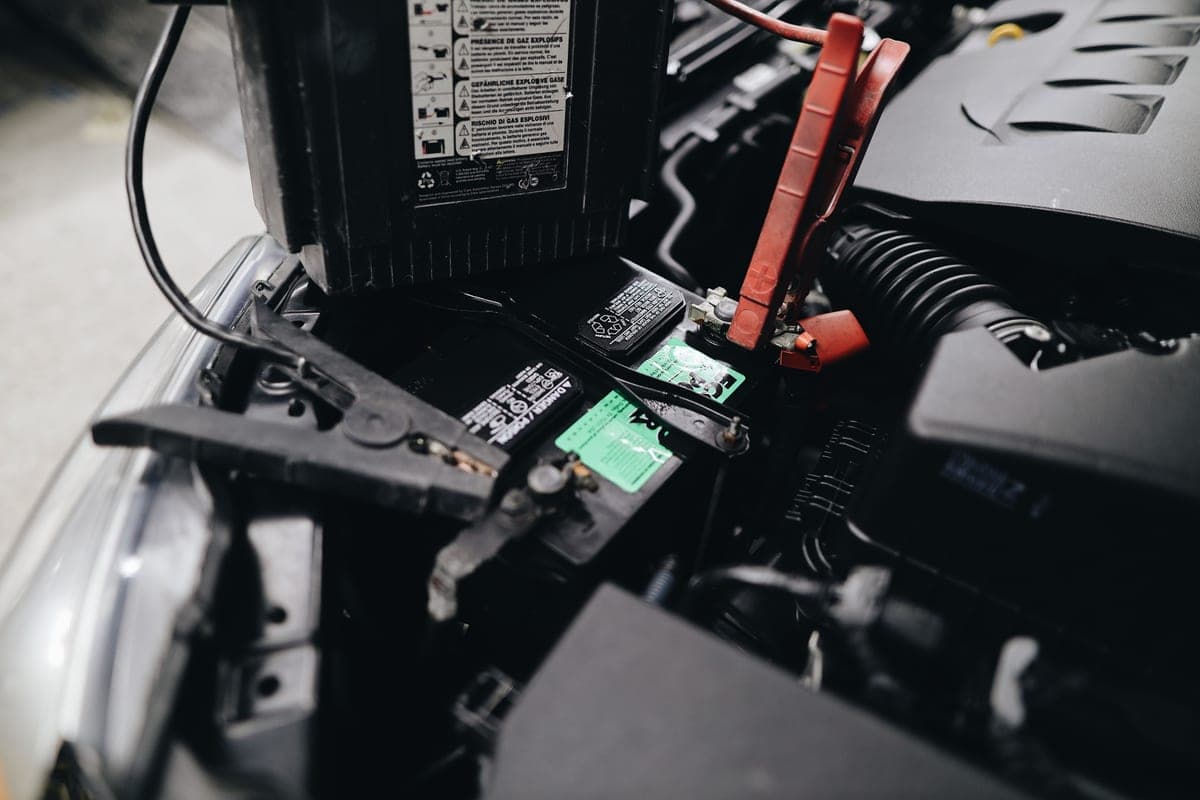
Many vehicles have designated jump-start terminals rather than exposed battery posts, especially trucks and cars with the battery in the trunk or under a seat. Check the owner's manual. Connecting to the wrong point is the most common cause of a jump that does nothing.
Connect red to positive
Clamp the red lead firmly to the positive terminal or designated positive point. Wiggle it — a clamp resting on corrosion rather than biting into metal will not pass hundreds of amps.
Connect black to negative
Clamp the black lead to the negative terminal, or to the unpainted engine ground point your vehicle's manual specifies. Follow your pack's instructions here; some manufacturers specify the battery's negative post and some specify a chassis ground.
Switch the pack on and wait for ready
Turn the pack on and wait for its ready indicator. If it shows a fault or a reverse-polarity warning instead, stop and re-check the clamps — do not force it. If it shows nothing at all, the pack may be too discharged to engage.
Crank for three to five seconds, no longer
Turn the key or press start and hold for a maximum of three to five seconds. If the engine does not catch, stop, wait 30 seconds and try again. Continuous cranking drains the pack and overheats the starter motor.
Disconnect black first, then red
Once the engine is running, switch the pack off, remove the black clamp first, then the red. Removing the ground first means a dropped positive clamp cannot short to the body. Then drive for at least 20 minutes so the alternator puts something back.
If the first attempt does nothing
- Nothing at all — no click, no crank. Check the clamps are biting clean metal, not a corroded terminal or a painted surface. Corrosion is a surprisingly effective insulator at these currents.
- A single click, no crank. The starter solenoid is engaging but the motor is not turning. That can be a poor connection, an underrated pack, or a failing starter.
- Slow, laboured cranking. The pack is delivering but not enough. Either it is undersized for your engine — check the sizing table — or it is not fully charged itself.
- Pack shows a fault. Re-seat the clamps and confirm polarity. If it persists, your battery may be below the pack's detection threshold; most packs have a manual override for that case.
Diesel: one extra step
On a diesel, wait for the glow-plug or grid-heater cycle to complete before cranking — the dashboard light will go out. Cranking through pre-heat draws the pack down while the engine is at its least willing to start, and it is the most common reason a correctly sized pack appears to fail on a diesel.
Afterwards
Two things. Recharge the pack as soon as you get home; a discharged pack is no use to the next problem. Work out why the battery was flat. If you cannot point to a cause — lights left on, a door ajar overnight — the battery or the charging system is failing, and the fix is a charger and a voltage check, not a bigger pack.
1. Easiest pack to get right
NOCO Boost Plus GB40
NOCO · Best for most cars and small suvs
The default answer for a four- or six-cylinder car: 1,000 peak amps, 24 watt-hours, and light enough that it actually stays in the trunk.
Published specifications
What works
- 24 Wh sits far under the 100 Wh carry-on threshold, so flying with it needs no airline approval
- 2.45 lb and pocketable — the size that decides whether a tool is still in the trunk six months later
- IP65 enclosure, so a wet shoulder in the rain is not a problem
- Reverse-polarity protection means a backwards clamp does not spark
What does not
- 1,000 peak amps runs out of headroom above a 6.0 L gas engine
- The 3.0 L diesel ceiling rules out most modern diesel pickups
- 24 Wh is a small reserve — it is a jump starter, not a power bank substitute
Skip it if
Not the one to buy if you drive a diesel pickup or a big V8. You would be at the edge of its rating on a cold morning, which is exactly when you want margin.
#ad Affiliate link · We show no price here; Amazon shows the current one
Raw specifications: NOCO’s own page for the NOCO Boost Plus GB40.
2. Best if the battery is hard to reach
NOCO Boost HD GB70
NOCO · Best for diesel pickups and big v8s
The one to buy if you drive a diesel: 2,000 peak amps, a 6.0-liter diesel rating and 56 watt-hours, which is the smallest pack with real margin on a cold diesel.
Published specifications
What works
- The 6.0 L diesel rating covers the common 3.0 L and 6.7 L light-truck diesels with margin
- 56 Wh is still comfortably under the 100 Wh carry-on threshold, so it flies as hand luggage
- 12 V 15 A accessory output, and a 400-lumen light that is genuinely usable roadside
- 12 V / 3 A fast charge brings it back in about three hours
What does not
- 4.18 lb — noticeably heavier than the compact packs, and it wants a dedicated spot
- Overkill for a commuter four-cylinder; you are paying for headroom you will not use
Skip it if
Not the one to buy if you only ever start a four-cylinder commuter. Buy diesel headroom when you have a diesel.
#ad Affiliate link · We show no price here; Amazon shows the current one
Raw specifications: NOCO’s own page for the NOCO Boost HD GB70.
Key takeaways
- Get safe and visible before you touch anything electrical.
- Check the manual for designated jump points — many vehicles have them.
- Crank three to five seconds maximum, then pause 30 seconds.
- Disconnect the black clamp first so a dropped red clamp cannot short.
- Stop after about three attempts; more cranking damages the starter.
How we sourced this
Every figure on this page came from one of the following. Where a manufacturer or regulator does not publish a number, we say so rather than estimate it.
Common questions
- Which clamp do I connect first on a jump starter?
- Red to positive first, then black to the negative terminal or the engine ground point your vehicle specifies. On disconnection, reverse it: black off first, then red, so that a dropped positive clamp cannot short against the body.
- How long should I crank with a jump starter?
- Three to five seconds per attempt, then pause for about 30 seconds. Continuous cranking drains the pack quickly and can overheat the starter motor. If the engine has not started after roughly three attempts, stop and look for a different fault.
- Do I need to leave the car running after a jump start?
- Drive it for at least 20 minutes so the alternator can replace some of what the start consumed. Idling in the driveway charges much more slowly than driving. If the battery is flat again the next morning, the battery or charging system is the problem.
- Can I use a jump starter in the rain?
- Packs with an IP65 rating, which is common, are built to tolerate rain — though the rating may depend on port covers being closed. The larger concern is your own safety on a wet roadside: visibility matters more than the electrical question.
More in Jump Starters
A jump pack is the one trunk tool that turns a tow truck into a five-minute inconvenience. This is how to size one, and which ones are worth the space.
Read next

Guide
Jump Starter Safety
The risks that remain with a protected lithium pack: clamp shorts, damaged cells, frozen batteries, hydrogen, and the traffic behind you.
Guide
Will It Start a Dead Battery?
The difference between a discharged battery and a failed one, what a pack can and cannot do about each, and how to tell which you have.
Troubleshooting
Jump Starter Not Working
A symptom-by-symptom walk through the common failures, and how to tell a dead pack from a pack that is refusing to engage on purpose.
Head to head
Jump Starter vs Cables
The honest comparison: where cables still make sense, why a pack is safer, and why most drivers should carry both.
Found something out of date, or a figure you can source better than we did? Tell us — corrections get read first. Our methodology explains how picks are made, and contact is one click away.