Tire Inflators
The best tire pressure gauges under $25
A gauge is the referee for every other number on this site, and the good news is that the referee is cheap. Under $25 buys an ANSI-calibrated instrument.
Disclosure: we earn a commission if you buy through the Amazon links on this page, at no extra cost to you. Commission never decides a verdict or a ranking position — read our editorial policy and affiliate disclosure.
How we assessed these: picks are selected from manufacturers' published specifications, current retailer listings and the live price layer — not from hands-on testing of every unit. The bracket in the title describes the market tier; the live figure in each buy button, stamped with the date it was read, is the only price we stand behind.
Short answer
Buy the JACO ElitePro 100 PSI dial gauge: JACO publishes an ANSI B40.1 calibration and a plus or minus 1.5 percent accuracy claim, it has a 10-inch hose so the chuck seats square on the valve, it has a bleed button, and it needs no batteries. If your valves are hard to reach straight on, the ACCU-GAGE right-angle gauge is the one that physically fits, with an ANSI B40.1 Grade B tolerance and a bronze Bourdon movement. The budget pick is the Milton S-920 pencil gauge — nickel-plated brass, 10 to 70 PSI in 2-pound steps, a tread depth gauge on the same tool, and no published accuracy standard at all, which is the honest reason it is the backup rather than the gauge you set pressures with.
Quick picks
Tap any row to jump to the full write-up. Scoring criteria are published in full on our methodology page.
| # | Product | Best for | Our read | Price |
|---|---|---|---|---|
| 1 | 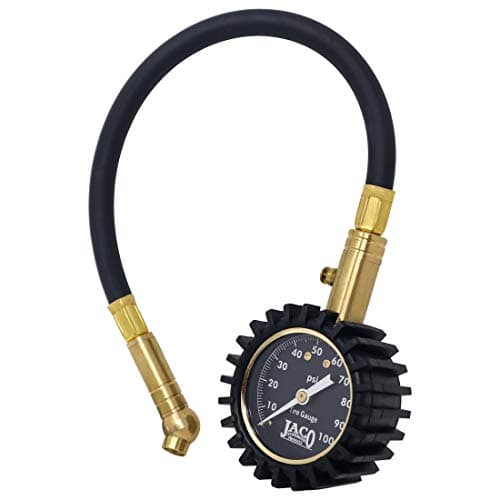 JACO ElitePro Tire Pressure Gauge 100 PSI Best overall | The gauge most drivers should own | ANSI B40.1, plus or minus 1.5 percent, hose and bleed valve | $22.90View on Amazon #ad Affiliate link · Price as of November 10, 2026 |
| 2 | 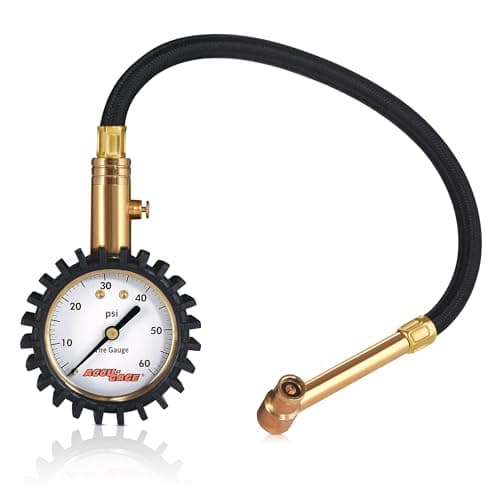 ACCU-GAGE by Milton Dial Gauge, Right-Angle Chuck, 60 PSI Best for awkward valves | Valves you cannot reach straight on | ANSI B40.1 Grade B on a braided hose, right-angle chuck | $22.89View on Amazon #ad Affiliate link · Price as of November 10, 2026 |
| 3 | 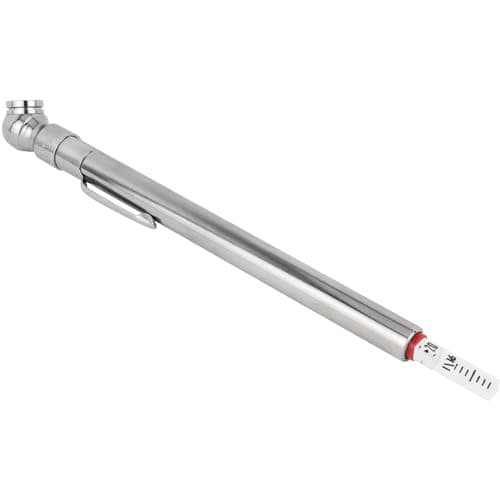 Milton S-920 Pencil Tire Gauge Budget pick | The gauge that is always in the car | 10 to 70 PSI pencil gauge, 2 lb steps, no published standard | $12.90View on Amazon #ad Affiliate link · Price as of November 10, 2026 |
NHTSA's position on tire pressure is not subtle: it affects handling, braking, tread life and fuel economy, and a tire can be meaningfully underinflated without looking flat. Everything downstream of that — the pressure you choose, the inflator you use, the reading you trust at a rest stop — depends on one instrument being honest, and under $25 buys one.
What it does not buy is a wide-range digital gauge with a 0.1 PSI display, which sits just above this bracket. For a car running 32 to 36 PSI, that is not the compromise it sounds like: a narrow-range analog dial calibrated to a published standard out-reads a wide-range digital gauge at the bottom of its scale. Best tire pressure gauges is the full roundup including the digital option.
What a published standard actually means
ANSI B40.1 is the American standard for mechanical pressure gauges, and it does not grade a gauge with a single number. It divides the scale into thirds and allows a different tolerance in each: tighter through the middle third, looser at both ends. That is why the range matters so much — a 60 PSI gauge puts a car's 35 PSI tires in the tightest part of its scale, while a 150 PSI gauge puts them near the bottom.
It also means "highly accurate" on a listing, with no standard named, is a sentence rather than a specification. Two of the three gauges here name a standard. The third does not, and we say so in its row instead of implying otherwise. Tire inflator accuracy covers why a good gauge and a good inflator can legitimately disagree.
| Gauge | Range | Published accuracy | Standard | Hose and chuck | Batteries |
|---|---|---|---|---|---|
| Milton S-920 pencil gauge | 10 to 70 PSI | Not published | Not published | Single-head chuck, no hose | None |
| ACCU-GAGE right-angle 60 PSI | 0 to 60 PSI | Grade B tolerance across the scale | ANSI B40.1 Grade B | 11 in braided hose, right-angle chuck | None |
| JACO ElitePro 100 PSI | 5 to 100 PSI | Plus or minus 1.5 percent | ANSI B40.1 | 10 in hose, 360-degree swivel chuck | None |
Figures are each maker's own published specifications, linked in Sources. Milton does not publish an accuracy figure or a standard for the S-920, so those cells say so rather than carrying our guess.
The hose is the feature nobody shops for
The single biggest source of a bad reading is not the mechanism — it is the chuck not seating square on the valve. A rigid gauge pressed against a valve at an angle leaks while you read it, and the number is low by an amount nobody can estimate.
A flexible hose fixes that completely, which is why both of the hose-equipped gauges here are ranked above the pencil gauge. The bleed valve is the second quiet upgrade: it turns correcting an overfill into a two-second button press rather than a trip back to the pump.
Why own a pencil gauge at all
Because it is always there. The Milton costs so little that there is no reason for a second car, a motorcycle or a glovebox to be without one, it has a tread depth gauge and a deflator pin on the same tool, and it will still work in twenty years because there is nothing in it to fail.
It is a backup, not a reference. Two-pound increments and no published standard mean it will tell you that a tire is low — which is the most important thing a gauge ever does — without being the instrument you use to set a pressure precisely. How often should you check tire pressure is the habit that makes owning either worth anything.
The picks
1. Best overall
JACO ElitePro Tire Pressure Gauge 100 PSI
JACO · Best for the gauge most drivers should own
An analog dial calibrated to ANSI B40.1 with a plus or minus 1.5 percent accuracy claim, a flexible hose so the chuck seats square on the valve, and a bleed button for letting pressure back out.
Published specifications
- Pressure range
- 5 to 100 PSI source
- Stated accuracy
- Plus or minus 1.5 percent source
- Calibration standard
- ANSI B40.1 source
- Dial
- 2 in, glow-in-the-dark face source
- Hose
- 10 in rubberized air hose source
- Chuck
- 360-degree swivel source
- Bleed valve
- Built in source
- Body
- Solid brass with rubberized shock guard source
- Batteries
- None required source
- Warranty
- Lifetime source
What works
- The hose is the feature that matters most - it lets the chuck sit square on the valve instead of being levered sideways, which is where most bad readings come from
- The needle holds the reading after you pull the chuck away, so you read it in the light instead of crouched at the wheel
- The bleed button means over-inflating is a two-second fix rather than a reason to go back to the pump
- No battery to be dead when you need it, and a lifetime warranty behind the calibration claim
What does not
- 100 PSI across a 2-inch dial means fine increments are tight to read - a 60 PSI gauge resolves passenger-car pressures better
- Analog gauges drift if you drop them, and nothing on the gauge tells you when that has happened
- Bulkier than a pencil gauge, so it lives in the door pocket or trunk rather than a jacket
Skip it if
Not the one if you want a number to one decimal place or you set pressures on an RV or a light truck above 100 PSI. A digital gauge with a wider scale is the right tool there.
#ad Affiliate link · Price as of November 10, 2026
Raw specifications: JACO’s own page for the JACO ElitePro Tire Pressure Gauge 100 PSI.
2. Best for awkward valves
ACCU-GAGE by Milton Dial Gauge, Right-Angle Chuck, 60 PSI
Milton · Best for valves you cannot reach straight on
A brass dial gauge built around a bronze Bourdon tube, certified to ANSI B40.1 Grade B, on a braided hose with a right-angle chuck that gets onto the awkward valve a straight gauge fights.
Published specifications
- Pressure range
- 0 to 60 PSI source
- Accuracy standard
- ANSI B40.1 Grade B source
- Movement
- Bronze Bourdon tube, unaffected by temperature, humidity or altitude source
- Hose
- 11 in braided hose source
- Chuck
- Right-angle air chuck source
- Bleed valve
- Push-button bleeder source
- Body
- Brass, with protective rubber guard source
- Batteries
- None required source
- Stated use
- Motorcycle, car and truck tires source
What works
- A right-angle chuck is the honest answer to a motorcycle wheel or a valve shrouded by a brake rotor - it seats where a straight chuck cannot
- Milton publishes the accuracy standard rather than a marketing percentage, and a Bourdon-tube movement does not care how cold the garage is
- 0 to 60 PSI puts every passenger-car pressure in the middle of the scale, which is where any dial gauge is most accurate
- Brass body, rubber guard, no batteries - the kind of tool that is still right in ten years
What does not
- ANSI B40.1 Grade B allows plus or minus 2 percent through the middle of the scale and 3 percent at the ends, so this is a reliable gauge, not a laboratory one
- 60 PSI is not enough for most travel trailers or light-truck load pressures
- The right-angle chuck is slightly slower on an ordinary, easy-to-reach valve than a straight one
Skip it if
Skip it if everything you own takes a straight chuck and runs above 60 PSI. The right-angle head is a solution to a specific problem, and you pay for it in reach on an open valve.
#ad Affiliate link · Price as of November 10, 2026
Raw specifications: Milton’s own page for the ACCU-GAGE by Milton Dial Gauge, Right-Angle Chuck, 60 PSI.
3. Budget pick
Milton S-920 Pencil Tire Gauge
Milton · Best for the gauge that is always in the car
A nickel-plated brass pencil gauge reading 10 to 70 PSI in 2-pound steps, with a tread depth gauge and a deflator pin at the other end and a pocket clip so it never gets lost in the trunk.
Published specifications
- Pressure range
- 10 to 70 PSI / 60 to 500 kPa source
- Increments
- 2 lb source
- Body
- Nickel-plated brass tubing, corrosion resistant source
- Chuck
- Single-head air chuck source
- Also on the tool
- Tread depth gauge and built-in deflator pin source
- Indicator
- Nylon indicator bar source
- Carry
- Built-in pocket clip source
- Batteries
- None required source
What works
- Costs less than a tank of gas and fits in a door pocket, which is why it is the gauge that actually gets used
- The tread depth gauge on the same tool turns a pressure check into a tire check
- Nothing on it can go flat, run out of charge or lose calibration in a hot trunk the way electronics can
- Milton publishes the range and the increment, so you know exactly what you are reading
What does not
- 2-pound increments are the resolution - you cannot read 34 PSI on this gauge, only 34-ish
- No bleed valve, so letting air out means pressing the chuck sideways and guessing
- A pencil gauge has to be held dead square on the valve or it reads low, and it is the easiest gauge in the world to hold crooked
- No hold function - take it off the valve and the bar stays put, but a knock resets it
Skip it if
Not the gauge to set pressures with if you care about a specific number. It is the one that lives in the car and tells you a tire has lost 6 pounds, which is the job that actually matters.
#ad Affiliate link · Price as of November 10, 2026
Raw specifications: Milton’s own page for the Milton S-920 Pencil Tire Gauge.
Key takeaways
- Under $25 buys a gauge with a published ANSI B40.1 calibration, which is more than most of this category offers.
- ANSI B40.1 grades by thirds of the scale, so buy the smallest range that covers your highest pressure.
- A hose matters more than the mechanism — a chuck seating square is where most bad readings are won or lost.
- A bleed valve turns an overfill into a button press.
- An accuracy claim with no standard named is marketing; one of the three gauges here publishes nothing, and we say so.
- A pencil gauge is the always-present backup, not the gauge you set pressures with.
How we sourced this
Every figure on this page came from one of the following. Where a manufacturer or regulator does not publish a number, we say so rather than estimate it.
- JACO ElitePro Tire Pressure Gauge 100 PSI — published specifications and ANSI B40.1 calibration
- JACO Superior Products — tire pressure gauge FAQs, including how ANSI B40.1 grades accuracy across the scale
- ACCU-GAGE by Milton dial tire pressure gauge, right-angle chuck, 0-60 PSI — published specifications
- Milton S-920 tire and tread pencil gauge — published range, increments and construction
- NHTSA TireWise — tire safety ratings and awareness
- NHTSA — Tire Safety: Everything Rides On It (PDF)
Common questions
- Are cheap tire pressure gauges accurate?
- Some are, and the way to tell is whether a published standard is named. Under $25 includes gauges calibrated to ANSI B40.1, which is a defined tolerance rather than a claim.
- Is a dial gauge or a pencil gauge better?
- A dial gauge with a hose, every time, for setting pressures: the hose seats the chuck square and the needle holds the reading. A pencil gauge is the cheap backup that lives permanently in the car.
- What range tire pressure gauge should I buy?
- The smallest that covers your highest pressure. ANSI B40.1 holds the middle third of the scale to a tighter tolerance, so a 60 PSI gauge reads a 35 PSI car tire better than a 150 PSI gauge does.
- Do I need a gauge if my inflator has one?
- It is worth owning one. An inflator's display reads pressure at the pump while air is moving; a standalone gauge reads static pressure at the valve. Inflate with the pump, verify with the gauge.
- Do tire pressure gauges need calibration?
- Mechanical gauges can drift, especially after being dropped, and nothing on the gauge will tell you. The cheap sanity check is owning two and comparing them occasionally.
More in Tire Inflators
The cheapest tool that prevents the second-most-common roadside stop. Here is which type fits your tires, and the two specs that actually matter.
Read next
Best tire pressure gauge
Best Tire Gauges
Chosen on the accuracy standard the maker publishes, a scale that puts your tires mid-dial, and a chuck that seats square on the valve — plus honest limits on every pick.
Guide
Gauge Accuracy
Why built-in gauges drift, how to check yours against a reference, and why we will not publish per-model deviation numbers we have not measured.
Guide
What PSI Should My Tires Be?
The single most common tire mistake, fixed in two minutes: placard versus sidewall, checking cold, and what cold weather does to the reading.
Guide
How Often to Check
Why monthly is the right interval, what cold weather does to the number, and why a TPMS light is not a substitute for a gauge.
Found something out of date, or a figure you can source better than we did? Tell us — corrections get read first. Our methodology explains how picks are made, and contact is one click away.