Tire Inflators
The best tire pressure gauges
An inflator's built-in display is a convenience. A gauge with a published accuracy standard is the thing that tells you whether the number you just set is true.
Disclosure: we earn a commission if you buy through the Amazon links on this page, at no extra cost to you. Commission never decides a verdict or a ranking position — read our editorial policy and affiliate disclosure.
How we assessed these: picks are selected from manufacturers' published specifications, stated accuracy standards and current retailer listings — not from hands-on calibration testing against a reference gauge. We publish no measured error figures, because we do not measure them.
Short answer
For most drivers, buy the JACO ElitePro 100 PSI dial gauge: it publishes an ANSI B40.1 calibration, it has a hose so the chuck seats square, and it needs no batteries. If you set pressures on a truck, trailer or RV, the ElitePro Digital reads to 200 PSI in 0.1 PSI steps. If your valves are hard to reach, the ACCU-GAGE right-angle gauge is the one that fits.
Quick picks
Tap any row to jump to the full write-up. Scoring criteria are published in full on our methodology page.
| # | Product | Best for | Our read | Price |
|---|---|---|---|---|
| 1 | 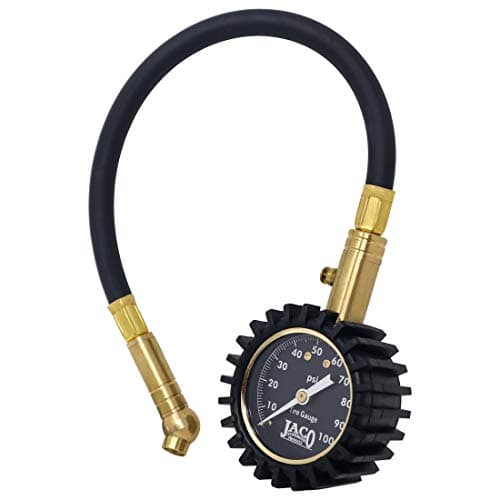 JACO ElitePro Tire Pressure Gauge 100 PSI Best overall | The gauge most drivers should own | ANSI B40.1 analog dial, hose and bleed valve, no batteries | $22.90View on Amazon #ad Affiliate link · Price as of November 10, 2026 |
| 2 | 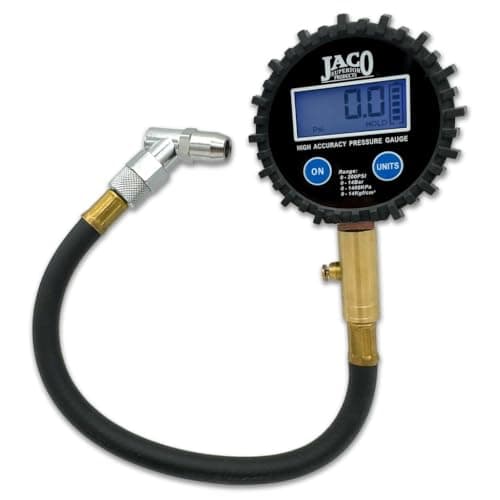 JACO ElitePro Digital Tire Pressure Gauge 200 PSI Best for trucks, trailers and RVs | Trucks, trailers and RVs that run real pressure | 5 to 200 PSI, 0.1 PSI steps, ASME Grade 2A, backlit | $29.90View on Amazon #ad Affiliate link · Price as of November 10, 2026 |
| 3 | 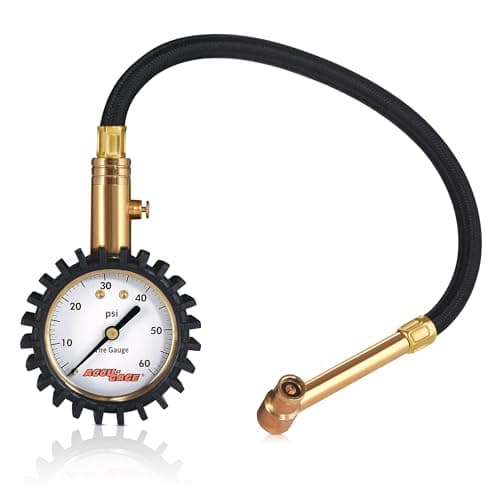 ACCU-GAGE by Milton Dial Gauge, Right-Angle Chuck, 60 PSI Best for awkward valves | Valves you cannot reach straight on | Right-angle chuck on a braided hose, brass, ANSI Grade B | $22.89View on Amazon #ad Affiliate link · Price as of November 10, 2026 |
| 4 | 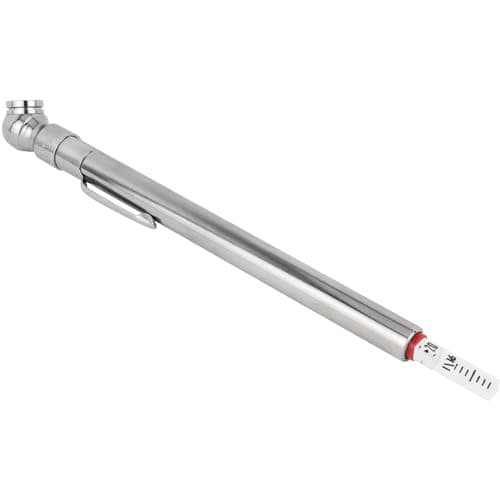 Milton S-920 Pencil Tire Gauge Best glovebox gauge | The gauge that is always in the car | 10 to 70 PSI pencil gauge with a tread depth gauge on it | $12.90View on Amazon #ad Affiliate link · Price as of November 10, 2026 |
A tire pressure gauge is the cheapest tool in the car that changes something measurable about how it drives. NHTSA's position is not subtle: pressure affects handling, braking, tread life and fuel economy, and a tire can be meaningfully underinflated without looking flat. Everything downstream of that — the pressure you choose, the inflator you use, the reading you trust at a rest stop — depends on one instrument being honest.
Which is why this page exists separately from our tire inflator picks. An inflator's built-in display is a convenience feature on a pump; a gauge is a measuring instrument with a published tolerance. They are not the same purchase, and the good news is that the gauge is the cheap half.
Why the gauge on the pump is not enough
Three different gauges are involved in a typical top-up, and only one of them is designed to be accurate. The gauge on the gas station air hose lives outdoors, gets dropped daily and is read while air is flowing. The gauge built into a portable inflator reads pressure at the pump, through a hose, usually while the motor is running. A standalone tire gauge reads static pressure at the valve with nothing moving.
That last condition is the whole point. Pressure measured while air is moving through a restriction is not the pressure in the tire, and a gauge that has been bounced around a forecourt for two years has no claim on a tolerance it once met. Tire inflator accuracy covers this in more detail, including why a good inflator and a good gauge can disagree by two or three pounds and both be working correctly.
The practical rule: inflate with whatever you have, then check with the gauge. The gauge is the referee.
The criteria we buy on
- A published accuracy standard, not a marketing percentage. ANSI B40.1 and ASME Grade 2A are defined specifications with a grade; "highly accurate" is a sentence a copywriter wrote.
- A scale that puts your tires in the middle of it. Every dial gauge is most accurate through the middle third of its range, so a 60 PSI gauge beats a 150 PSI gauge for a car on 35 PSI tires.
- A chuck that seats square on the valve. This is the single biggest source of bad readings, and a flexible hose solves it better than any amount of precision in the mechanism.
- A bleed valve, so correcting an overfill is a button press instead of a trip back to the pump.
- A hold function — a needle or display that keeps the reading after you pull the chuck off, because you cannot read a gauge and hold it on a valve at the same time.
- Construction that survives a trunk. Brass bodies and rubber guards exist because dropping an instrument is how it loses its calibration.
- No batteries, or batteries you can replace. A dead cell in an unused glovebox gauge is the most common way a gauge fails.
| Gauge | Range | Published accuracy | Standard | Readout | Batteries |
|---|---|---|---|---|---|
| JACO ElitePro 100 PSI | 5 to 100 PSI | Plus or minus 1.5 percent | ANSI B40.1 | 2 in glow dial, hold until reset | None |
| JACO ElitePro Digital 200 PSI | 5 to 200 PSI | Plus or minus 0.5 percent of full scale | ASME Grade 2A | 2.5 in backlit LCD, 0.1 PSI steps | 2 x AAA |
| ACCU-GAGE by Milton, right-angle, 60 PSI | 0 to 60 PSI | Grade B tolerance across the scale | ANSI B40.1 Grade B | Dial, needle holds until bled | None |
| Milton S-920 pencil gauge | 10 to 70 PSI | Not published | Not published | Sliding bar, 2 lb increments | None |
Figures are each maker's own published specifications, linked in Sources. Milton does not publish an accuracy figure or standard for the S-920, so that row says so rather than carrying our guess.
What "accurate" actually means on a tire gauge
Accuracy claims on gauges are where most buying advice goes soft, so here is the part worth understanding before you spend anything.
ANSI B40.1 is the American standard for mechanical pressure gauges, and it does not grade a gauge with one number. It divides the scale into thirds and allows a different tolerance in each: tighter through the middle third, looser at the two ends. JACO publishes the arithmetic for its own gauges — on a 0 to 60 PSI dial, Grade B works out to roughly 1.8 PSI of permitted error below 20 PSI, 1.2 PSI between 21 and 40, and 1.8 PSI again above 41. That is why the middle of the scale matters so much: it is literally the part of the dial the standard holds to a tighter tolerance.
Digital gauges usually quote a percentage of FULL SCALE instead, which behaves differently and catches people out. The JACO ElitePro Digital is rated plus or minus 0.5 percent of full scale on a 200 PSI instrument — that is about 1 PSI of permitted error, and it is 1 PSI whether you are reading 200 PSI or 32 PSI. At 32 PSI, a 1 PSI tolerance is about 3 percent, not 0.5 percent. The gauge is still excellent; the display's 0.1 PSI resolution is simply finer than its accuracy, which is true of nearly every digital gauge sold.
Analog, digital or pencil
Dial gauges
A dial gauge with a hose is the default right answer for a car owner. The mechanism is a Bourdon tube — a curved metal tube that straightens slightly under pressure — and Milton makes the useful point that a bronze Bourdon tube is unaffected by temperature, humidity or altitude. Nothing to charge, nothing to boot up, and the needle stays where it landed until you press the bleeder. The weakness is that it is a mechanical instrument: drop it hard and it can read wrong forever without telling you.
Digital gauges
Digital wins on two things that matter in real use: range and readability. A 200 PSI digital gauge covers passenger cars, trailer tires and light-truck load pressures with one tool, and a backlit screen is genuinely better at a dark rest stop than squinting at a needle. The trade is batteries, and an auto shut-off that will time out while you are still walking to the next wheel.
Pencil gauges
A pencil gauge is not a precision instrument and should not be bought as one. The Milton S-920 reads in 2-pound increments, has no bleed valve and has to be held dead square on the valve or it reads low. What it has instead is total reliability and a price that makes it reasonable to have one in every vehicle — and the tread depth gauge on the other end turns a pressure check into a tire check. Buy it as the backup that is always there, not as the gauge you set pressures with.
Match the scale to the tires you own
This is the decision most buyers get backwards, because a bigger number looks like more gauge. It is not. Pick the lowest full-scale range that comfortably covers the highest pressure you will ever set, and your readings land in the accurate part of the instrument.
| What you own | Typical set pressure | Range to buy |
|---|---|---|
| Car, crossover, most SUVs | Around 30 to 36 PSI | 60 PSI, or 100 PSI if one vehicle is higher |
| Half-ton pickup, loaded | Up to around 45 to 50 PSI | 60 to 100 PSI |
| Compact spare | Often around 60 PSI | 100 PSI |
| Travel trailer, utility trailer | 50 to 80 PSI | 100 to 200 PSI |
| Motorcycle | Around 30 to 40 PSI | 60 PSI with an angled chuck |
| Bicycle on Schrader valves | 40 to 80 PSI | 100 PSI, or a dedicated bike gauge for Presta |
Set pressures are the ranges these vehicle classes commonly use and are given to size the GAUGE, not to tell you your pressure. Your own figure is on the door jamb placard, never the tire sidewall.
That last point is worth repeating because it is the most common mistake in the whole subject: the number molded into the tire sidewall is a maximum, not a recommendation. The pressure you want is on the placard inside the driver's door. What PSI should my tires be covers where to find it and the handful of cases where a different number is correct — and the spare is almost always one of them, because a compact spare usually wants far more air than the tires it replaces.
How to get a true reading
Checking pressure properly
Check cold
Measure before driving, or after the car has sat for at least three hours. Driving heats the air and raises the reading, so a warm check reads high and you end up setting the tire low.
Seat the chuck square
Push the gauge straight onto the valve stem until the hiss stops. A chuck held at an angle leaks while it reads, which always reads low. This is what a flexible hose is for.
Read it off the valve
Pull the gauge away and read it in good light. A dial needle and a digital hold both keep the number; there is no reason to read it crouched in a wheel well.
Correct in one direction at a time
If it is low, add air and re-check. If it is high, use the bleed valve in short presses rather than trying to hit the number in one go.
Do the spare too
It is the only tire you will need when a tire has already failed, and it is the one nobody checks. Then put the valve caps back on.
Cold weather is the other half of this. Air pressure falls as temperature drops, which is why the warning light appears on the first cold morning of the year on tires nobody touched. Tire pressure in cold weather has the arithmetic, and how often you should check is the habit that makes owning a good gauge worth anything.
The picks
1. Best overall
JACO ElitePro Tire Pressure Gauge 100 PSI
JACO · Best for the gauge most drivers should own
An analog dial calibrated to ANSI B40.1 with a plus or minus 1.5 percent accuracy claim, a flexible hose so the chuck seats square on the valve, and a bleed button for letting pressure back out.
Published specifications
- Pressure range
- 5 to 100 PSI source
- Stated accuracy
- Plus or minus 1.5 percent source
- Calibration standard
- ANSI B40.1 source
- Dial
- 2 in, glow-in-the-dark face source
- Hose
- 10 in rubberized air hose source
- Chuck
- 360-degree swivel source
- Bleed valve
- Built in source
- Body
- Solid brass with rubberized shock guard source
- Batteries
- None required source
- Warranty
- Lifetime source
What works
- The hose is the feature that matters most - it lets the chuck sit square on the valve instead of being levered sideways, which is where most bad readings come from
- The needle holds the reading after you pull the chuck away, so you read it in the light instead of crouched at the wheel
- The bleed button means over-inflating is a two-second fix rather than a reason to go back to the pump
- No battery to be dead when you need it, and a lifetime warranty behind the calibration claim
What does not
- 100 PSI across a 2-inch dial means fine increments are tight to read - a 60 PSI gauge resolves passenger-car pressures better
- Analog gauges drift if you drop them, and nothing on the gauge tells you when that has happened
- Bulkier than a pencil gauge, so it lives in the door pocket or trunk rather than a jacket
Skip it if
Not the one if you want a number to one decimal place or you set pressures on an RV or a light truck above 100 PSI. A digital gauge with a wider scale is the right tool there.
#ad Affiliate link · Price as of November 10, 2026
Raw specifications: JACO’s own page for the JACO ElitePro Tire Pressure Gauge 100 PSI.
2. Best for trucks, trailers and RVs
JACO ElitePro Digital Tire Pressure Gauge 200 PSI
JACO · Best for trucks, trailers and rvs that run real pressure
A 5 to 200 PSI digital gauge JACO rates at plus or minus 0.5 percent of full scale to ASME Grade 2A, reading in 0.1 PSI steps on a backlit screen that holds the number after the chuck comes off.
Published specifications
- Pressure range
- 5 to 200 PSI source
- Stated accuracy
- Plus or minus 0.50 percent of full scale source
- Calibration standard
- ASME Grade 2A source
- Resolution
- 0.10 PSI increments source
- Display
- 2.5 in LCD with blue backlight source
- Hose
- 10 in rubberized air hose source
- Chuck
- 1/4 in NPT threaded, 360-degree swivel, angled chuck included source
- Bleed valve
- Built in source
- Batteries
- 2 x AAA, included, 120-second auto shut-off source
- Body
- Brass and steel with shock guard source
- Warranty
- Lifetime source
What works
- A 200 PSI top end covers trailer tires, light-truck loads and semi duals that a 60 PSI gauge cannot read at all
- 0.1 PSI resolution and a hold function remove the two guesses an analog dial still asks you to make
- The backlight is the difference between reading a gauge at a dark rest stop and holding a phone in your teeth
- A threaded chuck plus the angled adapter reaches inner duals and recessed valves on alloy wheels
What does not
- Plus or minus 0.5 percent of FULL scale is about 1 PSI at any reading, so at 32 PSI the real tolerance is nearer 3 percent - better than most analog gauges, but not the 0.1 PSI the display implies
- Two AAA cells are two more things to be dead in a cold trunk than an analog gauge has
- The auto shut-off is quick enough to be annoying if you are working slowly around four wheels
Skip it if
Overkill for one commuter car on 35 PSI tires. The analog dial gauge costs less, needs no batteries, and resolves that range perfectly well.
#ad Affiliate link · Price as of November 10, 2026
Raw specifications: JACO’s own page for the JACO ElitePro Digital Tire Pressure Gauge 200 PSI.
3. Best for awkward valves
ACCU-GAGE by Milton Dial Gauge, Right-Angle Chuck, 60 PSI
Milton · Best for valves you cannot reach straight on
A brass dial gauge built around a bronze Bourdon tube, certified to ANSI B40.1 Grade B, on a braided hose with a right-angle chuck that gets onto the awkward valve a straight gauge fights.
Published specifications
- Pressure range
- 0 to 60 PSI source
- Accuracy standard
- ANSI B40.1 Grade B source
- Movement
- Bronze Bourdon tube, unaffected by temperature, humidity or altitude source
- Hose
- 11 in braided hose source
- Chuck
- Right-angle air chuck source
- Bleed valve
- Push-button bleeder source
- Body
- Brass, with protective rubber guard source
- Batteries
- None required source
- Stated use
- Motorcycle, car and truck tires source
What works
- A right-angle chuck is the honest answer to a motorcycle wheel or a valve shrouded by a brake rotor - it seats where a straight chuck cannot
- Milton publishes the accuracy standard rather than a marketing percentage, and a Bourdon-tube movement does not care how cold the garage is
- 0 to 60 PSI puts every passenger-car pressure in the middle of the scale, which is where any dial gauge is most accurate
- Brass body, rubber guard, no batteries - the kind of tool that is still right in ten years
What does not
- ANSI B40.1 Grade B allows plus or minus 2 percent through the middle of the scale and 3 percent at the ends, so this is a reliable gauge, not a laboratory one
- 60 PSI is not enough for most travel trailers or light-truck load pressures
- The right-angle chuck is slightly slower on an ordinary, easy-to-reach valve than a straight one
Skip it if
Skip it if everything you own takes a straight chuck and runs above 60 PSI. The right-angle head is a solution to a specific problem, and you pay for it in reach on an open valve.
#ad Affiliate link · Price as of November 10, 2026
Raw specifications: Milton’s own page for the ACCU-GAGE by Milton Dial Gauge, Right-Angle Chuck, 60 PSI.
4. Best glovebox gauge
Milton S-920 Pencil Tire Gauge
Milton · Best for the gauge that is always in the car
A nickel-plated brass pencil gauge reading 10 to 70 PSI in 2-pound steps, with a tread depth gauge and a deflator pin at the other end and a pocket clip so it never gets lost in the trunk.
Published specifications
- Pressure range
- 10 to 70 PSI / 60 to 500 kPa source
- Increments
- 2 lb source
- Body
- Nickel-plated brass tubing, corrosion resistant source
- Chuck
- Single-head air chuck source
- Also on the tool
- Tread depth gauge and built-in deflator pin source
- Indicator
- Nylon indicator bar source
- Carry
- Built-in pocket clip source
- Batteries
- None required source
What works
- Costs less than a tank of gas and fits in a door pocket, which is why it is the gauge that actually gets used
- The tread depth gauge on the same tool turns a pressure check into a tire check
- Nothing on it can go flat, run out of charge or lose calibration in a hot trunk the way electronics can
- Milton publishes the range and the increment, so you know exactly what you are reading
What does not
- 2-pound increments are the resolution - you cannot read 34 PSI on this gauge, only 34-ish
- No bleed valve, so letting air out means pressing the chuck sideways and guessing
- A pencil gauge has to be held dead square on the valve or it reads low, and it is the easiest gauge in the world to hold crooked
- No hold function - take it off the valve and the bar stays put, but a knock resets it
Skip it if
Not the gauge to set pressures with if you care about a specific number. It is the one that lives in the car and tells you a tire has lost 6 pounds, which is the job that actually matters.
#ad Affiliate link · Price as of November 10, 2026
Raw specifications: Milton’s own page for the Milton S-920 Pencil Tire Gauge.
What we deliberately left out
There is a large category of cheap digital gauges that quote plus or minus 1 percent accuracy with no standard named at all. Some of them are probably fine. The problem is that the claim is unfalsifiable: without a grade, a scale and a tolerance distribution, "1 percent" is a number on a listing rather than a specification, and there is no way to tell the good ones from the bad ones before you own one. Every gauge above either names a published standard or — in the Milton's case — tells you plainly that it does not.
We also left out inflators with built-in gauges, not because they are bad but because they answer a different question. If you want one tool that pumps and reads, the best tire inflators with a gauge is that page — and a separate reference gauge still earns its keep next to one.
Key takeaways
- The gauge is the referee: inflate with whatever you have, then verify with an instrument that publishes a tolerance.
- ANSI B40.1 grades accuracy by thirds of the scale, so buy the smallest range that covers your highest pressure.
- A percentage of full scale on a digital gauge is a fixed error in PSI — about 1 PSI on a 200 PSI gauge, at any reading.
- Resolution is not accuracy; a 0.1 PSI display does not mean 0.1 PSI of truth.
- A hose and a square-seating chuck fix more bad readings than a finer mechanism does.
- Check cold, read off the valve, and do the spare — a compact spare usually needs far more pressure than the other four.
- A pencil gauge is the backup that is always in the car, not the gauge you set pressures with.
If a cap is doing the deciding, the best tire pressure gauges in the under-25 bracket covers the three on this page that sit in the cheapest tier — which, in this category, is most of them. And if you are also replacing the thing that puts the air in, VIAIR 88P alternatives is worth a look, because one of those units publishes a gauge accuracy figure and the compressor it replaces does not.
How we sourced this
Every figure on this page came from one of the following. Where a manufacturer or regulator does not publish a number, we say so rather than estimate it.
- JACO ElitePro Tire Pressure Gauge 100 PSI — published specifications and ANSI B40.1 calibration
- JACO ElitePro Digital Tire Pressure Gauge 200 PSI — published specifications and ASME Grade 2A accuracy
- JACO Superior Products — tire pressure gauge FAQs, including how ANSI B40.1 grades accuracy across the scale
- ACCU-GAGE by Milton dial tire pressure gauge, right-angle chuck, 0-60 PSI — published specifications
- Milton S-920 tire and tread pencil gauge — published range, increments and construction
- NHTSA TireWise — tire safety ratings and awareness
- NHTSA — Tire Safety: Everything Rides On It (PDF)
Common questions
- What is the most accurate type of tire pressure gauge?
- A digital gauge usually publishes the tightest tolerance, but the type matters less than the published standard and the range. A dial gauge certified to ANSI B40.1 whose scale puts your tires mid-dial will out-read a wide-range digital gauge at the bottom of its scale.
- Are digital tire pressure gauges better than analog?
- They are better at range and readability, and they need batteries. A 200 PSI digital gauge covers cars, trailers and light trucks with one tool and lights up in the dark; an analog dial gauge works forever, needs nothing, and is usually cheaper.
- How accurate are gas station air pumps?
- Unpredictably. The gauge lives outdoors, gets handled constantly, and reads while air is flowing through a long hose, which is not the same as static pressure in the tire. Use the pump to add air and your own gauge to confirm the result.
- What does ANSI B40.1 mean on a tire gauge?
- It is the American standard for mechanical pressure gauges. It splits the scale into thirds and permits a different error in each — tighter in the middle third, looser at both ends. Grade B, the common tire-gauge grade, allows roughly 2 percent through the middle and 3 percent at the extremes.
- Should I use the pressure on the tire sidewall?
- No. The sidewall number is a maximum. The pressure your vehicle wants is on the placard inside the driver's door, and it is usually well below the sidewall figure.
- Do tire pressure gauges need to be calibrated?
- Mechanical gauges can drift, especially after being dropped, and nothing on the gauge will tell you. The cheap sanity check is owning two gauges and comparing them occasionally; if they disagree by more than a pound or two, one of them has moved.
More in Tire Inflators
The cheapest tool that prevents the second-most-common roadside stop. Here is which type fits your tires, and the two specs that actually matter.
Read next
Guide
Gauge Accuracy
Why built-in gauges drift, how to check yours against a reference, and why we will not publish per-model deviation numbers we have not measured.
Guide
What PSI Should My Tires Be?
The single most common tire mistake, fixed in two minutes: placard versus sidewall, checking cold, and what cold weather does to the reading.
Best With a Gauge
Best Inflators With a Gauge
Inflators whose gauge and preset shutoff are genuinely usable, plus the one-minute check that makes any gauge trustworthy.
Guide
How Often to Check
Why monthly is the right interval, what cold weather does to the number, and why a TPMS light is not a substitute for a gauge.
Head to head
88P vs 400P
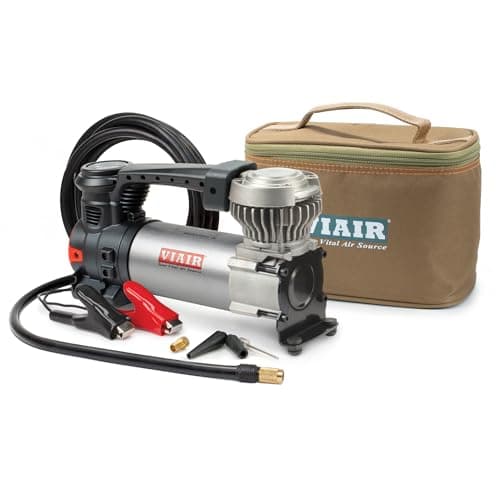
VIAIR's published duty cycle, air flow and amp draw set side by side, with the tire sizes and voltages each compressor is actually rated for.
Found something out of date, or a figure you can source better than we did? Tell us — corrections get read first. Our methodology explains how picks are made, and contact is one click away.