Tire Inflators
Why is my tire losing air?
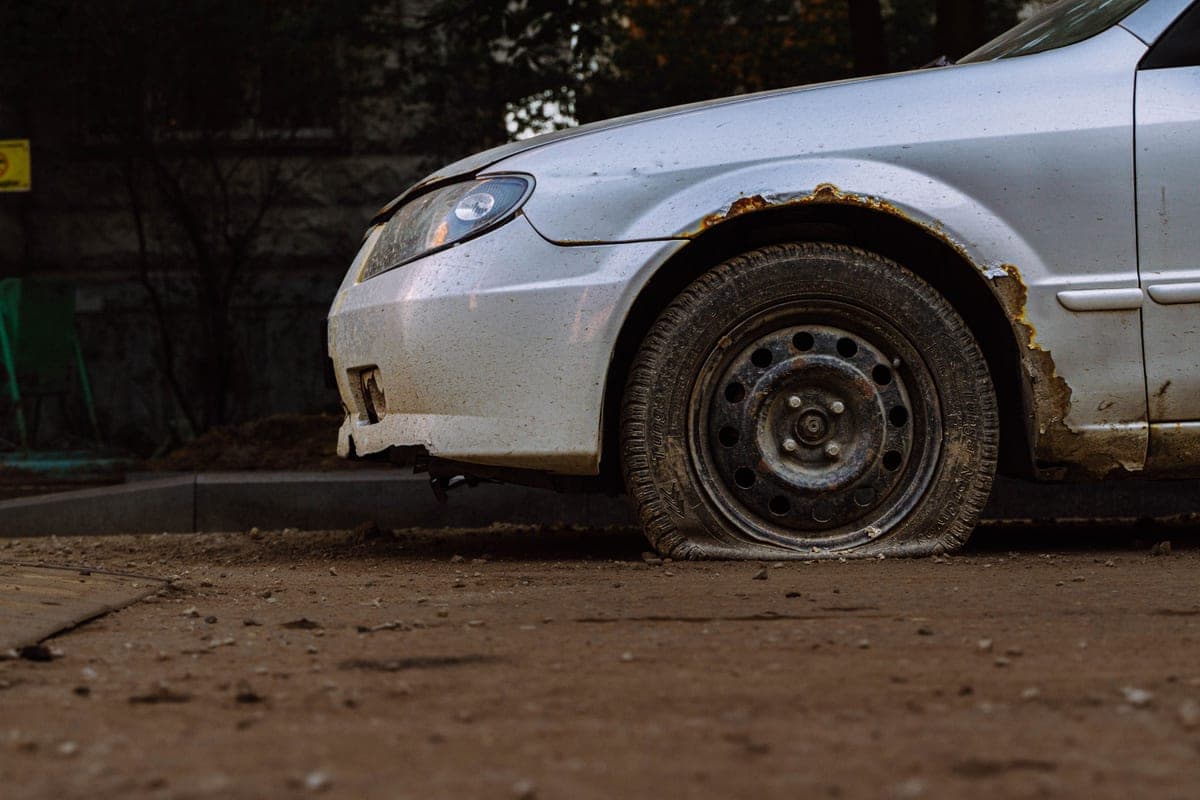
A tire that goes soft every week and shows no nail in the tread is usually leaking from one of four places, and three of them are at the wheel.
Disclosure: we earn a commission if you buy through the Amazon links on this page, at no extra cost to you. Commission never decides a verdict or a ranking position — read our editorial policy and affiliate disclosure.
Short answer
A tire losing air with no visible nail is usually leaking at the valve stem, at the bead where tire meets rim, through a corroded wheel, or past the TPMS sensor seal. A fifth of apparent leaks are not leaks at all but temperature change — roughly 1 PSI per 10 degrees Fahrenheit. Soapy water finds the real ones in five minutes.
The reason this question is so common is that the mental model is wrong. People look for a puncture, find nothing, and conclude the tire is mysteriously defective. In reality most slow leaks are not in the tread at all — they are at the wheel, where four separate seals have to hold air and any of them can fail without leaving a mark you can see from a standing position.
The four real leak paths
| Source | Typical behavior | How to confirm | Fix |
|---|---|---|---|
| Valve stem | Steady loss over days, often worse in cold | Soapy water on the stem and around its base | A new stem — inexpensive, and usually done with any tire service |
| Bead seat | Loss that varies with temperature and parking | Soapy water along the rim edge, both sides | Dismount, clean the bead seat, remount |
| Corroded wheel | Returns after being fixed, common on older alloys | Soapy water at the rim, plus visible white powdery corrosion | Clean and seal the mating surface, or replace the wheel |
| TPMS sensor seal | Slow, steady, from the sensor's seat inside the wheel | Soapy water around the stem base on a sensor-equipped valve | A new sensor seal kit, or a new sensor |
| Tread or sidewall puncture | Can be fast or very slow with a sealed-in object | Soapy water over the whole tread; look for a nail head | A proper patch-plug repair from the inside, not a plug alone |
This is our ordering of the common causes by how often they explain a no-visible-hole leak. It is a diagnostic guide, not a tire manufacturer's service procedure.
The soapy water test
This is the whole diagnosis and it costs nothing. Mix dish soap into water until it is properly slippery, inflate the tire to its placard pressure, and then paint the mixture generously onto the suspect areas with a sponge or a spray bottle. Air escaping makes a growing cluster of bubbles, which is far easier to see than it sounds.
- Start at the valve stem. Coat the stem, the cap threads and the base where the stem enters the wheel. This single spot explains a large share of slow leaks.
- Work the rim edge next, all the way around, on both the outboard and the inboard face if you can reach it. Bead and corrosion leaks show up here.
- Then the tread, section by section, looking for a nail head or a screw you missed because it sits flush.
- Finally the sidewall. A sidewall leak is a tire to replace rather than repair — no reputable shop patches a sidewall.
- Mark anything you find with chalk or tape before the soap dries, because you will not find it twice.
The leak that is not a leak
Before you take a wheel off, rule out the weather. Air pressure falls as air cools, at roughly 1 PSI for every 10 degrees Fahrenheit. A tire set correctly on a 75-degree afternoon reads about 3 PSI lower on a 45-degree morning, and the TPMS light comes on, and it looks exactly like a slow leak. The giveaway is the pattern: a temperature effect shows up on all four tires at once and comes back when the day warms up, while a real leak affects one tire and keeps going.
There is also simple permeation. All tires lose a little air through the rubber itself over time, which is why how often should you check tire pressure exists as a page: a pound a month is normal and is not a fault. Tire pressure in cold weather has the full seasonal version, including why you should set pressures cold.
How much loss is a problem
- About 1 PSI a month across all four tires: normal permeation. Top up at your regular check and move on.
- 2 to 3 PSI overnight when the temperature drops sharply: probably the weather. Check again in the afternoon before worrying.
- 1 PSI a day on one tire: a real leak. Find it with soap and get it repaired. This is the band most people live in while telling themselves it is fine.
- Noticeable loss within hours: stop driving on it and fit the spare. A tire run badly underinflated builds heat in the sidewall, and that is how a slow leak becomes a blowout.
- TPMS light on with all four tires at placard pressure: suspect the sensor or its battery rather than the tires. Sensors have a finite life.
What to own so this is a five-minute job
The reason a slow leak turns into a roadside problem is almost never ignorance — it is friction. If topping a tire up means driving to a gas station and feeding coins into a machine with a broken gauge, it does not happen weekly. If there is an inflator in the trunk, it happens in four minutes on the driveway while you are doing something else.
A plain 12-volt socket-powered inflator is the lowest-friction version of that, because there is nothing to keep charged and it works whenever the car does. A compact cordless unit is better if you have more than one vehicle or dislike trailing a cord to a rear tire — the trade is a battery you have to remember. 12-volt versus cordless tire inflators is the comparison, and is a portable tire inflator worth it is the prior question.
The picks
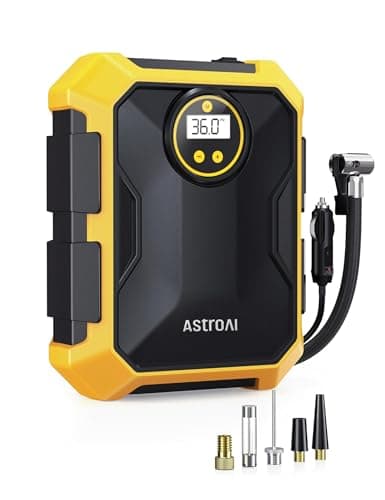
1. The cheapest way to stop guessing
AstroAI 12V Tire Inflator
AstroAI · Best for the cheapest inflator still worth owning
A plain 12 V socket-powered inflator with a digital gauge and auto-shutoff — the baseline that covers a car's tires with no battery to maintain.
This manufacturer does not publish a full specification table for this model on its own site. Rather than repeat figures we cannot source, the assessment below is limited to what the product category and the retailer listing genuinely establish.
What works
- Powered from the 12 V socket, so it works whenever the car does
- Nothing to keep charged, which means it is never flat when the tire is
- Digital preset shutoff at the target pressure
What does not
- The cord limits where you can work, and reaching a rear tire can be tight
- Small-motor inflators in this tier run hot; large tires need rest intervals
- Gauge accuracy in this class varies unit to unit, so verify against a separate gauge
Skip it if
Not the pick if you regularly air down and back up for trails, or run light-truck tires. That is dedicated-compressor work.
#ad Affiliate link · Price as of October 17, 2026
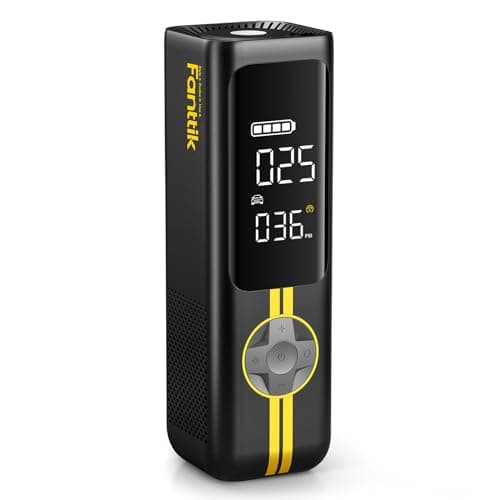
2. Best for a weekly top-up habit
Fanttik X8 Apex
Fanttik · Best for cordless top-ups from a glovebox
A self-contained cordless inflator small enough to live in a door pocket, with a backlit digital gauge and a preset target pressure.
Published specifications
- Maximum pressure
- 150 PSI source
- Internal battery
- 28.8 Wh lithium-ion source
- Stated gauge accuracy
- ±1 PSI source
- Stated runtime
- Up to 40 minutes continuous source
- Stated fill time
- 56 seconds, 215/55 R17 from 28 to 33 PSI source
- Operating temperature
- 14 to 113 °F (-10 to 45 °C) source
- Weight
- 1.74 lb source
- Recharging
- USB-C, 15 W maximum source
- Work light
- 40 lumens source
- Preset modes
- 4 — bicycle, motorcycle, car, ball; PSI, kPa and bar source
- Warranty
- 12 months source
What works
- No cable to the car at all — it runs off its own internal battery
- Small enough that it stays in the vehicle, which is most of the battle
- Preset-and-stop pressure control avoids the overshoot you get chasing an analogue gauge
What does not
- An internal battery is one more thing to keep charged, and cold weather cuts into it
- Cordless inflators this size heat up on large tires; expect to work in stages
- Manufacturer duty-cycle figures for this class are not consistently published
Skip it if
Not the pick for light-truck or RV tires. Small cordless units are built for top-ups, not for taking a 35-inch tire from flat to 60 PSI.
#ad Affiliate link · Price as of October 17, 2026
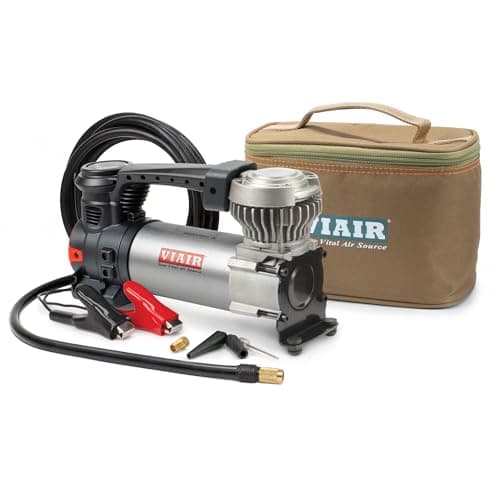
3. Best if the leak is on a truck tire
VIAIR 88P Portable Compressor
VIAIR · Best for truck, suv and off-road tires
A battery-clamp compressor built for the tire sizes socket-powered units cannot handle without stopping to cool down.
Published specifications
- Maximum working pressure
- 120 PSI source
- Air flow
- 1.97 CFM at 0 PSI source
- Duty cycle
- 25 minutes at 30 PSI source
- Supply
- 12 V, battery clamps source
- Maximum amp draw
- 20 A source
- Inrush current
- 45 A at 0 PSI source
- Ingress protection
- IP53 source
- Operating temperature
- -4 to 158 °F source
- Tire size rating
- Up to 33 in source
- Weight
- 4.75 lb source
- Power cord / air hose
- 10 ft / 16 ft source
What works
- Connects to the battery terminals rather than the 12 V socket, so socket fuse current is not the limit
- Built for larger tires and repeated fills — the duty cycle is the whole reason to buy it
- Metal body and a real air hose rather than a molded plastic assembly
What does not
- The battery-clamp connection means popping the hood every time
- Bigger and heavier than any glovebox inflator
- Overkill, and slower to set up, for a routine cold-morning top-up
Skip it if
Not the pick if you drive a sedan and just want to correct 4 PSI once a month. That is what a socket inflator is for.
#ad Affiliate link · Price as of October 17, 2026
Key takeaways
- Most no-visible-hole leaks are at the wheel: valve stem, bead seat, wheel corrosion or the TPMS seal.
- Soapy water on an inflated tire finds all of them in about five minutes.
- Start at the valve stem — it is the single most common source.
- Roughly 1 PSI per 10 degrees Fahrenheit of temperature change is physics, not a leak.
- A temperature effect hits all four tires and reverses; a leak hits one and continues.
- About 1 PSI a month is normal permeation. 1 PSI a day on one tire is a repair.
- Sealant is an emergency measure, not a fix — it can foul the TPMS sensor and complicate a proper repair.
How we sourced this
Every figure on this page came from one of the following. Where a manufacturer or regulator does not publish a number, we say so rather than estimate it.
Common questions
- Why is my tire losing air but there is no hole?
- Because most slow leaks are not in the tread. The usual sources are the valve stem, the bead where the tire seals against the rim, corrosion on an older alloy wheel, or the TPMS sensor's seal. Soapy water painted onto an inflated tire finds all four.
- How do I find a slow leak in a tire?
- Inflate to the placard pressure, then paint soapy water onto the valve stem first, the rim edge second, the tread third and the sidewall last. Escaping air makes a growing cluster of bubbles. Mark anything you find before the soap dries.
- Is it normal for tires to lose air in cold weather?
- Yes. Pressure falls about 1 PSI for every 10 degrees Fahrenheit of cooling, so a tire set on a warm afternoon reads low on a cold morning and may light the TPMS warning. The clue that it is weather and not a leak is that it affects all four tires and recovers as the day warms.
- How much air loss in a tire is normal?
- Roughly 1 PSI a month through ordinary permeation, spread across all four tires. One tire losing a pound a day is a real leak and should be repaired — driving on a badly underinflated tire builds sidewall heat, which is how a slow leak becomes a blowout.
- Can a TPMS sensor cause a slow leak?
- Yes. On sensor-equipped valves the sensor seals inside the wheel, and that seal can weep. It is also worth remembering that a TPMS light with all four tires at correct pressure usually means the sensor or its internal battery is at fault rather than the tire.
More in Tire Inflators
The cheapest tool that prevents the second-most-common roadside stop. Here is which type fits your tires, and the two specs that actually matter.
Read next
Head to head
Inflator vs Sealant
When air is enough, when you need sealant, what sealant does to a TPMS sensor and a future repair, and why most drivers should carry both.
Guide
How Often to Check
Why monthly is the right interval, what cold weather does to the number, and why a TPMS light is not a substitute for a gauge.
Guide
Cold Weather Tire Pressure
The 1-PSI-per-10-degrees rule, why the placard figure is already a cold figure, and which inflators publish an operating range that covers winter.
Guide
What PSI Should My Tires Be?
The single most common tire mistake, fixed in two minutes: placard versus sidewall, checking cold, and what cold weather does to the reading.
Found something out of date, or a figure you can source better than we did? Tell us — corrections get read first. Our methodology explains how picks are made, and contact is one click away.