Tire Inflators
Tire pressure in cold weather
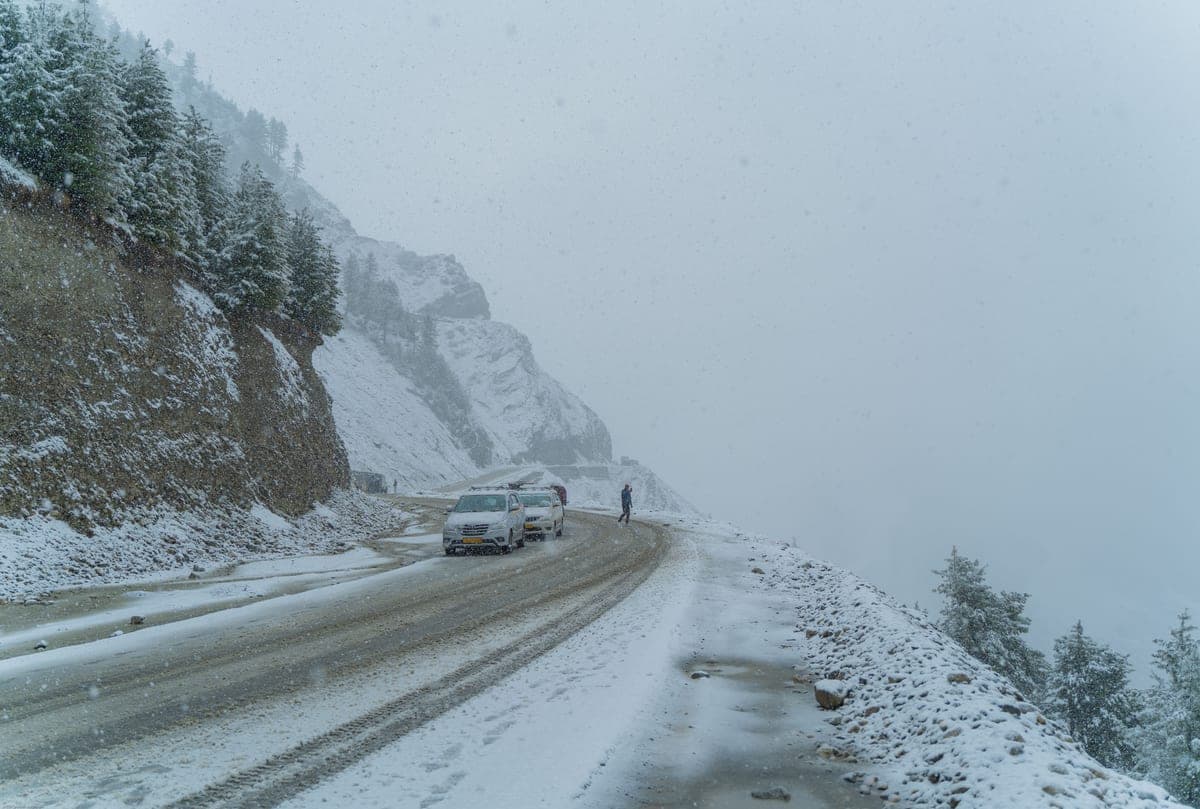
The first frost of the year lights up more TPMS warnings than anything else, and almost none of them are punctures.
Disclosure: we earn a commission if you buy through the Amazon links on this page, at no extra cost to you. Commission never decides a verdict or a ranking position — read our editorial policy and affiliate disclosure.
Short answer
Tire pressure falls about 1 PSI for every 10 degrees Fahrenheit the air cools, so a tire set on a 75-degree afternoon reads roughly 4 PSI low on a 35-degree morning. Set pressures to the door placard figure when the tires are cold, not warm, and expect to add air twice over a winter.
This is the single most predictable event in tire maintenance. Every year the first properly cold morning produces a wave of TPMS warnings, and almost all of them are the same thing: air that was at the right pressure in September is at a lower pressure in November because it is colder, and nothing is wrong with the tire. Understanding the number turns an alarming dashboard light into a four-minute job on the driveway.
The rule, and what it looks like in practice
| Ambient temperature | Approximate reading | TPMS likely to warn? |
|---|---|---|
| 75 °F | 35 PSI | No |
| 55 °F | About 33 PSI | No |
| 35 °F | About 31 PSI | Possibly — this is the usual first warning |
| 15 °F | About 29 PSI | Yes on most vehicles |
| -5 °F | About 27 PSI | Yes |
Calculated from the roughly 1 PSI per 10 degrees Fahrenheit relationship, applied to a 35 PSI starting point. It is an approximation to plan by, not a measurement of your tires. Federal law requires a TPMS to warn at 25 percent below the placard pressure, which is where the warning threshold in the last column comes from.
Two things fall out of that table. The first is that the TPMS is not being oversensitive — a tire 4 PSI down on a 35 PSI placard figure is genuinely underinflated and genuinely worth fixing, because underinflation costs fuel economy, wears the shoulders of the tread and builds heat in the sidewall. The second is that the warning arriving on the first cold morning is not evidence of a leak. Why is my tire losing air separates the two, and the test is simple: temperature affects all four tires at once.
Why you set pressures cold
The figure on the placard inside your driver's door is a cold inflation pressure. "Cold" here does not mean winter — it means the tires have not been driven on recently and are at ambient temperature. Driving heats a tire and raises its pressure by several PSI, so a pressure set after a highway run is set high, and will read low once everything cools.
Practically: check and set in the morning before you drive, or after the car has sat for at least a few hours. If you have driven to a gas station to use the air line, you are already working with warm tires — in which case set to the placard figure anyway and re-check cold at the next opportunity rather than trying to do arithmetic at the pump. What PSI should my tires be covers reading the placard, including why the number on the tire sidewall is not the number you want.
What a winter season actually requires
- Check at the first real cold snap. That is when the biggest single drop happens, and it is when the light appears.
- Check again mid-winter. Ordinary permeation continues on top of the temperature effect — see how often should you check tire pressure.
- Check the spare. A spare at 20 PSI is not a spare. What PSI should a spare tire be covers the higher pressure most compact spares want.
- Re-check in spring, because the reverse happens: the same tires read high as the weather warms, and the correct response is to let air out to the placard figure.
Not every inflator works in the cold
This is the part of the subject that gets skipped, and it is the reason this page has picks at all. Inflators carry published operating temperature ranges, and they vary enormously. VIAIR publishes -4 to 158 degrees Fahrenheit for the 88P, which covers almost any North American winter morning. Fanttik publishes 14 to 113 degrees Fahrenheit for the X8 Apex — a perfectly honest figure for a compact lithium tool, and one that stops above a genuinely cold morning in the northern half of the country.
That is not a reason to avoid cordless. It is a reason to know which tool you have and where it lives. A lithium inflator kept in the house and carried out to the car works fine at 5 degrees for the few minutes it is in use; the same tool left in a cold trunk overnight may be sluggish or refuse to run, and its battery will certainly deliver less. A 12-volt compressor drawing from the car has no such problem, which is the quiet argument for socket power in winter. The best tire inflators for cold weather is the full roundup built on those published ranges.
The picks
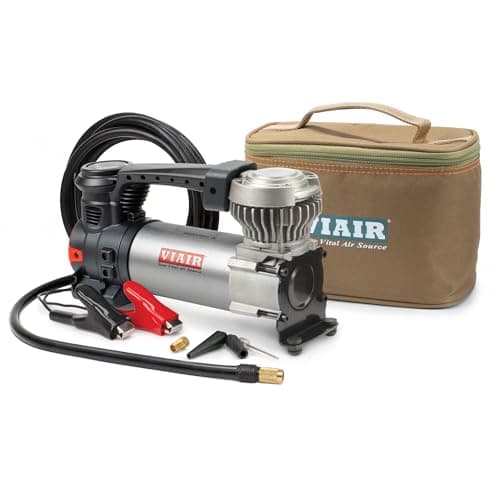
1. Best published cold rating
VIAIR 88P Portable Compressor
VIAIR · Best for truck, suv and off-road tires
A battery-clamp compressor built for the tire sizes socket-powered units cannot handle without stopping to cool down.
Published specifications
- Maximum working pressure
- 120 PSI source
- Air flow
- 1.97 CFM at 0 PSI source
- Duty cycle
- 25 minutes at 30 PSI source
- Supply
- 12 V, battery clamps source
- Maximum amp draw
- 20 A source
- Inrush current
- 45 A at 0 PSI source
- Ingress protection
- IP53 source
- Operating temperature
- -4 to 158 °F source
- Tire size rating
- Up to 33 in source
- Weight
- 4.75 lb source
- Power cord / air hose
- 10 ft / 16 ft source
What works
- Connects to the battery terminals rather than the 12 V socket, so socket fuse current is not the limit
- Built for larger tires and repeated fills — the duty cycle is the whole reason to buy it
- Metal body and a real air hose rather than a molded plastic assembly
What does not
- The battery-clamp connection means popping the hood every time
- Bigger and heavier than any glovebox inflator
- Overkill, and slower to set up, for a routine cold-morning top-up
Skip it if
Not the pick if you drive a sedan and just want to correct 4 PSI once a month. That is what a socket inflator is for.
#ad Affiliate link · Price as of October 17, 2026
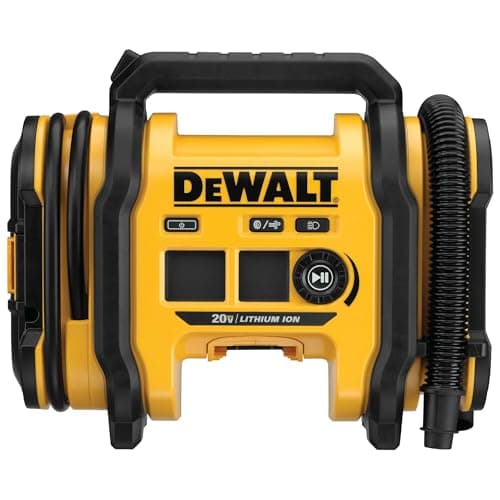
2. Best if it lives indoors
DEWALT DCC020IB 20V MAX Inflator
DEWALT · Best for anyone already on dewalt 20v batteries
Three power sources in one body — 20V MAX battery, 12 V socket or 110 V wall — with a digital gauge and auto-shutoff, which is what makes an inflator usable everywhere.
Published specifications
What works
- The 12 V socket option means a dead tool battery never leaves you stranded
- A threaded chuck screws onto the valve stem instead of clamping — the difference between a solid seal and a hissing one
- Set-and-walk-away auto-shutoff at your target pressure
- High-volume mode handles air mattresses and inflatables, not just tires
What does not
- Sold as a bare tool — battery, charger and AC adapter are separate purchases
- Bigger and heavier than a pocket 12 V inflator, so it wants trunk space
Skip it if
Not the pick if you own no DEWALT batteries and only ever top up car tires. A plain 12 V inflator is smaller and cheaper for that job.
#ad Affiliate link · Price as of October 17, 2026
Raw specifications: DEWALT’s own page for the DEWALT DCC020IB 20V MAX Inflator.
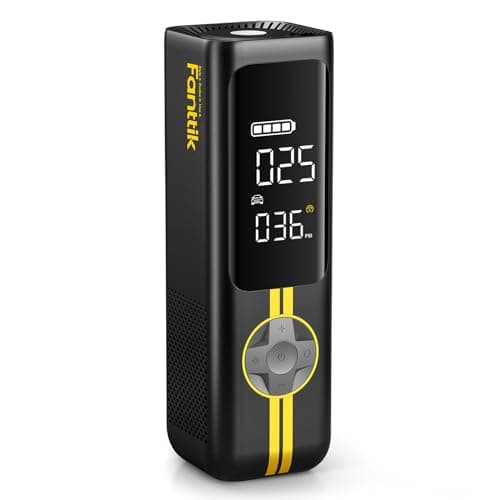
3. Best cordless, with a caveat
Fanttik X8 Apex
Fanttik · Best for cordless top-ups from a glovebox
A self-contained cordless inflator small enough to live in a door pocket, with a backlit digital gauge and a preset target pressure.
Published specifications
- Maximum pressure
- 150 PSI source
- Internal battery
- 28.8 Wh lithium-ion source
- Stated gauge accuracy
- ±1 PSI source
- Stated runtime
- Up to 40 minutes continuous source
- Stated fill time
- 56 seconds, 215/55 R17 from 28 to 33 PSI source
- Operating temperature
- 14 to 113 °F (-10 to 45 °C) source
- Weight
- 1.74 lb source
- Recharging
- USB-C, 15 W maximum source
- Work light
- 40 lumens source
- Preset modes
- 4 — bicycle, motorcycle, car, ball; PSI, kPa and bar source
- Warranty
- 12 months source
What works
- No cable to the car at all — it runs off its own internal battery
- Small enough that it stays in the vehicle, which is most of the battle
- Preset-and-stop pressure control avoids the overshoot you get chasing an analogue gauge
What does not
- An internal battery is one more thing to keep charged, and cold weather cuts into it
- Cordless inflators this size heat up on large tires; expect to work in stages
- Manufacturer duty-cycle figures for this class are not consistently published
Skip it if
Not the pick for light-truck or RV tires. Small cordless units are built for top-ups, not for taking a 35-inch tire from flat to 60 PSI.
#ad Affiliate link · Price as of October 17, 2026
Cold mornings are also when batteries fail, and the two problems arrive together more often than coincidence would suggest — a cold snap is simply the first honest test of the year for everything in the car. Car battery dead in cold weather covers that side, and the winter car emergency kit is the checklist that assumes both will happen eventually.
Key takeaways
- Pressure falls about 1 PSI per 10 degrees Fahrenheit of cooling.
- A tire set at 35 PSI on a 75-degree day reads near 31 PSI at 35 degrees — enough to trigger a TPMS warning.
- The placard figure is a cold inflation pressure: set it before driving, not after.
- Do not overinflate in autumn to compensate. Top up when the weather turns instead.
- Temperature affects all four tires at once; a leak affects one.
- Let air back out to the placard figure in spring, when the same tires read high.
- Check your inflator's published operating range — VIAIR publishes -4 °F for the 88P, Fanttik 14 °F for the X8 Apex.
How we sourced this
Every figure on this page came from one of the following. Where a manufacturer or regulator does not publish a number, we say so rather than estimate it.
Common questions
- How much does tire pressure drop in cold weather?
- About 1 PSI for every 10 degrees Fahrenheit the air cools. A tire set to 35 PSI on a 75-degree afternoon reads roughly 31 PSI at 35 degrees and about 29 PSI at 15 degrees, which is why the first cold morning of the year lights up so many TPMS warnings.
- Should I add air to my tires in the winter?
- Yes — back up to the placard figure, checked when the tires are cold. The pressure genuinely is low rather than merely reading low, and an underinflated tire costs fuel, wears its shoulders and runs hot. Expect to top up at least twice over a winter.
- Should I overinflate tires in cold weather?
- No. Setting pressures above the placard figure to get ahead of the cold leaves the tires overinflated on every mild day, which shrinks the contact patch and wears the center of the tread. Set to the placard number and top up again when it gets colder.
- Why is my TPMS light on every cold morning?
- Because a TPMS is required to warn at 25 percent below the placard pressure, and a normal overnight temperature drop can take a tire most of the way there. If all four tires are affected and the light clears as the day warms, that is temperature. If one tire keeps dropping, that is a leak.
- Do tire inflators work in freezing weather?
- Some do, and the makers publish the range. VIAIR publishes -4 to 158 degrees Fahrenheit for the 88P; Fanttik publishes 14 to 113 degrees for the X8 Apex. A compact lithium unit kept indoors and carried out works fine; one left in a cold trunk overnight may not.
More in Tire Inflators
The cheapest tool that prevents the second-most-common roadside stop. Here is which type fits your tires, and the two specs that actually matter.
Read next
Best for Cold Weather
Best for Cold Weather
Published operating-temperature ranges, why a lithium pack is the wrong power source in January, and the inflators that still do the job on a frozen driveway.
Guide
What PSI Should My Tires Be?
The single most common tire mistake, fixed in two minutes: placard versus sidewall, checking cold, and what cold weather does to the reading.
Troubleshooting
Tire Losing Air
The four real causes of a slow leak, the soapy-water test that finds each one, and how to tell a leak from ordinary temperature change.
Guide
How Often to Check
Why monthly is the right interval, what cold weather does to the number, and why a TPMS light is not a substitute for a gauge.
Found something out of date, or a figure you can source better than we did? Tell us — corrections get read first. Our methodology explains how picks are made, and contact is one click away.