Tire Inflators
Can a tire inflator deflate a tire?
Some can, most cannot, and the ones that cannot give you a far better alternative that costs almost nothing.
Disclosure: we earn a commission if you buy through the Amazon links on this page, at no extra cost to you. Commission never decides a verdict or a ranking position — read our editorial policy and affiliate disclosure.
How we assessed these: picks are selected from manufacturer specifications, current retailer listings and published owner feedback — not from hands-on testing of every unit. Where a manufacturer does not publish a figure, it is left out rather than estimated.
Short answer
Only if it has an explicit deflate mode, and most do not. The DEWALT DCC020IB publishes high-volume inflate and deflate functions. A standard inflator is a one-way pump and cannot reverse. To let air out, press the valve stem pin, use the valve core tool molded into many valve caps, or fit a dedicated deflator.
The reason most inflators cannot deflate is mechanical rather than a feature decision. A compressor has a one-way valve in the head so the air it has pushed into the tire cannot come back out through the pump, which is exactly what you want when filling. Running that process in reverse requires a different air path, and most manufacturers do not build one.
The exceptions are usually high-volume units — the ones designed to fill air mattresses, pool toys and inflatable kayaks as well as tires. Deflating an air mattress is a genuine use case for a high-volume pump, and tires come along for the ride. The DEWALT DCC020IB is the example in our registry: it publishes a high-pressure mode with auto-shutoff for tires, plus separate high-volume inflate and deflate modes.
What to do instead, which is cheaper and faster
| Method | Control | Speed | Notes |
|---|---|---|---|
| Press the valve pin with a key or screwdriver | Poor | Slow | Works anywhere, risks bending the pin or losing the core |
| Valve core tool in the cap | Fair | Slow | Many metal valve caps have one molded in; keep one in the kit |
| Inflator with a deflate mode | Good | Moderate | Only if your unit publishes the function |
| Screw-on deflator with a gauge | Good | Fast | Purpose-built for airing down, reads as it vents |
| Automatic deflators set to a target | Best | Fast | Set once, screw on all four, walk away |
Speed and control ratings are our assessment of the methods, not a manufacturer claim. The key point is that none of the better options is an inflator.
That table contains the real answer to the question. If you want to let a little air out because you overshot, the pin in the valve stem does the job in seconds and you already own it. If you air down deliberately and regularly — trail driving, sand, snow — a set of automatic deflators is the right tool and costs a fraction of a compressor.
Why you probably want to let air out at all
There are three honest reasons, and one bad one. The bad one first: letting air out because the pressure reads high after a highway drive. Resist that. Tire pressure rises as the tire heats, and the placard figure in the door jamb is a cold pressure. Bleeding a warm tire down to the cold figure leaves it underinflated once it cools. What PSI your tires should be covers the placard-versus-sidewall question in full.
- You overshot the target. Easy to do chasing an analogue gauge, which is the argument for a preset-and-stop inflator that cuts off on its own.
- You are airing down for traction. Lower pressure lengthens the contact patch on sand, snow and rock. This is the main legitimate reason to deflate deliberately, and it is also the reason you need a real compressor to air back up afterwards — see tire inflators for off-road use.
- You are seating a bead or fitting a tire. A workshop job rather than a roadside one, and it needs more airflow than any portable unit provides.
Airing down commits you to airing back up
This is the part that catches people out. Letting air out takes seconds with a deflator. Putting it back takes real equipment, because going from 18 PSI to 35 PSI on four light-truck tires is a lot of air. A glovebox inflator will do it eventually, in stages, with cooling breaks — and that is not a theoretical limitation, it is what duty cycle means.
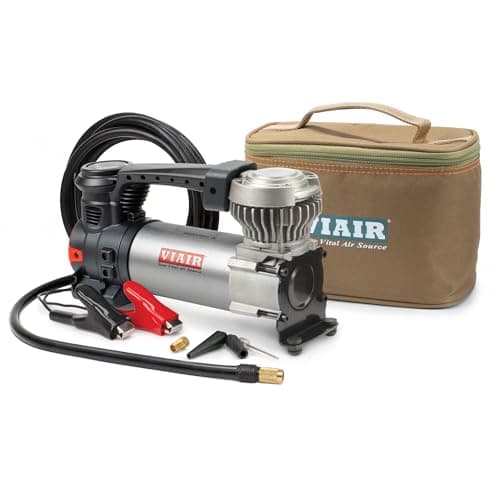
The VIAIR 400P publishes 2.30 CFM at 0 PSI, a 33 percent duty cycle at 100 PSI and a 25-foot air hose that reaches all four corners from one hookup, which is why it is the pick for anyone airing down deliberately. Tire inflator duty cycle explained is worth reading before you buy anything for this job.
The small tool worth keeping in the kit
A metal valve cap with a core tool molded into the top, and a spare valve core or two, takes up no space and solves two problems: letting air out in a controlled way, and dealing with a core that is leaking or has been damaged. A leaking core is a surprisingly common cause of a tire that goes soft over a week, and it is a two-minute fix rather than a tire-shop visit.
Pair that with a gauge you trust. Inflator gauges vary unit to unit in this category, and the whole point of controlled deflation is hitting a number. Tire inflator accuracy covers how much to trust a built-in display, and how often you should check tire pressure covers the routine.
What we would buy
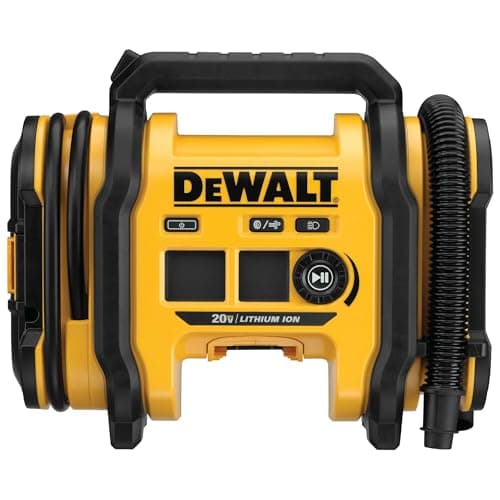
1. Best inflator with a published deflate mode
DEWALT DCC020IB 20V MAX Inflator
DEWALT · Best for anyone already on dewalt 20v batteries
Three power sources in one body — 20V MAX battery, 12 V socket or 110 V wall — with a digital gauge and auto-shutoff, which is what makes an inflator usable everywhere.
Published specifications
What works
- The 12 V socket option means a dead tool battery never leaves you stranded
- A threaded chuck screws onto the valve stem instead of clamping — the difference between a solid seal and a hissing one
- Set-and-walk-away auto-shutoff at your target pressure
- High-volume mode handles air mattresses and inflatables, not just tires
What does not
- Sold as a bare tool — battery, charger and AC adapter are separate purchases
- Bigger and heavier than a pocket 12 V inflator, so it wants trunk space
Skip it if
Not the pick if you own no DEWALT batteries and only ever top up car tires. A plain 12 V inflator is smaller and cheaper for that job.
#ad Affiliate link · Price as of October 16, 2026
Raw specifications: DEWALT’s own page for the DEWALT DCC020IB 20V MAX Inflator.
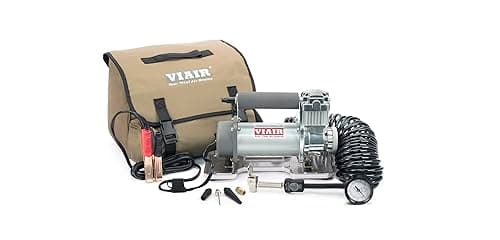
2. Best for airing back up afterwards
VIAIR 400P Portable Compressor
VIAIR · Best for airing back up after a trail
A step up from the 88P for people who air down deliberately: 150 PSI, a published 33 percent duty cycle at 100 PSI, and a 25-foot hose that reaches all four corners.
Published specifications
- Maximum working pressure
- 150 PSI source
- Air flow
- 2.30 CFM at 0 PSI source
- Duty cycle
- 33% at 100 PSI source
- Supply
- 12 V or 24 V, battery clamps source
- Maximum amp draw
- 30 A at 12 V, 15 A at 24 V source
- Inrush current
- 81 A at 0 PSI (PN 40043) source
- Ingress protection
- IP54 source
- Weight
- 10.40 lb source
- Power cord / air hose
- 8 ft / 25 ft source
What works
- Battery-clamp connection, so the 12 V socket's fuse is not the ceiling on throughput
- A published duty cycle — 33 percent at 100 PSI — which almost nothing in this category gives you
- 25 feet of air hose reaches every corner of a vehicle from one hookup
- Metal construction and a real air hose rather than a molded plastic assembly
What does not
- 10.40 lb and the bulk that goes with it — dedicated recovery-gear territory, not a glovebox tool
- 30 A at 12 V rules out any accessory socket; it is battery clamps or nothing
- Slower to set up than a socket inflator for a routine cold-morning top-up
Skip it if
Overkill for a car that needs 4 PSI once a month. That is a socket inflator's job, and this is a lot of equipment to carry for it.
#ad Affiliate link · Price as of October 16, 2026
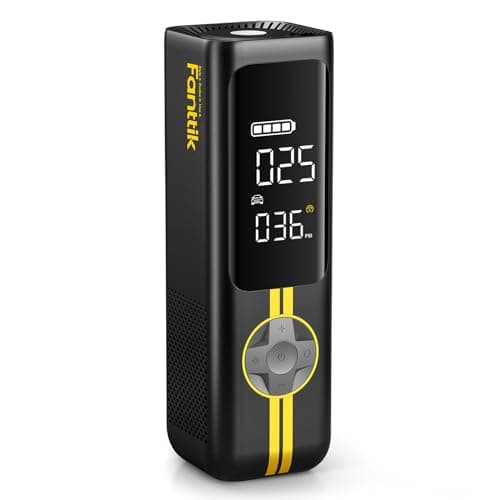
3. Best for precise target pressures
Fanttik X8 Apex
Fanttik · Best for cordless top-ups from a glovebox
A self-contained cordless inflator small enough to live in a door pocket, with a backlit digital gauge and a preset target pressure.
Published specifications
- Maximum pressure
- 150 PSI source
- Internal battery
- 28.8 Wh lithium-ion source
- Stated gauge accuracy
- ±1 PSI source
- Stated runtime
- Up to 40 minutes continuous source
- Stated fill time
- 56 seconds, 215/55 R17 from 28 to 33 PSI source
- Operating temperature
- 14 to 113 °F (-10 to 45 °C) source
- Weight
- 1.74 lb source
- Recharging
- USB-C, 15 W maximum source
- Work light
- 40 lumens source
- Preset modes
- 4 — bicycle, motorcycle, car, ball; PSI, kPa and bar source
- Warranty
- 12 months source
What works
- No cable to the car at all — it runs off its own internal battery
- Small enough that it stays in the vehicle, which is most of the battle
- Preset-and-stop pressure control avoids the overshoot you get chasing an analogue gauge
What does not
- An internal battery is one more thing to keep charged, and cold weather cuts into it
- Cordless inflators this size heat up on large tires; expect to work in stages
- Manufacturer duty-cycle figures for this class are not consistently published
Skip it if
Not the pick for light-truck or RV tires. Small cordless units are built for top-ups, not for taking a 35-inch tire from flat to 60 PSI.
#ad Affiliate link · Price as of October 16, 2026
Key takeaways
- Most inflators cannot deflate — the one-way valve in the pump head makes reversing impossible.
- High-volume units are the exception; the DEWALT DCC020IB publishes a deflate mode.
- For small corrections, the valve pin or a valve core tool is faster and free.
- For deliberate airing down, screw-on or automatic deflators are the right tool.
- Never bleed a warm tire down to the cold placard figure — you will end up underinflated.
- Airing down commits you to airing back up, which needs a real compressor and a published duty cycle.
How we sourced this
Every figure on this page came from one of the following. Where a manufacturer or regulator does not publish a number, we say so rather than estimate it.
Common questions
- Do portable tire inflators have a deflate function?
- Most do not. A standard inflator is a one-way pump with a check valve in the head, so it cannot run in reverse. High-volume units designed for air mattresses as well as tires sometimes do — the DEWALT DCC020IB publishes separate high-volume inflate and deflate modes.
- How do you let air out of a tire without a deflator?
- Press the pin in the middle of the valve stem with a key, a small screwdriver or the core tool molded into many metal valve caps. Release in short bursts and check the pressure between them, because air leaves faster than you expect.
- Should I let air out if my tires read high after driving?
- No. Pressure rises as tires heat up, and the figure on your door jamb placard is a cold pressure. If you bleed a warm tire down to the cold number, it will be underinflated once it cools. Check and set pressures before driving, or after the car has sat for a few hours.
- What is the best way to air down for off-road driving?
- A set of screw-on deflators, ideally the automatic type you preset to a target pressure and then fit to all four wheels. They are far faster and more consistent than pressing valve pins, and they cost a fraction of the compressor you will need to air back up afterwards.
More in Tire Inflators
The cheapest tool that prevents the second-most-common roadside stop. Here is which type fits your tires, and the two specs that actually matter.
Read next
Best for Off-Road
Best for Off-Road
Battery-clamp compressors built for repeated large-volume fills, and why the 12 V socket is the ceiling you have to get past.
Guide
Duty Cycle Explained
What duty cycle means, why it decides whether an inflator can handle large tires, and what to infer when the manufacturer stays silent.
Guide
What PSI Should My Tires Be?
The single most common tire mistake, fixed in two minutes: placard versus sidewall, checking cold, and what cold weather does to the reading.
Guide
Gauge Accuracy
Why built-in gauges drift, how to check yours against a reference, and why we will not publish per-model deviation numbers we have not measured.
Found something out of date, or a figure you can source better than we did? Tell us — corrections get read first. Our methodology explains how picks are made, and contact is one click away.