Jump Starters
The best jump starters for small cars
A hatchback or a compact sedan is the easiest engine in this category to start — which means the right pack is small, cheap and always in the car, not the biggest one on the shelf.
Disclosure: we earn a commission if you buy through the Amazon links on this page, at no extra cost to you. Commission never decides a verdict or a ranking position — read our editorial policy and affiliate disclosure.
How we assessed these: picks are selected from manufacturers' published specifications, stated engine ratings and current retailer listings — not from hands-on cranking tests of every unit. We publish no measured cranking currents or start counts, because we do not measure them.
Short answer
For most small cars, buy the NOCO Boost Plus GB40: its published 6.0-liter gas rating is roughly double what a 1.6 to 2.0-liter four-cylinder needs, which is the margin you want on a cold morning. The GBX45 is the pick if packed size is the priority — it is lighter and recharges from a USB-C laptop brick. The budget pick is the NOCO Boost Sport GB20, whose published 4.0-liter gas rating genuinely covers a small engine, as long as you accept that it has no diesel rating and no headroom for a bigger car later.
Quick picks
Tap any row to jump to the full write-up. Scoring criteria are published in full on our methodology page.
| # | Product | Best for | Our read | Price |
|---|---|---|---|---|
| 1 | 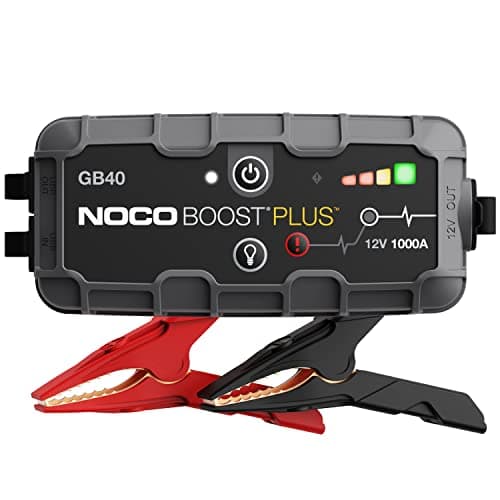 NOCO Boost Plus GB40 Best overall | Most cars and small SUVs | 6.0 L gas rating is double what a compact asks for | $99.95View on Amazon #ad Affiliate link · Price as of November 10, 2026 |
| 2 | 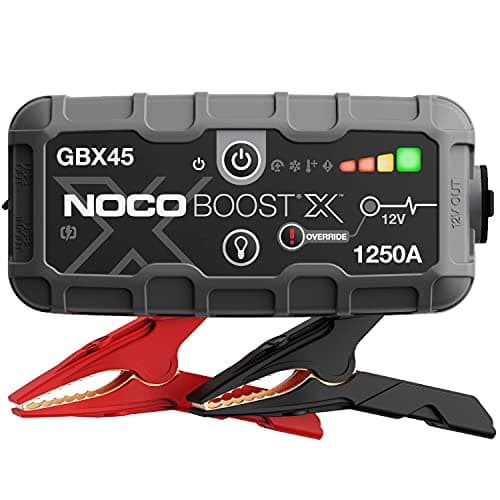 NOCO Boost X GBX45 Best compact option | Travel and carry-on use | 2.16 lb with USB-C in and out — the smallest sensible pack | $124.95View on Amazon #ad Affiliate link · Price as of November 10, 2026 |
| 3 | 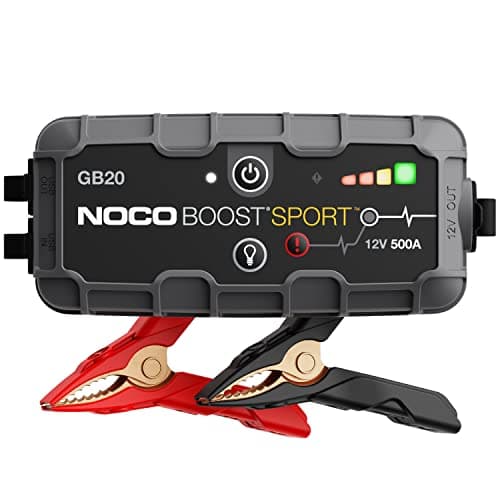 NOCO Boost Sport GB20 Budget pick | Motorcycles, ATVs and small engines | 500 A, 4.0 L gas rating, 2.1 lb — enough for a small engine | $79.95View on Amazon #ad Affiliate link · Price as of November 10, 2026 |
| 4 | 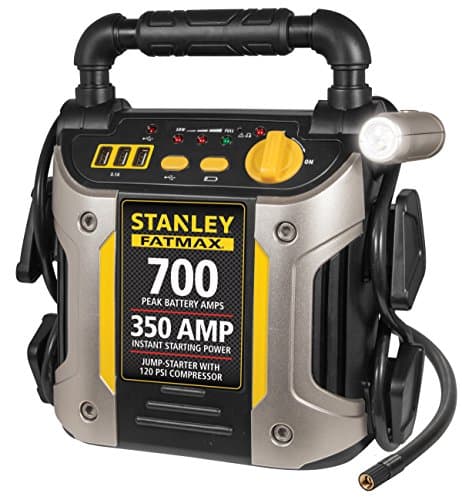 STANLEY FATMAX J7CS Best if you also want air | A cheap one-box jump-and-inflate station | Rated to V6, with a 120 PSI compressor in the same case | $80.99$89.99View on Amazon #ad Affiliate link · Price as of November 10, 2026 |
A small car is the best-case scenario in this whole category. A 1.6-liter four-cylinder needs far less current to turn over than a V8, let alone a diesel, and the battery is physically smaller too. That changes the buying question in a useful way: you are not shopping for maximum capability, you are shopping for the smallest, cheapest pack that still has margin — because that is the one that ends up in the car rather than in a cupboard.
Which is also why the answer is not simply "the cheapest pack that lists your engine." Buying at the exact edge of a rating is how people get stranded twice. What size jump starter do I need works through the sizing logic in general; this page applies it to the small end.
Why we still recommend the GB40 over the cheaper GB20
On paper the GB20 covers a small car: NOCO publishes a 4.0-liter gas rating, and almost nothing in the compact class comes close to that. The reason the GB40 is still the main pick comes down to three things the specification sheet shows plainly.
- Cold takes some of the rating back. A lithium cell delivers less at low temperature, and a 4.0 L ceiling on a 2.0 L engine is less margin than it looks once the pack has spent a January night in a trunk.
- The GB20 has no diesel rating at all — NOCO states diesel is not recommended. If your next car is a small diesel, the pack does not come with you.
- The weight difference is 0.35 lb. Whatever you are buying by going smaller, it is not portability.
The GB20 remains the right call in one clear case: if the pack is mainly for a motorcycle, a quad or a mower and the car is a secondary thought. There it is correctly sized rather than undersized, and best jump starter for motorcycles is the page written around that use.
| Pack | Peak amps | Capacity | Gas rating | Weight | Recharges by |
|---|---|---|---|---|---|
| NOCO Boost Sport GB20 | 500 A | 24 Wh | Up to 4.0 L | 2.1 lb | USB |
| NOCO Boost Plus GB40 | 1,000 A | 24 Wh | Up to 6.0 L | 2.45 lb | USB |
| NOCO Boost X GBX45 | 1,250 A | 31 Wh | Up to 6.5 L | 2.16 lb | USB-C Power Delivery |
| STANLEY FATMAX J7CS | 700 A peak / 350 A instant | Not published | Rated to V6 | Not published | Built-in 120 V AC charger |
NOCO figures are from its published specification pages. STANLEY publishes a cylinder rating and peak and instant amp figures but no displacement rating, battery capacity or weight for the J7CS, so those cells say so.
The case for the one-box station instead
A lithium pack solves exactly one problem. The STANLEY FATMAX J7CS solves two, because it carries a 120 PSI compressor in the same case — and on a small car, a slow-leaking tire is a far more likely roadside event than a dead battery. STANLEY rates its jump starting to a V6, which covers any small car comfortably.
The costs are real: it is lead-acid, so it is heavier, bulkier and self-discharges, which means a reminder to top it up every few months or it will be flat when you need it. For a small car with limited trunk space, that is a genuine trade rather than an obvious win. Jump starter vs battery charger is worth reading if the pack is going to sit unused for long stretches.
The picks
1. Best overall
NOCO Boost Plus GB40
NOCO · Best for most cars and small suvs
The default answer for a four- or six-cylinder car: 1,000 peak amps, 24 watt-hours, and light enough that it actually stays in the trunk.
Published specifications
What works
- 24 Wh sits far under the 100 Wh carry-on threshold, so flying with it needs no airline approval
- 2.45 lb and pocketable — the size that decides whether a tool is still in the trunk six months later
- IP65 enclosure, so a wet shoulder in the rain is not a problem
- Reverse-polarity protection means a backwards clamp does not spark
What does not
- 1,000 peak amps runs out of headroom above a 6.0 L gas engine
- The 3.0 L diesel ceiling rules out most modern diesel pickups
- 24 Wh is a small reserve — it is a jump starter, not a power bank substitute
Skip it if
Not the one to buy if you drive a diesel pickup or a big V8. You would be at the edge of its rating on a cold morning, which is exactly when you want margin.
#ad Affiliate link · Price as of November 10, 2026
Raw specifications: NOCO’s own page for the NOCO Boost Plus GB40.
2. Best compact option
NOCO Boost X GBX45
NOCO · Best for travel and carry-on use
The travel pick: 1,250 peak amps at 2.16 lb with USB-C Power Delivery in and out, so it recharges from the same brick as your laptop.
Published specifications
- Peak amps
- 1,250 A source
- Internal battery
- 31 Wh lithium-ion source
- Gas engine rating
- Up to 6.5 liters source
- Diesel engine rating
- Up to 4.0 liters source
- Weight
- 2.16 lb (0.98 kg) source
- USB-C output
- Up to 20 V / 3 A Power Delivery source
- Water resistance
- IP65 with ports closed source
- Warranty
- 1-year hassle-free source
What works
- Lightest pack in the range at 2.16 lb, and 31 Wh means no airline paperwork
- USB-C Power Delivery both directions — one cable covers the pack, phone and laptop
- More gas headroom than the GB40 (6.5 L against 6.0 L) in a lighter body
What does not
- The IP65 rating only holds with the port covers closed — worth remembering in the rain
- The 4.0 L diesel ceiling is not enough for a full-size diesel pickup
Skip it if
Not the right pack for a diesel truck, and not the cheapest way to cover a small commuter — its premium buys packability, not amps.
#ad Affiliate link · Price as of November 10, 2026
Raw specifications: NOCO’s own page for the NOCO Boost X GBX45.
3. Budget pick
NOCO Boost Sport GB20
NOCO · Best for motorcycles, atvs and small engines
The smallest pack in the range and the right one for powersports: 500 peak amps, 2.1 lb, and a gas rating that stops at 4.0 liters — which is all a bike or a quad ever asks for.
Published specifications
What works
- 2.1 lb — light enough to live under a motorcycle seat or in an ATV storage box, which is the whole point
- 500 peak amps is correctly sized for powersports batteries rather than wildly over them
- Same IP65 enclosure and reverse-polarity protection as the larger packs
- 24 Wh, so it flies in carry-on baggage like the rest of the range
What does not
- The 4.0 L gas ceiling rules out most cars, so it is not a do-everything pack
- NOCO states diesel is not recommended at all for this model — read that as a hard limit
- Small reserve, so cold-weather attempts eat into it quickly
Skip it if
Do not buy it as your car's pack as well. NOCO's own rating stops at 4.0 L gas and says not recommended for diesel, and a bike pack asked to start a car is exactly the wrong economy.
#ad Affiliate link · Price as of November 10, 2026
Raw specifications: NOCO’s own page for the NOCO Boost Sport GB20.
4. Best if you also want air
STANLEY FATMAX J7CS
STANLEY · Best for a cheap one-box jump-and-inflate station
A lead-acid station with a 120 PSI compressor and triple USB, rated to V6 — the budget end of the one-box category, and honest about being it.
Published specifications
- Jump starting
- 700 peak amps / 350 instant starting amps, rated to V6 source
- Air compressor
- 120 PSI, backlit gauge source
- USB output
- Triple USB ports source
- Battery types
- 12 V AGM, gel and wet lead-acid source
- AC
- Built-in 120 V AC charger (charging input — not an AC power outlet) source
- Light
- LED, rotates 270 degrees source
What works
- Jump starting, a 120 PSI compressor and USB charging in one case at the cheapest point in the category
- Built-in AC charger, so there is no separate brick to lose
- Reverse-polarity alarm, and metal clamps rather than the plastic ones at this price
- Lead-acid, so a hot trunk does not permanently cost it capacity
What does not
- 700 peak / 350 instant amps and a V6 rating — this is not a truck or diesel tool
- Lead-acid self-discharges, so it needs topping up on a schedule or it is flat when you need it
- Heavier and bulkier than a lithium pack of equivalent starting ability
Skip it if
Not enough pack for a V8, a diesel or anything you rely on in the cold. STANLEY rates it to V6, and buying at the edge of a rating is how people end up stranded twice.
#ad Affiliate link · Price as of November 10, 2026
Raw specifications: STANLEY’s own page for the STANLEY FATMAX J7CS.
Key takeaways
- A four-cylinder is the easiest start in this category, so the goal is the smallest pack with margin, not the biggest pack you can afford.
- The GB40's 6.0 L gas rating against a 2.0 L engine is the margin that survives a cold night in a trunk.
- The GB20 is correctly sized for powersports and marginal for a car, and it carries no diesel rating at all.
- Weight differences across the compact tier are fractions of a pound, so portability is not what you buy by going smaller.
- On a small car, a flat tire is the likelier roadside event, which is the real argument for a jump-and-inflate station.
- Lead-acid stations need topping up on a schedule; lithium packs need it twice a year.
How we sourced this
Every figure on this page came from one of the following. Where a manufacturer or regulator does not publish a number, we say so rather than estimate it.
Common questions
- How many amps does a small car need to jump start?
- Far fewer than the listings imply. A 1.6 to 2.0-liter four-cylinder is comfortably inside a 1,000 peak amp pack with a published 6.0-liter gas rating, and that is the sizing we recommend for margin rather than because the engine demands it.
- Is a 500-amp jump starter enough for a small car?
- On paper yes — NOCO rates its 500-amp GB20 to 4.0 liters of gas. In practice it is less margin than it looks once the pack is cold, and it has no diesel rating, so we treat it as the budget option rather than the default.
- Where should I keep a jump starter in a small car?
- Somewhere you will not have to unpack the trunk to reach: a door pocket, a seat-back pocket or the glovebox if it fits. A pack buried under luggage is the one you will not get to in the rain.
- Do I need a jump starter if I have roadside assistance?
- They answer different problems. Roadside assistance covers everything; a pack covers the most common single fault in about five minutes without a wait. [Jump starter vs roadside assistance](/trunk-kit/jump-starter-vs-roadside-assistance) compares the two honestly.
- Will a small-car jump starter also work on a motorcycle?
- Yes, and that is the usual direction of compatibility. A pack sized for a car has more than enough for a powersports battery, provided you follow the maker's connection instructions.
More in Jump Starters
A jump pack is the one trunk tool that turns a tow truck into a five-minute inconvenience. This is how to size one, and which ones are worth the space.
Read next
Best Portable Jump Starters
Best Portable Jump Starters
Our main roundup: five packs from compact to heavy-duty, ranked on the engine rating the manufacturer will actually stand behind.
Guide
What Size Do I Need?
The sizing table by engine displacement and fuel type, using ratings manufacturers publish and warrant rather than peak-amp marketing.
Best for Motorcycles
Best for Motorcycles
Compact packs correctly sized for powersports batteries, plus why a bike battery dies differently from a car's.
Best Under $100
Best Jump Starters Under $100
What a sub-$100 pack genuinely covers, sized by published engine rating, plus the amp claims to distrust in this tier.
Found something out of date, or a figure you can source better than we did? Tell us — corrections get read first. Our methodology explains how picks are made, and contact is one click away.