Jump Starters
Car won't start and just clicks
Count the clicks. One is a starter problem; many is a current problem. The distinction decides whether a jump pack helps at all.
Disclosure: we earn a commission if you buy through the Amazon links on this page, at no extra cost to you. Commission never decides a verdict or a ranking position — read our editorial policy and affiliate disclosure.
How we assessed these: this page explains a diagnosis using published manufacturer figures and the standard voltage checks. It is not a substitute for a shop that can put a load tester on your own battery.
Short answer
Count the clicks. One loud click with no engine rotation means the starter solenoid engaged but the motor did not turn — usually a failed starter. Rapid repeated clicking means there is not enough current to hold the solenoid in, which is a discharged battery or a bad connection, and that one a jump starter fixes.
Clicking is the most informative noise a car that will not start can make, and almost all of the information is in how many times it clicks. The click itself is the starter solenoid — an electromagnet that shoves the starter gear into the flywheel and simultaneously closes the heavy contacts that feed the starter motor. Whether it clicks once or twenty times tells you which half of that job failed.
One loud click: the solenoid worked, the motor did not
A single solid clunk followed by silence means the solenoid had enough current to pull in, and then nothing turned. The common causes are a worn starter motor with a dead spot on its commutator, burnt solenoid contacts that click but no longer pass current, or — rarely and expensively — an engine that cannot turn.
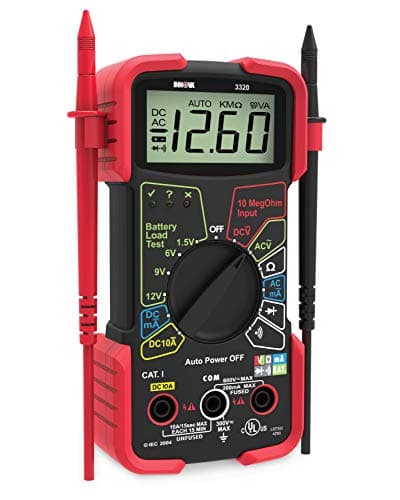
What matters practically is that extra current does not help here. A bigger jump pack produces the same single click. If you want to confirm it before paying anyone, measure voltage at the battery while a helper turns the key: a battery holding above roughly 10 volts during the attempt has delivered its side of the bargain, and the fault is downstream. That is a two-minute test with a basic meter.
Rapid clicking: not enough current
Fast repeated clicking is the solenoid chattering. It pulls in, the heavy contacts close, the starter motor's enormous inrush current drags system voltage down, the solenoid loses its grip and drops out, voltage recovers, and the whole cycle repeats several times a second. The cause is always the same category of thing: insufficient current at the solenoid.
- A discharged battery. Much the most common. It has enough charge to run the dash and click, nowhere near enough to crank. This is the fault a jump starter exists for.
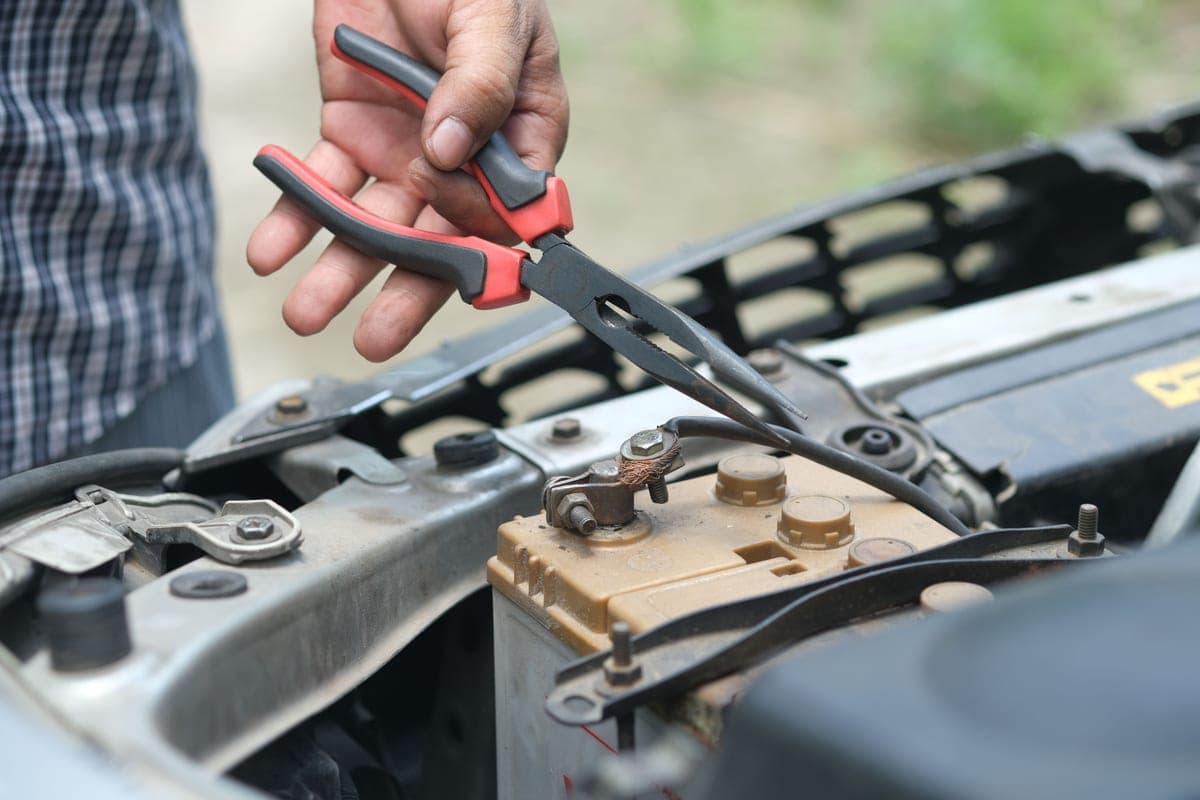
- A corroded or loose terminal. A connection that passes a few amps for the lights will not pass several hundred for the starter. Clean both posts and both clamps to bare metal and retighten.
- A bad engine or chassis ground. The return path matters as much as the feed. A corroded ground strap produces exactly this symptom with a healthy battery.
- An undersized jump pack. A 500-amp pack on a big V8 in the cold can chatter the solenoid rather than hold it. See what size jump starter do I need.
- A failing starter drawing too much. Less common, but a dragging motor can pull the system down far enough to chatter the solenoid on an otherwise good battery.
The voltage test that separates them
| Reading | Single loud click | Rapid clicking |
|---|---|---|
| Resting voltage, everything off | Usually normal — 12.4 V or above | Often low — 12.2 V or below |
| Voltage while attempting to start | Holds above about 10 V | Collapses well below 10 V |
| Does a jump starter help? | No — same click with any pack | Yes, usually immediately |
| Most likely fix | Starter or solenoid replacement | Charge or replace the battery; clean the connections |
Resting-voltage bands follow the state-of-charge table on our how to tell if a car battery is bad page. The cranking threshold is the standard field check, not a manufacturer specification for your vehicle.
If the clicking is rapid and the voltage collapses, you have both your diagnosis and your fix. Connect a pack, give it two or three minutes on the battery before cranking, and try again. Then — and this is the part people skip — find out why the battery was flat. A battery does not discharge for no reason, and the three usual answers are age, a parasitic drain, or an alternator that stopped charging.
Cold mornings make an honest battery click
Clicking that only happens on cold mornings and never in July is a battery nearing the end of its useful life, not a wiring fault. Cold works against you from both directions: the chemistry inside the battery slows down so it delivers less current, while the engine's oil thickens so the starter needs more. A battery with 60 percent of its original capacity is fine in summer and marginal at 10 degrees.
That is a replace-or-charge decision rather than a repair. Car battery dead in cold weather covers the seasonal version, and the best jump starters for cold weather covers the pack to keep in the car while you sort it out. If the car lives outside in winter, a maintainer is the cheap permanent fix — how long can you leave a battery maintainer on answers whether it can stay plugged in all season.
Clicks, then a new battery, and it still clicks
This is common enough to call out. A new battery that still produces rapid clicking almost always means the problem was never the battery: it is a cable, a terminal clamp or a ground strap. The giveaway is that the new battery reads full and still collapses under load. Clean every connection in the starting circuit — both battery posts, the clamp interiors, the engine ground strap and the starter feed where you can reach it — before buying anything else.
What to own
1. The five-minute diagnosis
INNOVA 3320 Digital Multimeter
INNOVA · Best for checking whether the battery is the problem
An auto-ranging meter is the difference between guessing and knowing whether you have a dead battery, a dead alternator or a parasitic drain.
This manufacturer does not publish a full specification table for this model on its own site. Rather than repeat figures we cannot source, the assessment below is limited to what the product category and the retailer listing genuinely establish.
What works
- Auto-ranging removes the main source of beginner error
- Reads resting and charging voltage, which is most of automotive electrical diagnosis
- Cheap enough that not owning one is hard to justify
What does not
- A voltage reading is not a load test — a battery can read 12.6 V and still fail under cranking load
- Entry-level leads are the weak point and are worth replacing
Skip it if
Not a scan tool. If you are chasing a check-engine light rather than an electrical fault, you want an OBD2 reader instead.
#ad Affiliate link · Price as of October 17, 2026
2. If the battery is just discharged
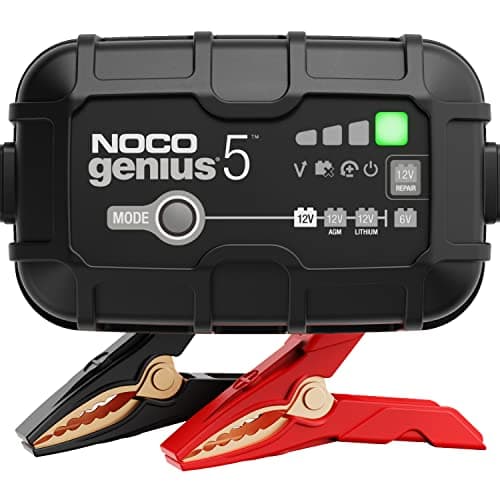
NOCO GENIUS5
NOCO · Best for one car, charging and maintaining
The single most useful charger for one vehicle: 5 amps, 6 V and 12 V, batteries up to 120 Ah, and it can be left connected indefinitely.
Published specifications
What works
- 5 A recharges a car battery overnight and then holds it — one unit does both jobs
- Rated down to -4 °F, so it works in an unheated garage
- The 77-inch cable reaches from a wall outlet to most engine bays without an extension
- 3-year warranty, against 1 year on the jump-starter line
What does not
- 5 A is slow for a deeply discharged large battery — a 100 Ah battery is an all-nighter
- The 120 Ah ceiling rules out larger deep-cycle banks
Skip it if
Not enough charger if you are reviving deep-cycle RV or marine batteries. Step up to the GENIUS10 and its 230 Ah range.
#ad Affiliate link · Price as of October 17, 2026
Raw specifications: NOCO’s own page for the NOCO GENIUS5.
3. The pack that ends the rapid clicking
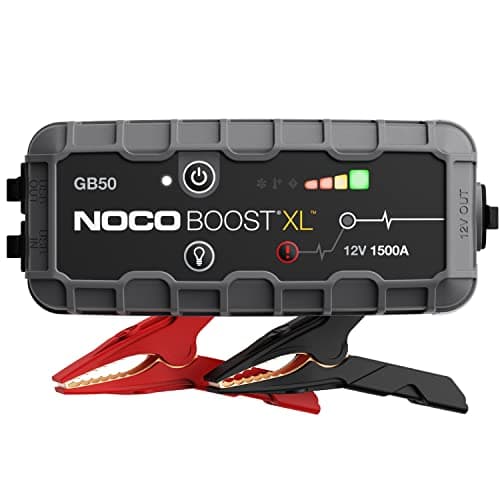
NOCO Boost Plus GB50
NOCO · Best for v6 and small v8 gas engines
The middle rung: 1,500 peak amps and 35 watt-hours for a quarter-pound more than the GB40, which is the cheapest headroom in the range.
Published specifications
What works
- A full liter more gas headroom than the GB40 for 0.26 lb more weight
- 35 Wh still clears the 100 Wh carry-on limit with room to spare
- Doubles the flashlight output over the GB40 at 200 lumens
What does not
- Overlaps awkwardly with the GBX45, which is lighter and charges over USB-C
- Still short of the 6.0 L diesel rating a modern diesel pickup wants
Skip it if
Skip it if convenience matters more than amps — the GBX45 is lighter and takes USB-C Power Delivery, and the GB50's edge is raw current.
#ad Affiliate link · Price as of October 17, 2026
Raw specifications: NOCO’s own page for the NOCO Boost Plus GB50.
Key takeaways
- One loud click with no rotation is the starter or solenoid. A bigger jump pack will not change it.
- Rapid clicking is insufficient current: a flat battery, a dirty connection, a bad ground, or an undersized pack.
- Measure voltage while cranking. Holding above about 10 volts points downstream; collapsing points at the battery or connections.
- Three attempts maximum on a single-click fault — repeated cranking makes it worse.
- With rapid clicking, leave the pack connected for two or three minutes before cranking again.
- Clicking only in cold weather is an aging battery, not a wiring fault.
- A new battery that still clicks means the fault is in the cables, clamps or ground strap.
How we sourced this
Every figure on this page came from one of the following. Where a manufacturer or regulator does not publish a number, we say so rather than estimate it.
Common questions
- Why does my car just click when I try to start it?
- The click is the starter solenoid. One loud click with no engine rotation means it engaged and the motor did not turn, which points at the starter. Rapid repeated clicking means there is not enough current to hold the solenoid in, which points at a discharged battery or a poor connection.
- Will a jump starter fix a clicking car?
- It fixes the rapid-clicking version, usually immediately, because that fault is a current shortage. It will not fix a single loud click — that is a mechanical or contact failure in the starter, and any pack produces the same click.
- Car clicks once and won't start — is that the starter?
- Most often, yes: a worn starter motor or burnt solenoid contacts. Confirm it by measuring battery voltage during the attempt. If the battery holds above roughly 10 volts and the engine still does not turn, the battery has done its part and the fault is downstream.
- Why does my car click on cold mornings only?
- Because cold cuts what the battery can deliver at the same time thick oil increases what the starter needs. A battery that is fine in summer can be marginal at 10 degrees. That is an aging battery telling you its remaining capacity, not a fault in the wiring.
- New battery and the car still clicks. Why?
- Because the battery was not the problem. Rapid clicking with a known-good battery means the current is being lost on the way to the starter: corroded battery posts, a loose clamp, or a bad engine ground strap. Clean and tighten every connection in the starting circuit.
More in Jump Starters
A jump pack is the one trunk tool that turns a tow truck into a five-minute inconvenience. This is how to size one, and which ones are worth the space.
Read next
Troubleshooting
Won't Start After a Jump
The diagnostic order for a car that will not start even with a working jump pack on it — sorted by the noise it makes when you turn the key.
Guide
Is the Battery Bad?
The resting-voltage table, the cranking and charging checks, and how to tell a failed battery from a failing alternator or a parasitic drain.
Guide
Will It Start a Dead Battery?
The difference between a discharged battery and a failed one, what a pack can and cannot do about each, and how to tell which you have.
Guide
Dead Battery in the Cold
The mechanism behind winter no-starts, why a new battery can still fail, and the cheap prevention that works better than a bigger jump pack.
Found something out of date, or a figure you can source better than we did? Tell us — corrections get read first. Our methodology explains how picks are made, and contact is one click away.