Jump Starters
Do jump starters go bad?
A jump starter is a battery, and batteries age whether you use them or not. Two habits decide whether yours lasts three years or ten.

Disclosure: we earn a commission if you buy through the Amazon links on this page, at no extra cost to you. Commission never decides a verdict or a ranking position — read our editorial policy and affiliate disclosure.
Short answer
Yes. Jump starters go bad in two ways: they self-discharge until they are flat when you need them, and their cells age permanently. Heat drives both. A lithium pack stored in a cool cabin and topped up two to four times a year lasts years; the same pack baked in a trunk all summer loses capacity it never gets back.
The uncomfortable thing about a jump starter is that it is an insurance policy made out of a battery. You buy it, put it away, and find out whether it worked on the worst morning of the year. Two completely different failures can be waiting for you at that moment, and they need different habits to prevent.
Failure one: it is simply flat
Every battery loses charge sitting still. Lithium packs are good at this — a quality lithium pack holds a usable charge for many months — and lead-acid stations are poor at it, which is the single biggest practical difference between the two chemistries for a tool that spends its life waiting. NOCO publishes that its Boost packs hold a charge for up to a year in storage, which is a generous figure in this category and still not a license to forget about it.
The reason it is not a license to forget is that the shelf is not the hard case. The hard case is a pack that gets used to charge a phone twice, left at two bars, and then asked to crank a cold V6 in January. Self-discharge plus casual use plus cold is how a pack that was fine in September is useless in February. How to charge a jump starter sets out the interval, and the short version is: top it up when the clocks change and whenever you have used it for anything.
Failure two: the cells have aged
This one is permanent and you cannot charge your way out of it. Lithium cells lose capacity over time through calendar aging, and the rate depends overwhelmingly on temperature and on the state of charge they are held at. A pack stored warm and full ages fastest; a pack stored cool and around the middle of its range ages slowest. That is the physics behind every piece of storage advice on this page.
You can see the manufacturers acknowledging it in their published operating ranges. Fanttik publishes a 14 to 113 degree Fahrenheit operating range for its X8 Apex inflator — the same lithium chemistry — and NOCO publishes its own operating ranges for the Boost packs. A tool rated to 113 degrees is not a tool to leave on a parcel shelf in Arizona in July, and the cabin of a closed car in summer sun goes well past that. Jump starter storage and heat is the page that works this through properly.
| Lithium pack | Lead-acid station | |
|---|---|---|
| Self-discharge on a shelf | Slow — months of usable charge | Fast — weeks to a few months |
| Effect of a hot trunk | Permanent capacity loss | Mostly accelerated self-discharge |
| Effect of being stored flat | Can become unrecoverable | Sulfation, which is also permanent |
| Weight for the same starting ability | Much lighter | Much heavier |
| Recharge habit needed | Two to four times a year | Monthly, or on a maintainer |
This is our summary of how the two chemistries behave in this specific application, built from manufacturer storage guidance and published operating ranges — see Sources. It is not a bench test.
The four things that actually kill packs
- Heat. By a wide margin the biggest factor. A trunk in summer sun is the worst storage location in the car and it is where most packs live.
- Being stored flat. A lithium pack run down and then left for a year can drop below the voltage its protection circuit will accept, at which point it will not take a charge at all. A lead-acid station left flat sulfates. Either way, store it charged.
- Using it as a power bank. Charging a phone from a jump pack is a feature, and it is also how packs end up at 20 percent on the day they are needed. If you want a power bank, buy a power bank — or buy a pack with the reserve to be both, like the GBX155 in the best jump starter power bank.
- Deep cold at the moment of use. Cold does not permanently damage the pack, but it temporarily cuts what the pack can deliver, exactly when the engine wants more. That is a sizing problem rather than an aging problem — see the best jump starters for cold weather.
How to tell if yours has gone bad
There is no test as clean as the one for a car battery, but there are three useful signals. First, charge it fully and check it a month later: a pack that has dropped two or more bars in a month is self-discharging abnormally. Second, watch how long a full charge takes — a pack that reaches full far faster than it used to has lost capacity. Third, and most telling, note what happens under load: a pack that lights up, shows full, and then cannot hold the solenoid in has lost its ability to deliver current, which is the thing you were buying.
If any of those apply, the honest answer is to replace it rather than carry it. A pack you do not trust is worse than no pack, because it is the reason you did not make another plan. Why won't my jump starter work goes through the recoverable faults first, which is the right order — some apparent failures are a flat pack, a sleeping protection circuit or a clamp fault rather than a dead pack.
The maintenance routine, in full
- Store the pack in the cabin — a glovebox, a seat-back pocket, a door bin — not the trunk, and not on the parcel shelf in the sun.
- Top it up two to four times a year. Tie it to something you already remember, like the clock change or an oil service.
- Recharge it immediately after any use, including phone charging, rather than putting it back at two bars.
- Never store it flat over a winter or a summer.
- If it is lead-acid, put it on a maintainer or charge it monthly. Self-discharge is the dominant failure mode for that chemistry.
- Check the clamps when you charge it. A corroded clamp fails the same way a dead cell does.
The picks
1. The pack that ages best in practice
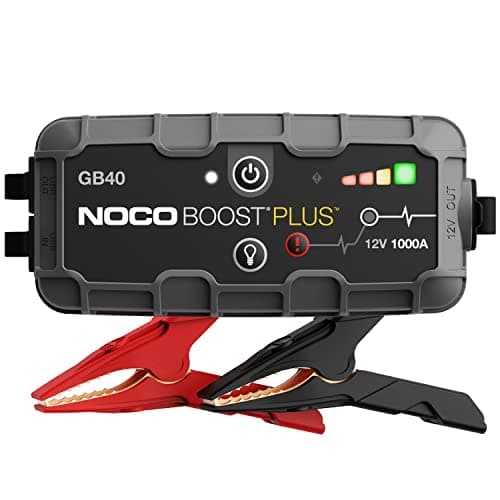
NOCO Boost Plus GB40
NOCO · Best for most cars and small suvs
The default answer for a four- or six-cylinder car: 1,000 peak amps, 24 watt-hours, and light enough that it actually stays in the trunk.
Published specifications
What works
- 24 Wh sits far under the 100 Wh carry-on threshold, so flying with it needs no airline approval
- 2.45 lb and pocketable — the size that decides whether a tool is still in the trunk six months later
- IP65 enclosure, so a wet shoulder in the rain is not a problem
- Reverse-polarity protection means a backwards clamp does not spark
What does not
- 1,000 peak amps runs out of headroom above a 6.0 L gas engine
- The 3.0 L diesel ceiling rules out most modern diesel pickups
- 24 Wh is a small reserve — it is a jump starter, not a power bank substitute
Skip it if
Not the one to buy if you drive a diesel pickup or a big V8. You would be at the edge of its rating on a cold morning, which is exactly when you want margin.
#ad Affiliate link · Price as of October 17, 2026
Raw specifications: NOCO’s own page for the NOCO Boost Plus GB40.
2. Easiest to actually keep charged
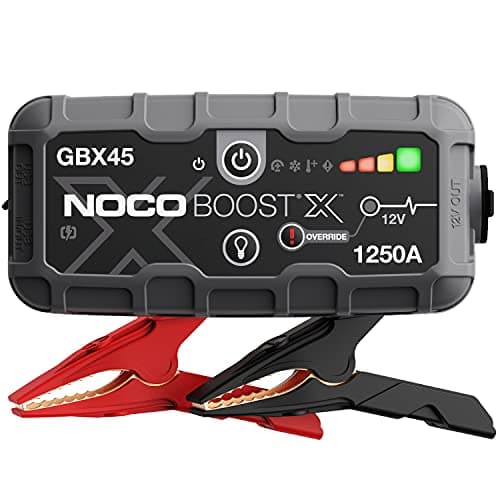
NOCO Boost X GBX45
NOCO · Best for travel and carry-on use
The travel pick: 1,250 peak amps at 2.16 lb with USB-C Power Delivery in and out, so it recharges from the same brick as your laptop.
Published specifications
- Peak amps
- 1,250 A source
- Internal battery
- 31 Wh lithium-ion source
- Gas engine rating
- Up to 6.5 liters source
- Diesel engine rating
- Up to 4.0 liters source
- Weight
- 2.16 lb (0.98 kg) source
- USB-C output
- Up to 20 V / 3 A Power Delivery source
- Water resistance
- IP65 with ports closed source
- Warranty
- 1-year hassle-free source
What works
- Lightest pack in the range at 2.16 lb, and 31 Wh means no airline paperwork
- USB-C Power Delivery both directions — one cable covers the pack, phone and laptop
- More gas headroom than the GB40 (6.5 L against 6.0 L) in a lighter body
What does not
- The IP65 rating only holds with the port covers closed — worth remembering in the rain
- The 4.0 L diesel ceiling is not enough for a full-size diesel pickup
Skip it if
Not the right pack for a diesel truck, and not the cheapest way to cover a small commuter — its premium buys packability, not amps.
#ad Affiliate link · Price as of October 17, 2026
Raw specifications: NOCO’s own page for the NOCO Boost X GBX45.
3. The heat-tolerant alternative
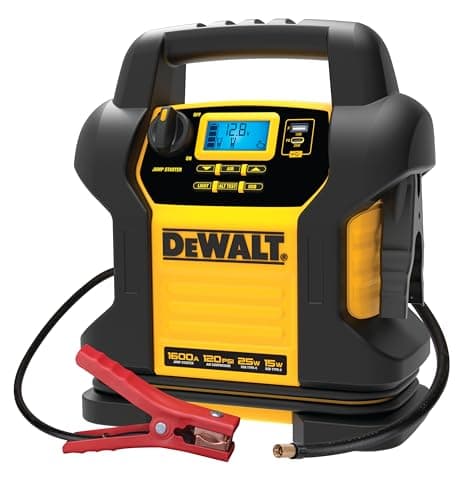
DEWALT DXAEJ14 Power Station
DEWALT · Best for one box that jumps and inflates
A lead-acid jump station with a built-in 120 PSI digital compressor and USB-A plus USB-C power — the combo box for people who would rather carry one heavy thing than two light ones.
Published specifications
- Jump starting
- 1,600 peak amps, rated to start most 4-, 6- and 8-cylinder engines source
- Air compressor
- 120 PSI digital, with AUTOSTOP source
- USB output
- USB-A 15 W and USB-C 25 W source
- Battery types
- 12 V lead-acid: wet, gel and AGM source
- Diagnostics
- Alternator Check, plus reverse-polarity protection source
- In the box
- Clamps and cables, sports needle adapter source
What works
- Jump starter, 120 PSI compressor and USB-A/USB-C power in a single case
- 1,600 peak amps is rated for 4-, 6- and 8-cylinder engines
- Lead-acid chemistry is untroubled by living in a hot trunk
- Alternator Check tells you whether the jump was the problem or the symptom
What does not
- Heavy and bulky next to any lithium pack — the usual reason combo boxes end up in the garage
- Lead-acid self-discharges, so it needs topping up on a schedule or it is flat when you need it
- The built-in compressor is a convenience feature, not a match for a dedicated inflator's duty cycle
- DEWALT's licensee publishes no weight, cable gauge, battery capacity or compressor duty cycle for this unit
Skip it if
Not for anyone whose priority is packed size or carry-on travel. If the tool has to fit a door pocket or a suitcase, buy a lithium pack and a separate inflator.
#ad Affiliate link · Price as of October 17, 2026
Key takeaways
- Packs fail two ways: self-discharged flat, and permanently aged. Heat causes both.
- A quality lithium pack holds usable charge for many months; lead-acid stations need monthly attention.
- Store it charged, cool and in the cabin — not in a summer trunk, and never flat.
- Using the pack as a phone charger is the most common reason it is at two bars when needed.
- Top up two to four times a year, and always straight after any use.
- A pack that charges much faster than it used to has lost capacity.
- A pack you do not trust is worse than no pack. Replace it.
How we sourced this
Every figure on this page came from one of the following. Where a manufacturer or regulator does not publish a number, we say so rather than estimate it.
- NOCO GB40 published specifications
- NOCO Boost Plus GB40 product page — jump starts per charge and USB recharge time
- NOCO Boost X GBX45 product page — USB-C Power Delivery recharge times
- Fanttik X8 APEX tire inflator published specifications
- DEWALT DXAEJ14 published product information (Baccus Global, DEWALT licensee)
- ODYSSEY Battery — frequently asked questions (winter storage, parasitic drain, maintainer use)
Common questions
- Do jump starters go bad if you never use them?
- Yes. Lithium cells lose capacity through calendar aging whether you use them or not, and the pack also self-discharges on the shelf. Temperature and storage charge level drive the rate, which is why a cool cabin and a twice-yearly top-up matter more than how often you use it.
- How long does a jump starter hold its charge?
- NOCO publishes up to a year of storage charge for its Boost packs, which is at the good end of the category. In practice the limiting factor is not the shelf but casual use — a pack used to charge phones and put back part-full is the one that disappoints in January.
- How often should I charge my jump starter?
- Two to four times a year if it is lithium and untouched, plus immediately after any use. If it is a lead-acid station, charge it monthly or keep it on a maintainer, because that chemistry self-discharges far faster.
- Is it bad to leave a jump starter in the car?
- Leaving it in the cabin is fine and is where it should be. Leaving it in a trunk or on a parcel shelf through a hot summer is what costs you capacity permanently — lithium tools carry published operating ranges in the low 100s of degrees Fahrenheit, and a closed car in the sun exceeds that.
- Can a dead jump starter be revived?
- Sometimes. A pack that has simply gone flat usually recovers on a normal charge, and many packs have a manual override for a battery too low to be detected. A lithium pack left fully discharged for a long time can fall below what its protection circuit will accept, and that one is finished.
More in Jump Starters
A jump pack is the one trunk tool that turns a tow truck into a five-minute inconvenience. This is how to size one, and which ones are worth the space.
Read next
Guide
Storage and Heat
Why a hot trunk permanently costs a lithium pack capacity, where to store it instead, and the one case where lead-acid genuinely wins.
How to
How to Charge One
Charging methods and times, how often to top up, and why a pack that sat in a hot car all summer needs checking before winter.
Troubleshooting
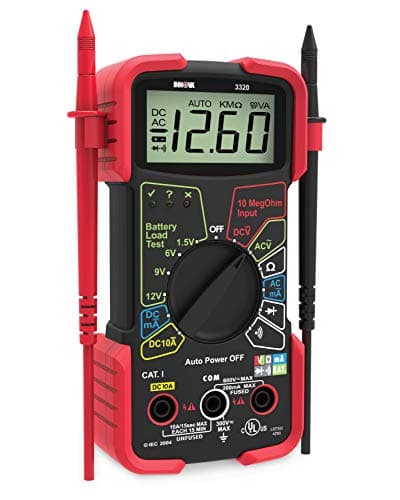
Jump Starter Not Working
A symptom-by-symptom walk through the common failures, and how to tell a dead pack from a pack that is refusing to engage on purpose.
Best brand overall
Best Brands
A brand-by-brand read on NOCO, DEWALT, STANLEY and the high-claim budget tier, ranked by how much of their spec sheet is actually published.
Found something out of date, or a figure you can source better than we did? Tell us — corrections get read first. Our methodology explains how picks are made, and contact is one click away.