Jump Starters
NOCO GB40 vs GB50
A quarter of a pound buys a full extra liter of gas headroom and half again the stored energy. Whether that is a bargain depends on one thing under your hood.

Disclosure: we earn a commission if you buy through the Amazon links on this page, at no extra cost to you. Commission never decides a verdict or a ranking position — read our editorial policy and affiliate disclosure.
How we assessed these: this comparison is built from NOCO's published specifications and current retailer listings, not from hands-on testing of both packs on the same engine. Figures we cannot source, we leave out.
Short answer
Buy the GB40 for a gas engine comfortably under 6.0 liters. Buy the GB50 if you are at or near that ceiling — a 6.2 L V8, a 4.0 L to 4.5 L diesel, or a cold climate — because 1,500 peak amps and a 7.0 L gas rating cost only 0.26 lb more. If packability and USB-C matter more than raw amps, the GBX45 beats both.
The GB50 is the quietest product in NOCO's Boost range. It gets less attention than the GB40 below it and the GB70 above it, and it has no review page of its own anywhere on this site, which is exactly why it is worth a page: on paper it is the best value in the lineup, and on paper is also where its problem lives, because the GBX45 sits in almost the same place for a different reason.
This page is the narrow question. If your decision is really "compact pack or diesel pack," read GB40 versus GB70 instead — that is the big either/or, and the engine ratings settle it quickly. What follows is for people who have already decided they want a compact lithium pack and are now staring at three of them.
The specs, side by side
| Specification | GB40 | GB50 | GBX45 |
|---|---|---|---|
| Starting current | 1,000 A peak | 1,500 A peak | 1,250 A peak |
| Internal battery | 24 Wh | 35 Wh | 31 Wh |
| Gas engine rating | Up to 6.0 L | Up to 7.0 L | Up to 6.5 L |
| Diesel engine rating | Up to 3.0 L | Up to 4.5 L | Up to 4.0 L |
| Weight | 2.45 lb | 2.71 lb | 2.16 lb |
| Flashlight | 100 lumens | 200 lumens | Not published as a lumen figure |
| Recharging | USB | USB | USB-C Power Delivery, in and out |
| Water resistance | IP65 | IP65 | IP65 with ports closed |
| Warranty | 1 year | 1 year | 1 year |
| Flies in carry-on | Yes (24 Wh) | Yes (35 Wh) | Yes (31 Wh) |
Figures are NOCO's own published specifications for each model, linked in Sources. The GBX45 column is here because it overlaps this comparison rather than sitting outside it.
What 0.26 lb actually buys
Going from the GB40 to the GB50 costs you 0.26 lb — about the weight of a phone — and buys three things NOCO publishes: 500 more peak amps, 11 more watt-hours of stored energy, and a full extra liter of gas engine rating. The flashlight also doubles from 100 to 200 lumens, which sounds like a throwaway spec until you are under a hood at night.
Of those, the engine rating is the one that should drive the decision, because it is NOCO's own statement about what the pack is for. Peak amps is a headline figure measured under conditions nobody can reproduce roadside; the liter rating is the manufacturer translating that into something you can check against your own car. Peak amps versus cranking amps explains why we weight it that way.
The 11 extra watt-hours matter in a second-order way: more stored energy means more starting attempts before the pack needs a recharge. On a warm day with a healthy battery you need one attempt. On a cold morning with a tired battery you might need three, and that is the scenario the capacity is for. Will a jump starter start a dead battery covers when more attempts help and when they do not.
The rule that decides it
Find your engine's displacement and fuel type on the label under the hood or in the manual, then find your line:
- Gas, up to about 5.0 L — GB40. You are well inside its 6.0 L rating with margin to spare, and the smaller, lighter pack is the one that stays in the car.
- Gas, 5.0 to 6.0 L — GB50, if you want margin. The GB40 covers it on paper; the GB50 means you are not sitting at the ceiling on the worst morning of the year.
- Gas, 6.0 to 7.0 L — GB50. A 6.2 L V8 is past the GB40's published rating, and this is the lightest pack in the range that covers it.
- Gas, above 7.0 L — neither. That is GB70 territory, at an 8.0 L rating.
- Diesel, up to 3.0 L — the GB40 covers it on paper and we would still buy the GB50. A small diesel at the GB40's exact ceiling has nothing left in reserve.
- Diesel, 3.0 to 4.5 L — GB50. This is the clearest case in the whole comparison.
- Diesel above 4.5 L, or any full-size diesel pickup — neither. Buy the GB70 and stop reading. The best jump starters for diesel trucks is the page for that.
The complication: the GBX45 sits in the same place
If this were just GB40 against GB50, the GB50 would win most of the arguments. It is not, because the GBX45 covers 6.5 liters of gas and 4.0 liters of diesel at 2.16 lb — lighter than the GB40, let alone the GB50 — and recharges over USB-C Power Delivery in both directions, so it takes the same brick as a modern laptop and will charge a phone back.
That reshapes the decision into two different questions rather than one. If what you want is amps and diesel rating, the GB50 is ahead: 1,500 A and 4.5 L diesel against 1,250 A and 4.0 L. If what you want is a pack that travels, the GBX45 is ahead on every axis that matters for travel — weight, charging and packed size. GBX45 versus GB40 takes that comparison on its own terms, and the best jump starter for travel is the wider field.
Our honest read: the GB50 is the better buy for a vehicle that stays in one region and might be a truck; the GBX45 is the better buy for a person who flies, drives rentals, or wants one charger for everything. The GB40 remains the right answer for the large middle of the market — a gas four or V6 that lives near home.
What is identical, and therefore not a tiebreaker
All three are IP65-rated, though NOCO qualifies the GBX45's rating as holding with the port covers closed. All three carry NOCO's reverse-polarity protection, which is the real safety advantage over jumper cables and the reason a backwards clamp does not produce a shower of sparks. All three carry the same one-year hassle-free warranty.
And all three are comfortably under the FAA's 100 watt-hour carry-on threshold at 24, 35 and 31 watt-hours, so none of them is harder to fly with than the others. Lithium jump starters must travel in carry-on rather than checked baggage, which is a rule about the chemistry and not about these particular models. Flying with a jump starter has the detail.
Three reasons to buy the GB40 anyway
- Your engine is nowhere near the ceiling. A 2.0 L four-cylinder does not care that the GB50 could start a 7.0 L V8. Buying headroom you will never draw is paying for a number.
- Size is the feature. 2.45 lb goes in a door pocket or a seat-back organizer. The reason people end up stranded next to a jump starter is that the jump starter is in the garage, and the smallest pack that covers your engine is the one most likely to be in the car.
- It is the most common pack in the range, which means accessories, cables and replacement clamps are easy to find. That is a small thing until you need it.
Two reasons to buy neither
First, if you drive a diesel pickup. Both of these packs are below what a 6.7 L truck engine wants, and buying at the edge of a rating is how people end up stranded twice. Second, if your battery is the actual problem rather than your luck. A pack that gets used monthly is a pack papering over a failing battery, and the fix is a charger or a replacement. How to tell if a car battery is bad is the five-minute test, and the best car battery chargers is the other half of the answer.
The picks
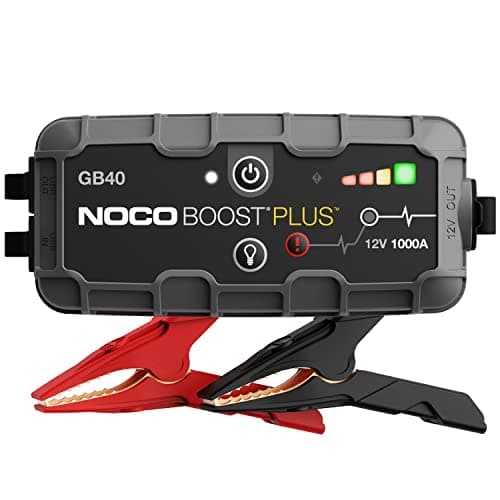
1. Enough for most drivers
NOCO Boost Plus GB40
NOCO · Best for most cars and small suvs
The default answer for a four- or six-cylinder car: 1,000 peak amps, 24 watt-hours, and light enough that it actually stays in the trunk.
Published specifications
What works
- 24 Wh sits far under the 100 Wh carry-on threshold, so flying with it needs no airline approval
- 2.45 lb and pocketable — the size that decides whether a tool is still in the trunk six months later
- IP65 enclosure, so a wet shoulder in the rain is not a problem
- Reverse-polarity protection means a backwards clamp does not spark
What does not
- 1,000 peak amps runs out of headroom above a 6.0 L gas engine
- The 3.0 L diesel ceiling rules out most modern diesel pickups
- 24 Wh is a small reserve — it is a jump starter, not a power bank substitute
Skip it if
Not the one to buy if you drive a diesel pickup or a big V8. You would be at the edge of its rating on a cold morning, which is exactly when you want margin.
#ad Affiliate link · Price as of October 16, 2026
Raw specifications: NOCO’s own page for the NOCO Boost Plus GB40.
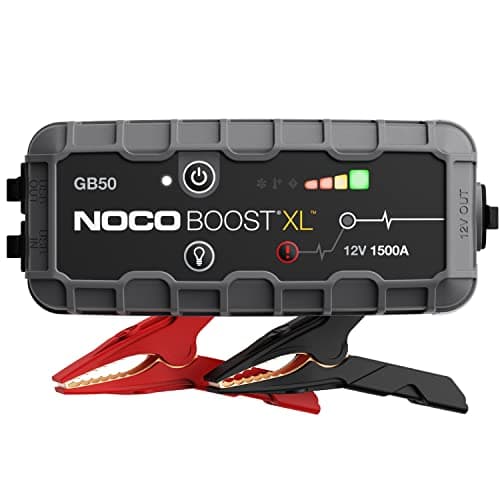
2. The cheapest headroom in the range
NOCO Boost Plus GB50
NOCO · Best for v6 and small v8 gas engines
The middle rung: 1,500 peak amps and 35 watt-hours for a quarter-pound more than the GB40, which is the cheapest headroom in the range.
Published specifications
What works
- A full liter more gas headroom than the GB40 for 0.26 lb more weight
- 35 Wh still clears the 100 Wh carry-on limit with room to spare
- Doubles the flashlight output over the GB40 at 200 lumens
What does not
- Overlaps awkwardly with the GBX45, which is lighter and charges over USB-C
- Still short of the 6.0 L diesel rating a modern diesel pickup wants
Skip it if
Skip it if convenience matters more than amps — the GBX45 is lighter and takes USB-C Power Delivery, and the GB50's edge is raw current.
#ad Affiliate link · Price as of October 16, 2026
Raw specifications: NOCO’s own page for the NOCO Boost Plus GB50.
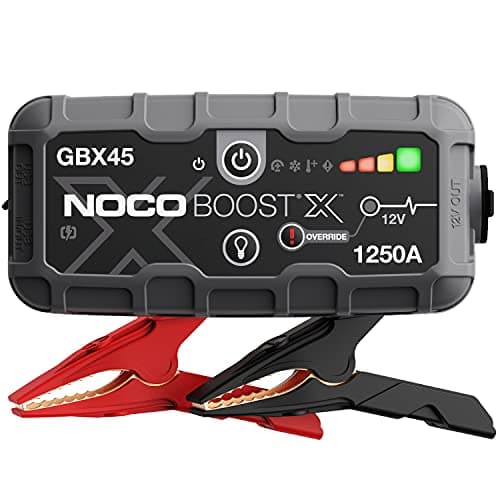
3. The option that complicates the choice
NOCO Boost X GBX45
NOCO · Best for travel and carry-on use
The travel pick: 1,250 peak amps at 2.16 lb with USB-C Power Delivery in and out, so it recharges from the same brick as your laptop.
Published specifications
- Peak amps
- 1,250 A source
- Internal battery
- 31 Wh lithium-ion source
- Gas engine rating
- Up to 6.5 liters source
- Diesel engine rating
- Up to 4.0 liters source
- Weight
- 2.16 lb (0.98 kg) source
- USB-C output
- Up to 20 V / 3 A Power Delivery source
- Water resistance
- IP65 with ports closed source
- Warranty
- 1-year hassle-free source
What works
- Lightest pack in the range at 2.16 lb, and 31 Wh means no airline paperwork
- USB-C Power Delivery both directions — one cable covers the pack, phone and laptop
- More gas headroom than the GB40 (6.5 L against 6.0 L) in a lighter body
What does not
- The IP65 rating only holds with the port covers closed — worth remembering in the rain
- The 4.0 L diesel ceiling is not enough for a full-size diesel pickup
Skip it if
Not the right pack for a diesel truck, and not the cheapest way to cover a small commuter — its premium buys packability, not amps.
#ad Affiliate link · Price as of October 16, 2026
Raw specifications: NOCO’s own page for the NOCO Boost X GBX45.
Whichever you buy, keep it charged and keep it in the car. NOCO's packs hold charge well, but a lithium pack left in a hot trunk for two summers is not the pack you bought — jump starter storage and heat covers what that costs, and how to charge a jump starter covers the maintenance habit. If winter is your concern, the cold-weather tire inflator roundup is the other tool the same mornings call for.
Key takeaways
- The GB50 costs 0.26 lb over the GB40 and buys 500 more peak amps, 11 more watt-hours and a full extra liter of gas rating.
- Decide on NOCO's published engine ratings, not on peak amps.
- GB40 for gas comfortably under 6.0 L; GB50 at or near the ceiling, for a 6.2 L V8, or for a 3.0 to 4.5 L diesel.
- In a cold climate, move one step up from whatever your engine strictly requires.
- The GBX45 complicates it: lighter than both, 6.5 L gas, USB-C in and out — the travel pick.
- Neither pack is enough for a full-size diesel pickup; that is the GB70's job.
- All three are under the 100 Wh carry-on limit, so flying is not a tiebreaker.
How we sourced this
Every figure on this page came from one of the following. Where a manufacturer or regulator does not publish a number, we say so rather than estimate it.
Common questions
- Is the NOCO GB50 worth it over the GB40?
- If your engine is at or near the GB40's 6.0-liter gas ceiling, or is a diesel between 3.0 and 4.5 liters, yes — 0.26 lb is a very small price for a full extra liter of rating and 500 more peak amps. For a four-cylinder commuter, no: that is headroom you will never draw.
- What is the difference between the NOCO GB40 and GB50?
- NOCO publishes 1,000 peak amps, 24 watt-hours, 6.0 liters gas and 3.0 liters diesel for the GB40, against 1,500 peak amps, 35 watt-hours, 7.0 liters gas and 4.5 liters diesel for the GB50. The GB50 also doubles the flashlight to 200 lumens and weighs 0.26 lb more.
- Can the NOCO GB40 start a V8?
- A gas V8 under 6.0 liters, yes — that covers most 4.6 L, 5.0 L and 5.7 L engines. A 6.2 L V8 is past the GB40's published rating, and that specific engine is the clearest case for the GB50.
- GB50 or GBX45 — which should I buy?
- The GB50 if you want amps and diesel capability: 1,500 A and a 4.5-liter diesel rating against the GBX45's 1,250 A and 4.0 liters. The GBX45 if you want a pack that travels: it is 0.55 lb lighter and recharges over USB-C Power Delivery, so one laptop charger covers it.
- Will the GB50 start a diesel truck?
- Not a full-size one. NOCO rates the GB50 to 4.5 liters of diesel, and common light-truck diesels are 3.0 L and 6.7 L — the big one is well past it. For that, the GB70 publishes a 6.0-liter diesel rating, and buying at the edge of a rating is how people end up needing a second jump.
More in Jump Starters
A jump pack is the one trunk tool that turns a tow truck into a five-minute inconvenience. This is how to size one, and which ones are worth the space.
Read next
Head to head
GB40 vs GB70
The head-to-head most buyers actually face. Published specs side by side, and a clear rule for which side of the line you are on.
Head to head
GBX45 vs GB40
Both start the same cars. The real difference is how fast each one refills and what else it can charge — which matters only if you are away from home.
Guide
What Size Do I Need?
The sizing table by engine displacement and fuel type, using ratings manufacturers publish and warrant rather than peak-amp marketing.
Best Portable Jump Starters
Best Portable Jump Starters
Our main roundup: five packs from compact to heavy-duty, ranked on the engine rating the manufacturer will actually stand behind.
Found something out of date, or a figure you can source better than we did? Tell us — corrections get read first. Our methodology explains how picks are made, and contact is one click away.