Battery Chargers
Can you charge a car battery without disconnecting it?
The advice to pull the terminals dates from an era of unregulated chargers. With a smart charger the answer is simply yes, with two exceptions.

Disclosure: we earn a commission if you buy through the Amazon links on this page, at no extra cost to you. Commission never decides a verdict or a ranking position — read our editorial policy and affiliate disclosure.
Short answer
Yes. With a modern microprocessor-controlled charger you can charge a car battery with both terminals still connected, and that is the normal way to do it. The old advice to disconnect comes from unregulated chargers that could push voltage high enough to trouble a car's electronics. Disconnect only for a bench charge or if your manual says so.
This question has a long tail of conflicting answers, and the reason is that it had a different answer thirty years ago. The chargers in most garages then were simple transformers with no feedback loop: they put out whatever they put out, which on a nearly-full battery could drift to a voltage a modern car's control modules would not appreciate. Pulling the negative terminal isolated the car and made that risk somebody else's problem.
What changed
Smart chargers regulate. A charger like the GENIUS5 or GENIUS10 runs a multi-stage profile — it measures the battery, applies a bulk charge, tapers through absorption, then holds a float voltage — and it never applies a voltage outside the band the battery and the vehicle are designed for. NOCO publishes 6-volt and 12-volt operation, capacity ranges of 120 and 230 amp-hours respectively, and a thermal sensor that adjusts for ambient temperature. That is a fundamentally different device from a 1990s trickle charger.
The result is that charging in place is both safe and preferable for most people most of the time. It is faster, because you are not undoing and redoing terminals. It avoids disturbing connections that were working, which is a real risk — a terminal clamp that gets loosened and reseated slightly wrong is a future no-start. And it avoids the thing nobody mentions, which is losing the car's stored settings.
The real cost of disconnecting a modern car
- Stored settings and learned values. Radio presets, seat positions, clock, and in some cars the transmission and idle learning. Most cars relearn in a few drives; some are more annoying about it than that.
- Security and key systems. A few vehicles want a procedure after a power interruption. Your manual is the authority, and that is the one place a disconnect can cost you an afternoon.
- The terminal itself. Battery terminals corrode, bolts round off, and lead posts deform. Every disconnection is a chance to make a connection worse. Should you disconnect a car battery when storing weighs this up for long-term storage, where the arithmetic is different.
- Your own time. The charge takes the same number of hours either way. The disconnection is pure overhead.
Where to clamp when you charge in place
Red to the positive post, then black to the negative post or to a clean unpainted engine ground, then plug the charger into the wall — in that order. Unplug the charger from the wall first when you are done, before touching the clamps. The reason for the order is that you never want to make or break a connection at a battery while the charger is energized, because that is the moment that can produce a spark near a battery that may be venting hydrogen.
| Connected in the car | Disconnected | |
|---|---|---|
| Typical use | Routine charging and maintaining | Bench charge, a battery out of the vehicle, or a service procedure |
| Smart charger safe? | Yes | Yes |
| Old unregulated charger safe? | Not advisable | Yes |
| Vehicle settings | Preserved | Often lost |
| Parasitic drain during charge | Present, which the charger absorbs | None |
| Risk introduced | Essentially none with a smart charger | A disturbed terminal connection |
Our summary of the trade-off for a modern vehicle and a modern charger. Your own owner's manual overrides this table for your specific car.
Does parasitic drain matter while charging?
Barely, and it is worth saying why. A connected modern car draws a small continuous current — alarm, keyless entry, body modules dozing — typically a fraction of an amp. A 5-amp charger absorbs that without noticing. It is only an issue at the other end of the scale: a 0.75-amp maintainer on a car with an unusually heavy drain may end up treading water rather than charging, which is a sizing problem rather than a connected-or-not problem.
If you suspect a genuine parasitic drain — a car that goes flat in a week without being driven — charging it in place forever is treating a symptom. How long can a car sit before the battery dies sets out the normal timescale, and how to tell if a car battery is bad separates a drain from a failing battery.
Can you leave it connected afterward?
If it is a maintainer, yes, indefinitely — that is the whole design intent. The Battery Tender Plus pushes 1.25 amps, handles automotive batteries up to 80 amp-hours and carries a published 10-year warranty, which tells you something about what the manufacturer expects it to be doing for the next decade. A smart charger in float mode behaves the same way, holding the battery at a safe voltage and doing nothing when it is not needed.
That is the real answer for a car that sits — a second vehicle, a weekend car, a winter layup. Leave a maintainer on it, connected, in place, and the problem disappears. How long can you leave a battery maintainer on answers the obvious worry, and battery charger versus maintainer explains which of the two you are actually buying.
The picks

1. Best for one car, in place
NOCO GENIUS5
NOCO · Best for one car, charging and maintaining
The single most useful charger for one vehicle: 5 amps, 6 V and 12 V, batteries up to 120 Ah, and it can be left connected indefinitely.
Published specifications
What works
- 5 A recharges a car battery overnight and then holds it — one unit does both jobs
- Rated down to -4 °F, so it works in an unheated garage
- The 77-inch cable reaches from a wall outlet to most engine bays without an extension
- 3-year warranty, against 1 year on the jump-starter line
What does not
- 5 A is slow for a deeply discharged large battery — a 100 Ah battery is an all-nighter
- The 120 Ah ceiling rules out larger deep-cycle banks
Skip it if
Not enough charger if you are reviving deep-cycle RV or marine batteries. Step up to the GENIUS10 and its 230 Ah range.
#ad Affiliate link · Price as of October 17, 2026
Raw specifications: NOCO’s own page for the NOCO GENIUS5.

2. Best for several vehicles
NOCO GENIUS10
NOCO · Best for several vehicles or a deep-cycle bank
Twice the current of the GENIUS5 and nearly twice the capacity range — 10 amps up to 230 Ah, which is where RV, marine and multi-vehicle households land.
Published specifications
What works
- 10 A halves the charge time on a flat car battery against a 5 A unit
- The 230 Ah range covers deep-cycle RV and marine batteries the GENIUS5 cannot
- Same -4 °F cold rating and 3-year warranty as the smaller GENIUS units
What does not
- 10 A into a small motorcycle battery is more current than it wants — use a 1 A or 2 A unit there
- Heavier and pricier than a GENIUS5 for a household with one car
Skip it if
Not the right charger for a single motorcycle, ATV or lawn-tractor battery. Small batteries want small current.
#ad Affiliate link · Price as of October 17, 2026
Raw specifications: NOCO’s own page for the NOCO GENIUS10.
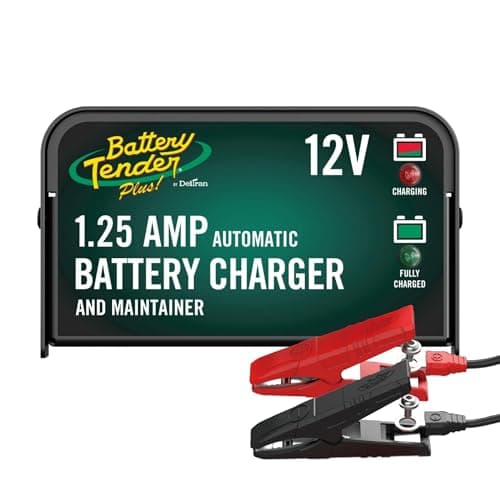
3. Best to leave connected long-term
Battery Tender Plus 12V 1.25A
Battery Tender · Best for long-term storage on a car battery
The storage-maintainer benchmark: 1.25 amps, automotive batteries up to 80 Ah, a four-step program and a 10-year warranty behind it.
Published specifications
What works
- A 10-year warranty is the longest in this category by a wide margin
- 1.25 A is low enough to leave connected through a winter without heat build-up
- Covers flooded, AGM and gel without a chemistry switch to get wrong
What does not
- 1.25 A is a maintainer current — it will not revive a deeply flat battery quickly
- The 80 Ah ceiling rules out large truck and deep-cycle batteries
- No 6 V mode on the standard Plus; that is a different model in the line
Skip it if
Not the unit for recovering a flat battery on a deadline. Buy it for the car that sits, not the car that stranded you this morning.
#ad Affiliate link · Price as of October 17, 2026
Raw specifications: Battery Tender’s own page for the Battery Tender Plus 12V 1.25A.
Key takeaways
- With a modern smart charger, charging in place with both terminals connected is normal and safe.
- The disconnect rule comes from unregulated chargers that could overshoot a safe voltage.
- Disconnecting a modern car can cost stored settings and risks disturbing a working terminal.
- Connect red first, then black, then plug in the charger. Unplug the charger before removing clamps.
- Parasitic drain is a fraction of an amp — irrelevant to a 5-amp charger, relevant to a tiny maintainer.
- Disconnect only for an old unregulated charger, a bench charge, or when your manual says to.
- A maintainer is designed to stay connected indefinitely. That is the fix for a car that sits.
How we sourced this
Every figure on this page came from one of the following. Where a manufacturer or regulator does not publish a number, we say so rather than estimate it.
Common questions
- Can you charge a car battery without disconnecting it?
- Yes, with a modern smart charger, and that is the usual way to do it. Multi-stage chargers regulate their output within the band the battery and vehicle electronics are designed for, so there is no need to pull a terminal for routine charging.
- Why do people say to disconnect the battery before charging?
- Because old unregulated chargers could drift to a voltage high enough to trouble a car's electronics, especially as the battery approached full. Disconnecting the negative terminal isolated the vehicle. With a microprocessor-controlled charger that risk is designed out.
- Which terminal do you connect first when charging a car battery?
- Red to positive, then black to negative or a clean engine ground, then plug the charger into the wall. Reverse that at the end: unplug the charger first, then remove the clamps. Never make or break a battery connection while the charger is energized.
- Will charging in place damage my car's electronics?
- Not with a smart charger. The exception is a vehicle whose owner's manual specifically instructs you to disconnect before external charging — a small number do, particularly some hybrids and EVs with managed 12-volt systems. Follow the manual over any general rule.
- Can I leave a charger connected to my car battery all winter?
- If it is a maintainer or a smart charger with a float stage, yes. That is the intended use: it holds the battery at a safe voltage and tapers to nothing when the battery is full. The Battery Tender Plus carries a 10-year warranty, which reflects how long it is expected to be doing exactly that.
More in Battery Chargers
A jump pack gets you moving. A charger is how you stop needing one. This is the home half of the problem.
Read next
How to
How to Charge a Battery
The full sequence with a portable charger: connection order, chemistry setting, what the stages mean, and when to remove the battery first.
Guide
Disconnecting for Storage
When pulling the negative terminal is the right call, what it costs you in settings and relearns, and why a maintainer beats it whenever power reaches the vehicle.
Head to head
Charger vs Maintainer
The difference in one table, why the amp rating is the giveaway, and which one solves the problem you actually have.

How to
Storing a Car Battery
The four rules for storing a battery out of the vehicle — state of charge, temperature, surface and a maintainer schedule — and what each one prevents.
Found something out of date, or a figure you can source better than we did? Tell us — corrections get read first. Our methodology explains how picks are made, and contact is one click away.