Battery Chargers
How to store a car battery
A battery on a shelf is not inert. It is slowly discharging, and below a certain point the damage it does to itself is permanent.

Disclosure: we earn a commission if you buy through the Amazon links on this page, at no extra cost to you. Commission never decides a verdict or a ranking position — read our editorial policy and affiliate disclosure.
Short answer
Charge the battery to full before storing it, keep it somewhere cool and dry and off a damp concrete floor, clean the terminals, and either put it on a maintainer or recharge it every month or two. A battery stored discharged sulfates, and sulfation is permanent capacity loss rather than a temporary state.
This page is about a battery that is out of the vehicle — a spare, a motorcycle battery over winter, a mower battery, or the battery you pulled from a car you are not driving until spring. If the battery is still in the vehicle, the calculation is different and should you disconnect a car battery when storing is the page you want. The two situations get conflated constantly and the advice is genuinely different.
Rule one: store it full
This is the rule that matters most, and it is the one most often broken, because the natural instinct is to pull a battery out when it is already low. A lead-acid battery that sits in a discharged state begins forming hard lead sulfate crystals on its plates, and unlike the soft sulfate of normal discharge those do not readily convert back. The capacity they cost is gone.
So charge it fully first, and only then put it away. If it is already deeply discharged, a charger with a start-voltage sensor will begin work on a battery that a simple charger refuses to recognize at all — that is what NOCO publishes on the GENIUS5 and GENIUS10. Battery desulfation, explained is honest about how much a repair mode recovers afterward, which is: some, sometimes. Prevention is much cheaper.
Putting a battery into storage
Clean the case and terminals
Wipe the case down and clean both posts to bright metal. Dirt and electrolyte film across the top of a case create a conductive path that slowly discharges the battery, which is a real effect and an easily removed one.
Charge it to full
Use a smart charger and let it finish — not a partial charge. Check resting voltage an hour after disconnecting: about 12.6 volts or above means full for a 12-volt lead-acid battery.
Pick the location
Cool, dry, out of direct sun, and where a leak would not matter. A heated house is worse than an unheated garage, because warmth accelerates self-discharge; freezing is only a risk for a battery that is already discharged.
Keep it off bare damp concrete
Not because concrete mysteriously drains batteries — that was true of old hard-rubber cases, not modern plastic ones — but because a cold damp floor condenses moisture on the case and corrodes the terminals. A board or a shelf solves it.
Put it on a maintainer, or diarize a recharge
A maintainer is the no-effort option and the one we would choose. Without one, recharge every month or two, and never let it slide to spring.
Check it before you refit it
Read resting voltage, charge it if it has dropped, and check that it holds. A battery that charges and falls again overnight has failed in storage and is better discovered now.
Rule two: cool, not cold, and never warm
Temperature drives self-discharge. A battery stored warm loses charge noticeably faster than one stored cool, which is why the worst place to put a spare battery is next to a furnace and a perfectly good place is a cool corner of an unheated garage. Cold actually slows self-discharge, so the cold itself is not the enemy.
The exception is the one that catches people: a discharged battery can freeze, because its electrolyte is closer to water than to acid, and a frozen battery is usually a destroyed battery. A fully charged battery is very resistant to freezing. That is the second reason rule one is rule one — storing it full protects it from the cold as well as from sulfation. Car battery dead in cold weather covers the in-service version of the same chemistry.
Rule three: match the maintainer to the battery
| Battery | Rough capacity | Charger to use | Published range |
|---|---|---|---|
| Motorcycle, ATV or mower | 8 to 30 Ah | NOCO GENIUS2 | Up to 40 Ah |
| Car or small SUV | 45 to 80 Ah | Battery Tender Plus | Automotive up to 80 Ah |
| Truck, or a battery already flat | 70 to 120 Ah | NOCO GENIUS5 | Up to 120 Ah |
| Stored where there is no outlet | Any | Solar maintainer | Maintenance only, not recovery |
Capacity bands are typical ranges for those battery classes, included to make the ranges usable; the published range column is each maker's own figure, cited in Sources.
The GENIUS2 is the one most people need and the one most people overbuy past. At 2 amps with a published 40 amp-hour range and a weight of 1.1 lb it is exactly right for the small batteries that spend half the year in storage — motorcycles, quads, mowers, generators. Putting a 10-amp charger on a 12 amp-hour motorcycle battery is not more thorough, it is harder on the battery. The best battery maintainers and trickle chargers covers the full category.
What not to do
- Do not store it discharged, even for a few weeks. This is the only mistake on the list that is permanent.
- Do not stack anything on top of it, and do not store it on its side. Even a sealed AGM battery is better upright, and a flooded battery definitely is.
- Do not leave an old unregulated trickle charger on it unattended. Those can overcharge and boil off electrolyte. A maintainer with a float stage is a different device — how long can you leave a battery maintainer on explains why one is safe and the other is not.
- Do not assume it survived. A battery that went into storage marginal comes out of storage failed. Test it before you rely on it — how to tell if a car battery is bad is the two-reading test.
- Do not store it where a spill matters. Flooded batteries vent and can leak. A plastic tray under it costs nothing.
The picks
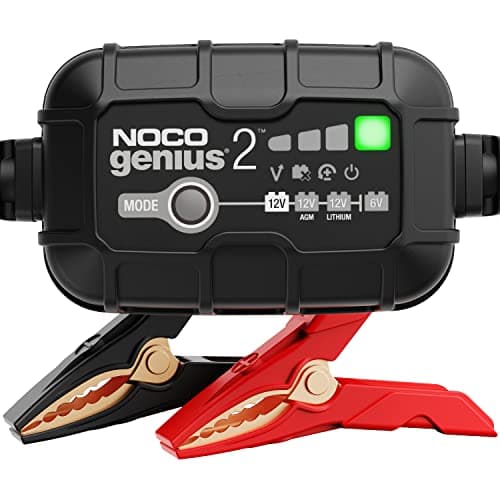
1. Best maintainer for a stored battery
NOCO GENIUS2
NOCO · Best for motorcycles, atvs and lawn equipment
A 2-amp maintainer for the small batteries a car charger would cook: motorcycles, ATVs, mowers and anything that sits for months.
Published specifications
What works
- 2 A is the right order of magnitude for a 10-20 Ah powersports battery
- Safe to leave connected through a whole off-season
- Light and small enough to live on a shelf beside the bike
What does not
- The 40 Ah ceiling makes it a maintainer for a car battery, not a recovery charger
- Recharging a flat car battery at 2 A takes most of a weekend
Skip it if
Not the charger to buy if your actual problem is a flat car battery you need back tonight. That is a 5 A or 10 A job.
#ad Affiliate link · Price as of October 17, 2026
Raw specifications: NOCO’s own page for the NOCO GENIUS2.
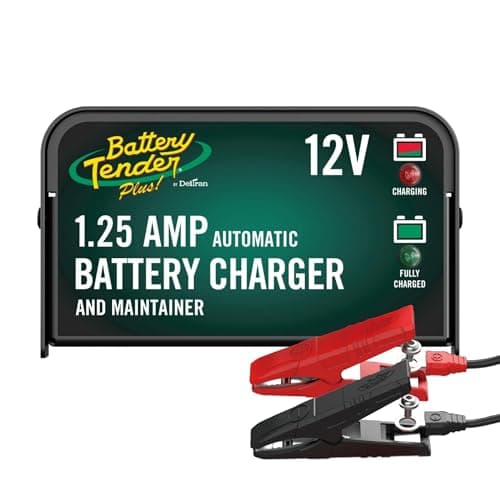
2. Best for a full-size battery on a shelf
Battery Tender Plus 12V 1.25A
Battery Tender · Best for long-term storage on a car battery
The storage-maintainer benchmark: 1.25 amps, automotive batteries up to 80 Ah, a four-step program and a 10-year warranty behind it.
Published specifications
What works
- A 10-year warranty is the longest in this category by a wide margin
- 1.25 A is low enough to leave connected through a winter without heat build-up
- Covers flooded, AGM and gel without a chemistry switch to get wrong
What does not
- 1.25 A is a maintainer current — it will not revive a deeply flat battery quickly
- The 80 Ah ceiling rules out large truck and deep-cycle batteries
- No 6 V mode on the standard Plus; that is a different model in the line
Skip it if
Not the unit for recovering a flat battery on a deadline. Buy it for the car that sits, not the car that stranded you this morning.
#ad Affiliate link · Price as of October 17, 2026
Raw specifications: Battery Tender’s own page for the Battery Tender Plus 12V 1.25A.

3. Best if it needs a real charge first
NOCO GENIUS5
NOCO · Best for one car, charging and maintaining
The single most useful charger for one vehicle: 5 amps, 6 V and 12 V, batteries up to 120 Ah, and it can be left connected indefinitely.
Published specifications
What works
- 5 A recharges a car battery overnight and then holds it — one unit does both jobs
- Rated down to -4 °F, so it works in an unheated garage
- The 77-inch cable reaches from a wall outlet to most engine bays without an extension
- 3-year warranty, against 1 year on the jump-starter line
What does not
- 5 A is slow for a deeply discharged large battery — a 100 Ah battery is an all-nighter
- The 120 Ah ceiling rules out larger deep-cycle banks
Skip it if
Not enough charger if you are reviving deep-cycle RV or marine batteries. Step up to the GENIUS10 and its 230 Ah range.
#ad Affiliate link · Price as of October 17, 2026
Raw specifications: NOCO’s own page for the NOCO GENIUS5.
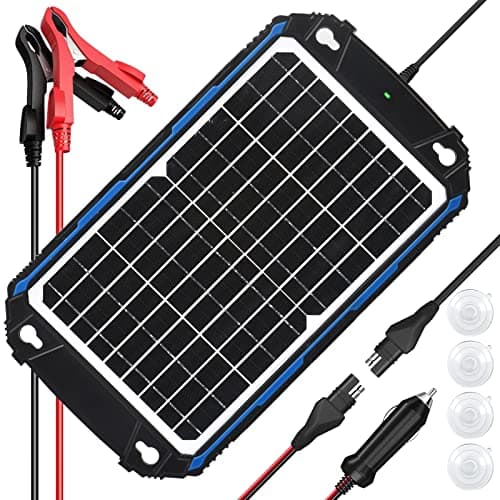
4. Best where there is no outlet
SUNER POWER 12W Solar Battery Maintainer Pro
SUNER POWER · Best for vehicles stored away from an outlet
For the boat, RV or seasonal vehicle parked where there is no power — a weatherproof 12-watt panel with its own MPPT charge controller, sized to offset parasitic drain rather than to charge from flat.
This manufacturer does not publish a full specification table for this model on its own site. Rather than repeat figures we cannot source, the assessment below is limited to what the product category and the retailer listing genuinely establish.
What works
- Needs no outlet, which is the entire point for a boat on a trailer or a car in long-term storage
- Offsets the parasitic draw that flattens a stored battery over months
- The charge controller is built in, so there is no separate regulator to buy or wire
- Nothing to plug in means nothing to forget
What does not
- Output depends on sun; a shaded or snow-covered panel does nothing
- It maintains a charged battery — it is not a way to recover a flat one
- 12 watts is a maintenance-scale panel, so it will not keep up with a parasitic fault
- The brand publishes no specification sheet of its own, so there are no manufacturer-sourced figures to put in a table
Skip it if
Not a replacement for a wall charger. If an outlet reaches the vehicle, a plug-in maintainer is more reliable and cheaper.
#ad Affiliate link · Price as of October 17, 2026
One last note on scope: everything here applies to lead-acid batteries, flooded and AGM alike. Lithium batteries store differently — they prefer to be stored part-charged rather than full, and they do not sulfate — so if you are storing a lithium jump pack rather than a car battery, do jump starters go bad is the page with the right advice for that chemistry.
Key takeaways
- Charge to full before storing. A discharged battery sulfates, and that loss is permanent.
- Clean the case and terminals — a dirty case top slowly discharges the battery.
- Cool and dry beats warm. Warmth speeds self-discharge; a full battery resists freezing.
- Keep it off a damp concrete floor to avoid condensation and terminal corrosion, not because concrete drains batteries.
- A maintainer is the no-effort answer. Without one, recharge every month or two.
- Size the maintainer to the battery: 2 A for a motorcycle or mower battery, not 10 A.
- Test it before refitting. A battery that charges and then falls overnight failed in storage.
How we sourced this
Every figure on this page came from one of the following. Where a manufacturer or regulator does not publish a number, we say so rather than estimate it.
- NOCO GENIUS2 published specifications
- NOCO GENIUS5 published specifications
- Battery Tender Plus 12V 1.25A product page
- Battery Tender 12V 5W mountable solar battery charger (021-1172) product page
- ODYSSEY Battery — frequently asked questions (winter storage, parasitic drain, maintainer use)
- John Deere TY25221B lawn and garden battery — 12 V, 30 Ah, 350 CCA, U1 BCI
Common questions
- How do you store a car battery when not in use?
- Charge it to full, clean the case and terminals, and put it somewhere cool and dry on a shelf or board rather than a damp floor. Then either keep it on a maintainer or recharge it every month or two. Storing it discharged is the one mistake that causes permanent damage.
- Does a car battery lose charge in storage?
- Yes, continuously. Self-discharge is a property of the chemistry and it speeds up with temperature, which is why a cool garage is a better store than a warm basement. A dirty case top makes it worse by providing a conductive path between the terminals.
- Is it bad to store a car battery on concrete?
- Not for the reason people say. Modern plastic cases do not discharge into a concrete floor — that was a hard-rubber-case problem decades ago. What a cold damp floor does do is condense moisture on the case and corrode the terminals, so a board or shelf is still worth using.
- Can a stored car battery freeze?
- A discharged one can, and a frozen battery is usually ruined, because its electrolyte is closer to water than acid when the charge is low. A fully charged battery is highly resistant to freezing. That is a second reason to store it full.
- How often should I charge a battery in storage?
- Every month or two if you are doing it manually, and more often if it is stored somewhere warm. A maintainer removes the question entirely — a float-stage maintainer can stay connected for the whole storage period safely, which is what they are built for.
More in Battery Chargers
A jump pack gets you moving. A charger is how you stop needing one. This is the home half of the problem.
Read next
Best Battery Maintainers
Best Maintainers
Low-current maintainers for seasonal and stored vehicles, including the solar option for anything parked away from an outlet.
Guide
Disconnecting for Storage
When pulling the negative terminal is the right call, what it costs you in settings and relearns, and why a maintainer beats it whenever power reaches the vehicle.
Guide
How Long Can You Leave It On?
Why modern maintainers are designed for permanent connection, what to check occasionally anyway, and the one kind of unit to never leave unattended.
Guide
Charging Still Connected
Why charging in place is normal with a modern charger, where the old disconnect rule came from, and the two situations that still justify it.
Found something out of date, or a figure you can source better than we did? Tell us — corrections get read first. Our methodology explains how picks are made, and contact is one click away.