Jump Starters
The best jump starters for a Honda CR-V
Small engine, modest demand, and the one page on this site where our usual advice to buy a rung up does not apply.
Disclosure: we earn a commission if you buy through the Amazon links on this page, at no extra cost to you. Commission never decides a verdict or a ranking position — read our editorial policy and affiliate disclosure.
How we assessed these: picks are selected from manufacturer specifications, current retailer listings and published owner feedback — not from hands-on testing of every pack on every engine. We publish no measured crank times, because we do not measure them.
Short answer
For a Honda CR-V, buy the NOCO Boost Plus GB40. A CR-V runs a 1.5-liter turbocharged four, a 2.0-liter hybrid or, on older cars, a 2.4-liter four — all far inside the GB40's published 6.0-liter gas rating, so you get large margin in a 2.45 lb pack. The GB20 covers it too and saves a third of a pound; nothing bigger buys you anything.
Quick picks
Tap any row to jump to the full write-up. Scoring criteria are published in full on our methodology page.
| # | Product | Best for | Our read | Price |
|---|---|---|---|---|
| 1 | 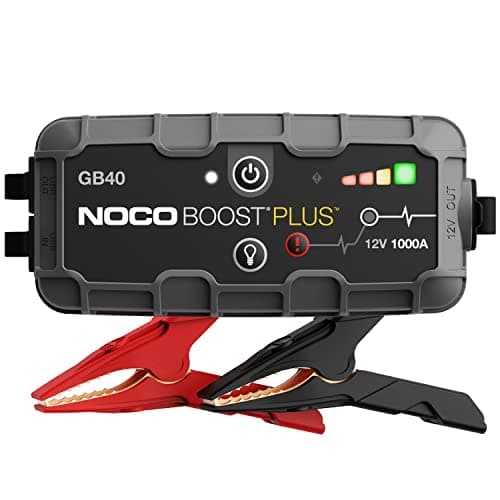 NOCO Boost Plus GB40 Best overall for a CR-V | Most cars and small SUVs | 1,000 A and 6.0 L of gas rating over a 1.5 L engine — all margin | $99.95View on Amazon #ad Affiliate link · Price as of October 17, 2026 |
| 2 | 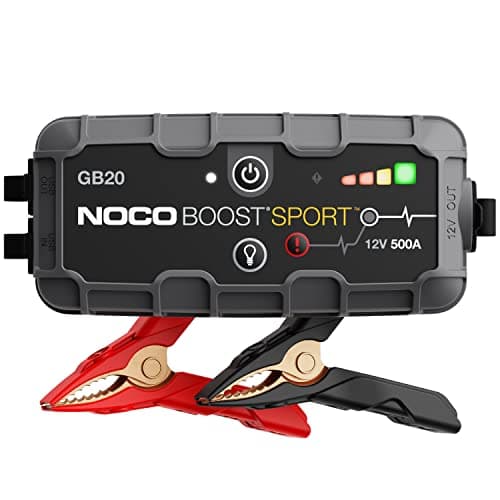 NOCO Boost Sport GB20 Smallest pack that still covers it | Motorcycles, ATVs and small engines | 500 A, 4.0 L gas rating, 2.1 lb | $79.95View on Amazon #ad Affiliate link · Price as of October 17, 2026 |
| 3 | 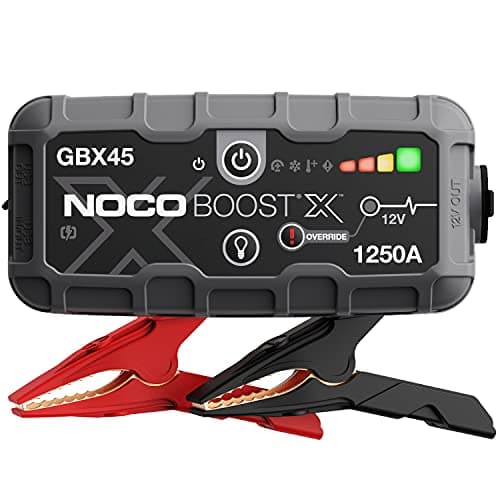 NOCO Boost X GBX45 Best if you travel | Travel and carry-on use | 2.16 lb, 31 Wh, USB-C Power Delivery in and out | $124.95View on Amazon #ad Affiliate link · Price as of October 17, 2026 |
| 4 | 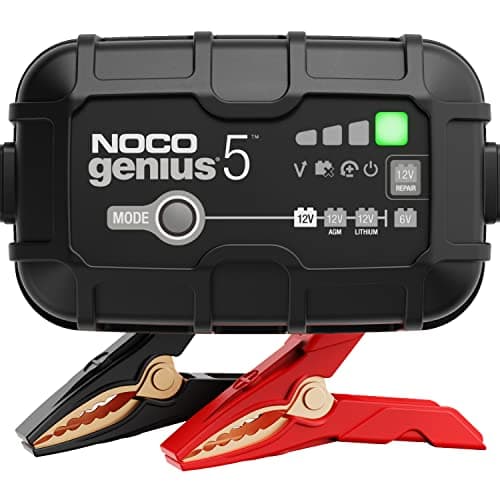 NOCO GENIUS5 The tool you probably need instead | One car, charging and maintaining | 5 A charger with a start-voltage sensor, 1.5 lb | $69.95View on Amazon #ad Affiliate link · Price as of October 17, 2026 |
Most of the vehicle-specific advice on this site pushes you up a rung, because most of it is about trucks. A CR-V is the opposite case and it is worth saying plainly: this is a compact SUV with a small four-cylinder engine, and almost every pack sold will start it. Buying a 2,000-amp diesel pack for a 1.5-liter turbo is paying for a number you will never draw, and the pack you end up with is twice the weight, which makes it likelier to live in the garage instead of the car.
The engines, against the published ratings
| Pack | Peak amps | Gas rating | Weight | Verdict for a CR-V |
|---|---|---|---|---|
| NOCO GB20 | 500 A | Up to 4.0 L | 2.1 lb | Covers every CR-V engine with room |
| NOCO GB40 | 1,000 A | Up to 6.0 L | 2.45 lb | Our pick — large margin, still pocketable |
| NOCO GBX45 | 1,250 A | Up to 6.5 L | 2.16 lb | The travel version of the same answer |
| NOCO GB50 | 1,500 A | Up to 7.0 L | 2.71 lb | More rating than this car can use |
| NOCO GB70 | 2,000 A | Up to 8.0 L | 4.18 lb | Wrong tool. This is a truck pack |
Ratings are NOCO's published figures per model. CR-V engine displacements are vehicle facts; reading them against a rating is our judgment, not a Honda recommendation.
The GB20 row is the interesting one. At a 4.0-liter gas rating it covers a 2.4-liter four with 1.6 liters of headroom, and it is the cheapest and lightest real pack NOCO makes. We still lead with the GB40 for two reasons: 24 watt-hours against the GB20's 24 is a wash, but the GB40's 1,000 peak amps give you more comfort on a cold morning with a tired battery, and the GB40 is the pack most likely to still be right if the next car in the driveway is bigger. What size jump starter do I need is the general rule; this is the one page where the smallest sensible answer is also a good answer.
The hybrid is the real caveat
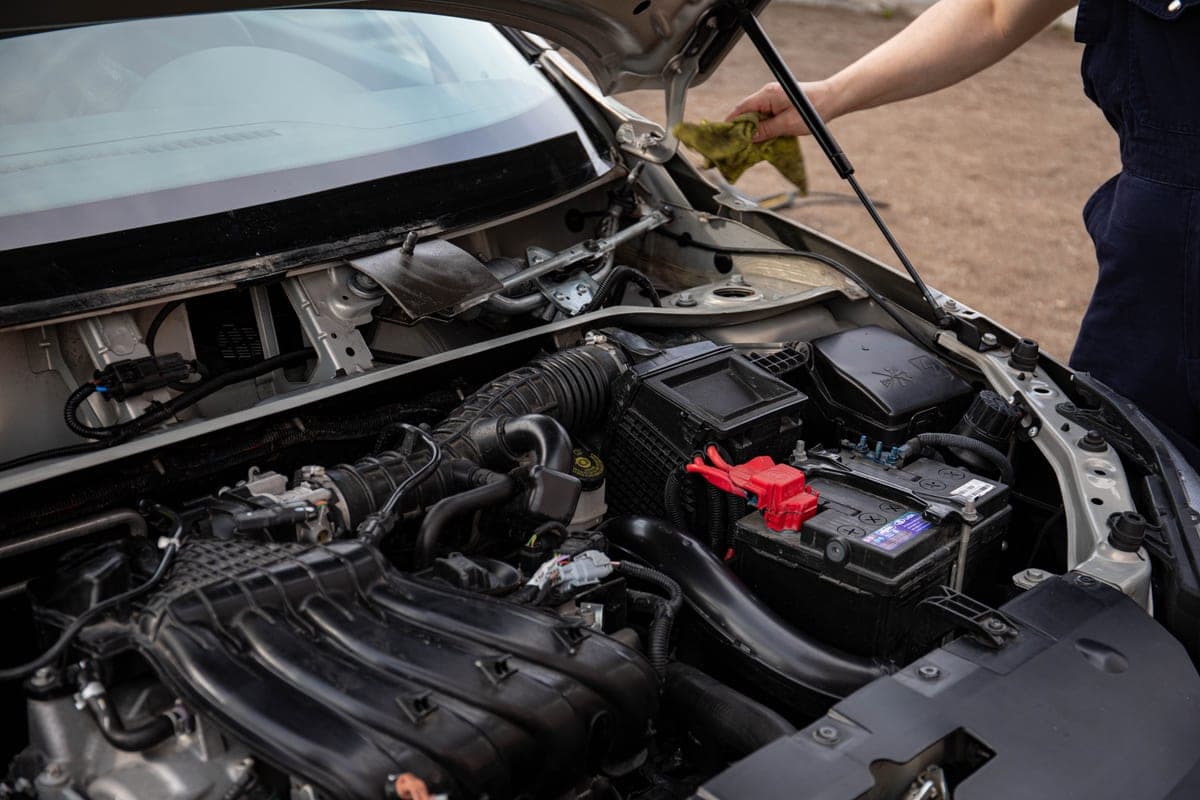
A CR-V Hybrid has a high-voltage traction battery and a conventional 12-volt battery, and they are completely different things. The 12-volt battery is what wakes the car up, runs the computers and closes the contactors that let the hybrid system do anything at all — and it is the battery that goes flat if the car sits. A jump starter connects to the 12-volt system and nothing else, at the terminals or at the manufacturer's designated jump points.
Two consequences follow. First, a dead hybrid is very often a dead 12-volt battery rather than an expensive traction-battery problem, which means a small pack genuinely fixes it. Second, you must never go looking for the orange high-voltage cabling with a clamp in your hand. Jump starters for hybrid cars covers the general case, and can you jump start an electric car covers the fully-electric version of the same confusion.
Why we put a charger in a jump starter roundup
Because on a car like this, the charger is more often the correct purchase. A CR-V that will not start is usually not an unlucky car — it is a car with a discharged or failing battery, and a jump pack treats that once a week forever while a charger fixes it on Saturday. The GENIUS5 pushes 5 amps, handles batteries up to 120 amp-hours, weighs 1.5 lb and has a start-voltage sensor that lets it begin work on a battery too flat for a dumb charger to recognize at all.
The diagnosis takes five minutes with a meter: read resting voltage with everything off, charge the battery fully, then read it again a day later. A battery that charges and holds was only discharged; one that charges and falls again is finished. How to tell if a car battery is bad walks the test, and jump starter versus battery charger settles which tool you actually needed.
The picks
1. Best overall for a CR-V
NOCO Boost Plus GB40
NOCO · Best for most cars and small suvs
The default answer for a four- or six-cylinder car: 1,000 peak amps, 24 watt-hours, and light enough that it actually stays in the trunk.
Published specifications
What works
- 24 Wh sits far under the 100 Wh carry-on threshold, so flying with it needs no airline approval
- 2.45 lb and pocketable — the size that decides whether a tool is still in the trunk six months later
- IP65 enclosure, so a wet shoulder in the rain is not a problem
- Reverse-polarity protection means a backwards clamp does not spark
What does not
- 1,000 peak amps runs out of headroom above a 6.0 L gas engine
- The 3.0 L diesel ceiling rules out most modern diesel pickups
- 24 Wh is a small reserve — it is a jump starter, not a power bank substitute
Skip it if
Not the one to buy if you drive a diesel pickup or a big V8. You would be at the edge of its rating on a cold morning, which is exactly when you want margin.
#ad Affiliate link · Price as of October 17, 2026
Raw specifications: NOCO’s own page for the NOCO Boost Plus GB40.
2. Smallest pack that still covers it
NOCO Boost Sport GB20
NOCO · Best for motorcycles, atvs and small engines
The smallest pack in the range and the right one for powersports: 500 peak amps, 2.1 lb, and a gas rating that stops at 4.0 liters — which is all a bike or a quad ever asks for.
Published specifications
What works
- 2.1 lb — light enough to live under a motorcycle seat or in an ATV storage box, which is the whole point
- 500 peak amps is correctly sized for powersports batteries rather than wildly over them
- Same IP65 enclosure and reverse-polarity protection as the larger packs
- 24 Wh, so it flies in carry-on baggage like the rest of the range
What does not
- The 4.0 L gas ceiling rules out most cars, so it is not a do-everything pack
- NOCO states diesel is not recommended at all for this model — read that as a hard limit
- Small reserve, so cold-weather attempts eat into it quickly
Skip it if
Do not buy it as your car's pack as well. NOCO's own rating stops at 4.0 L gas and says not recommended for diesel, and a bike pack asked to start a car is exactly the wrong economy.
#ad Affiliate link · Price as of October 17, 2026
Raw specifications: NOCO’s own page for the NOCO Boost Sport GB20.
3. Best if you travel
NOCO Boost X GBX45
NOCO · Best for travel and carry-on use
The travel pick: 1,250 peak amps at 2.16 lb with USB-C Power Delivery in and out, so it recharges from the same brick as your laptop.
Published specifications
- Peak amps
- 1,250 A source
- Internal battery
- 31 Wh lithium-ion source
- Gas engine rating
- Up to 6.5 liters source
- Diesel engine rating
- Up to 4.0 liters source
- Weight
- 2.16 lb (0.98 kg) source
- USB-C output
- Up to 20 V / 3 A Power Delivery source
- Water resistance
- IP65 with ports closed source
- Warranty
- 1-year hassle-free source
What works
- Lightest pack in the range at 2.16 lb, and 31 Wh means no airline paperwork
- USB-C Power Delivery both directions — one cable covers the pack, phone and laptop
- More gas headroom than the GB40 (6.5 L against 6.0 L) in a lighter body
What does not
- The IP65 rating only holds with the port covers closed — worth remembering in the rain
- The 4.0 L diesel ceiling is not enough for a full-size diesel pickup
Skip it if
Not the right pack for a diesel truck, and not the cheapest way to cover a small commuter — its premium buys packability, not amps.
#ad Affiliate link · Price as of October 17, 2026
Raw specifications: NOCO’s own page for the NOCO Boost X GBX45.
4. The tool you probably need instead
NOCO GENIUS5
NOCO · Best for one car, charging and maintaining
The single most useful charger for one vehicle: 5 amps, 6 V and 12 V, batteries up to 120 Ah, and it can be left connected indefinitely.
Published specifications
What works
- 5 A recharges a car battery overnight and then holds it — one unit does both jobs
- Rated down to -4 °F, so it works in an unheated garage
- The 77-inch cable reaches from a wall outlet to most engine bays without an extension
- 3-year warranty, against 1 year on the jump-starter line
What does not
- 5 A is slow for a deeply discharged large battery — a 100 Ah battery is an all-nighter
- The 120 Ah ceiling rules out larger deep-cycle banks
Skip it if
Not enough charger if you are reviving deep-cycle RV or marine batteries. Step up to the GENIUS10 and its 230 Ah range.
#ad Affiliate link · Price as of October 17, 2026
Raw specifications: NOCO’s own page for the NOCO GENIUS5.
Key takeaways
- The GB40 is the pick: 6.0 liters of published gas rating over a 1.5-liter engine is all margin, in a 2.45 lb pack.
- The GB20 also covers every CR-V engine and saves weight. Either is a sound buy.
- Do not buy a GB70 for a CR-V. It is a truck pack and the extra weight works against you.
- On a CR-V Hybrid, the pack connects to the 12-volt battery only — never near the high-voltage cabling.
- A dead hybrid is frequently just a dead 12-volt battery, which a small pack genuinely fixes.
- If the car needs jumping repeatedly, buy the GENIUS5 and test the battery instead of buying a bigger pack.
- Weight is the spec that decides whether the pack is in the car six months from now.
How we sourced this
Every figure on this page came from one of the following. Where a manufacturer or regulator does not publish a number, we say so rather than estimate it.
Common questions
- What size jump starter do I need for a Honda CR-V?
- Any pack with a published gas rating above about 2.5 liters, which is almost all of them. The GB20's 4.0-liter rating covers every CR-V engine and the GB40's 6.0-liter rating covers them with large margin. There is no reason to go above the GB50 for this car.
- Will a NOCO GB40 start a Honda CR-V?
- Comfortably. The CR-V's 1.5-liter turbo, 2.0-liter hybrid and older 2.4-liter engines all sit far below the GB40's published 6.0-liter gas rating, so you are not near its ceiling even on a cold morning with a tired battery.
- Can you jump start a Honda CR-V Hybrid?
- Yes — the 12-volt battery, which is what actually fails. Connect at the 12-volt terminals or the designated jump points only. The high-voltage traction battery is not something a jump starter touches, and the orange cabling is not something to go near with a clamp.
- Where is the battery in a Honda CR-V?
- Under the hood, on the driver's side, in the usual place for a compact SUV. That makes the CR-V one of the easy cars for this: you can stand at the fender and reach both terminals without moving anything.
- My CR-V keeps needing a jump. Is a bigger jump starter the answer?
- No. Repeated jumps mean the battery is discharged or failing, and a bigger pack just makes the symptom more convenient. Test the battery, then charge it properly with something like a 5-amp smart charger — if it charges and does not hold, replace it.
More in Jump Starters
A jump pack is the one trunk tool that turns a tow truck into a five-minute inconvenience. This is how to size one, and which ones are worth the space.
Read next
Best for Hybrids
Best for Hybrid Cars
Why hybrids need a modest pack, why their 12-volt battery fails so often, and the safety line you never cross.
Guide
What Size Do I Need?
The sizing table by engine displacement and fuel type, using ratings manufacturers publish and warrant rather than peak-amp marketing.
Best Portable Jump Starters
Best Portable Jump Starters
Our main roundup: five packs from compact to heavy-duty, ranked on the engine rating the manufacturer will actually stand behind.
Guide
Jump Starting an EV
The 12-volt battery is the one that strands EV owners, and a normal jump pack fixes it. The rules, the risks, and the packs that fit the job.
Found something out of date, or a figure you can source better than we did? Tell us — corrections get read first. Our methodology explains how picks are made, and contact is one click away.