Jump Starters
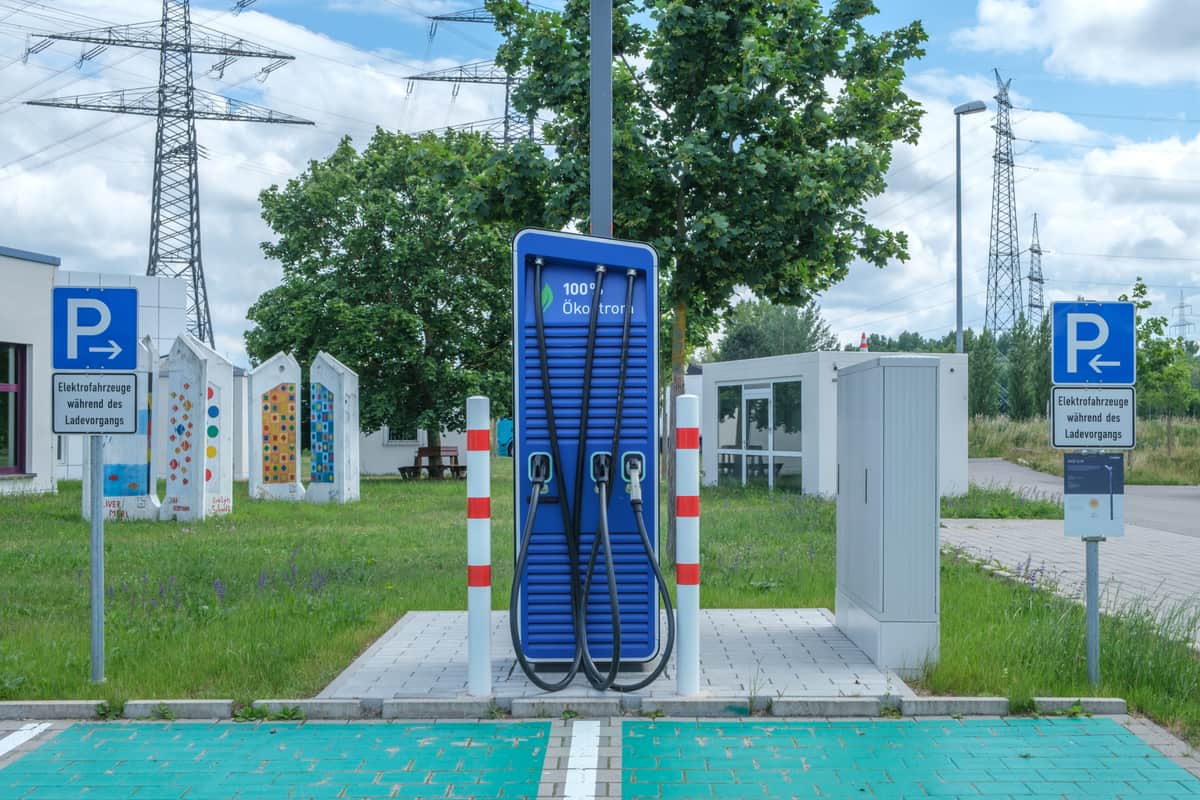
Can you jump start an electric car?
An EV has two batteries. The famous one cannot be jumped and does not need to be; the small one fails exactly like any other car's.
Disclosure: we earn a commission if you buy through the Amazon links on this page, at no extra cost to you. Commission never decides a verdict or a ranking position — read our editorial policy and affiliate disclosure.
Short answer
Yes, and more often than people expect — but only the 12-volt battery. Every electric car has one, it runs the computers, locks and contactors, and when it dies the car is as immobile as any other. A standard jump pack fixes that. The high-voltage traction battery cannot be jump started and must never be touched.
The confusion here is reasonable, because the word "battery" is doing two jobs. An EV's traction battery is the several-hundred-volt pack under the floor that moves the car; it is charged from a charging station and nothing in a trunk kit interacts with it. Separately, almost every EV also carries a conventional 12-volt battery, and that small, ordinary, unglamorous component is the one that leaves EV owners standing in parking lots.
Why an EV has a 12-volt battery at all
Because the whole low-voltage side of a car still runs on 12 volts: the body computers, the door locks, the displays, the lights, the horn, and — critically — the contactors that connect the traction battery to everything else. Until those contactors close, the big battery is electrically isolated by design. So the 12-volt battery is what wakes the car up, and if it is flat the car cannot use its own traction battery to help itself. A full traction battery and a dead 12-volt battery is a car that does nothing at all.
That is a genuinely counterintuitive failure, and it is common. A 12-volt battery in an EV leads a slightly odd life: no alternator, charged instead by a DC-DC converter from the traction pack whenever the car decides to, and subject to the same parasitic drains, cold snaps and old age as anyone else's.
What you connect to, and what you do not
| 12-volt battery | High-voltage traction battery | |
|---|---|---|
| What it does | Computers, locks, lights, contactors | Moves the car |
| Where it is | Under the hood, under a frunk liner, or in the trunk | Under the floor, sealed |
| Can it be jump started? | Yes, with a normal 12 V pack | No. Never |
| Cabling color | Conventional red and black | Orange — do not touch |
| What fixes it when flat | A jump pack, then a charger or a new battery | A charging station, or a flatbed |
Battery locations vary by model, and several manufacturers provide designated jump terminals rather than direct access to the 12-volt battery. Check your own manual for where yours are.
Finding the jump points is the real task
On a conventional car the battery is usually the first thing you see when the hood opens. On an EV it may be under a frunk floor panel, behind a cover in the trunk, or accessible only through two designated posts in the front compartment. Several manufacturers route a positive post and a ground stud specifically for this purpose, precisely because they do not want people hunting around a high-voltage vehicle with a clamp.
There is a second-order problem too: if the 12-volt battery is dead, the electrically-released hood or charge-port release may not work, which is exactly the situation the designated external terminals exist to solve. This is the strongest argument on this page for reading your own manual on a dry afternoon rather than in a parking garage. How to use a jump starter covers the order of operations once you have found the posts.
What size pack an EV needs
Much less than a gas car, and this is the one piece of good news. There is no engine to turn over. All the pack has to do is bring the 12-volt system up to a voltage where the car's electronics boot and the contactors close, after which the traction battery takes over and recharges the 12-volt battery through the DC-DC converter. That is a small job in current terms.
So the smallest real pack in the range is enough — a 500-amp, 24 watt-hour unit covers it — and the sensible buying criteria become weight, packed size and whether you will actually keep it charged. That makes the GB40 the easy default and the GBX45 the right answer for anyone who travels, because at 2.16 lb and 31 watt-hours it recharges from the same USB-C brick as a laptop and sits well under the 100 watt-hour airline threshold. Flying with a jump starter covers those limits, and the best jump starter for Tesla is the model-specific version of this page.
Three things an EV owner should not do
- Do not try to jump another car from your EV. Several manufacturers explicitly prohibit it. The 12-volt system and its DC-DC converter are not designed to supply hundreds of amps to someone else's starter motor, and the damage is on your side. Use a jump pack for the other car — that is what it is for.
- Do not expect a jump pack to help a flat traction battery. An EV out of charge is a tow or a mobile charging service, not a trunk-kit problem. The two systems are unrelated.
- Do not ignore a 12-volt battery that has died once. EV 12-volt batteries are frequently replaced on a schedule rather than on failure for good reason — when this one goes flat you do not merely lose cranking, you lose the car entirely. How to tell if a car battery is bad is the five-minute test, and a 12-volt battery that has been deeply discharged once is a battery to watch.
The picks
1. Best overall for an EV
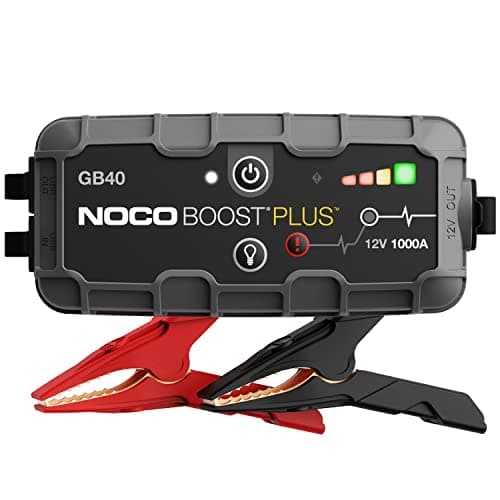
NOCO Boost Plus GB40
NOCO · Best for most cars and small suvs
The default answer for a four- or six-cylinder car: 1,000 peak amps, 24 watt-hours, and light enough that it actually stays in the trunk.
Published specifications
What works
- 24 Wh sits far under the 100 Wh carry-on threshold, so flying with it needs no airline approval
- 2.45 lb and pocketable — the size that decides whether a tool is still in the trunk six months later
- IP65 enclosure, so a wet shoulder in the rain is not a problem
- Reverse-polarity protection means a backwards clamp does not spark
What does not
- 1,000 peak amps runs out of headroom above a 6.0 L gas engine
- The 3.0 L diesel ceiling rules out most modern diesel pickups
- 24 Wh is a small reserve — it is a jump starter, not a power bank substitute
Skip it if
Not the one to buy if you drive a diesel pickup or a big V8. You would be at the edge of its rating on a cold morning, which is exactly when you want margin.
#ad Affiliate link · Price as of October 17, 2026
Raw specifications: NOCO’s own page for the NOCO Boost Plus GB40.
2. Best for an EV that travels
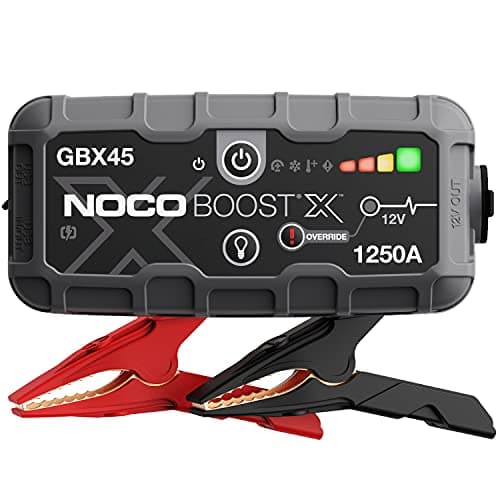
NOCO Boost X GBX45
NOCO · Best for travel and carry-on use
The travel pick: 1,250 peak amps at 2.16 lb with USB-C Power Delivery in and out, so it recharges from the same brick as your laptop.
Published specifications
- Peak amps
- 1,250 A source
- Internal battery
- 31 Wh lithium-ion source
- Gas engine rating
- Up to 6.5 liters source
- Diesel engine rating
- Up to 4.0 liters source
- Weight
- 2.16 lb (0.98 kg) source
- USB-C output
- Up to 20 V / 3 A Power Delivery source
- Water resistance
- IP65 with ports closed source
- Warranty
- 1-year hassle-free source
What works
- Lightest pack in the range at 2.16 lb, and 31 Wh means no airline paperwork
- USB-C Power Delivery both directions — one cable covers the pack, phone and laptop
- More gas headroom than the GB40 (6.5 L against 6.0 L) in a lighter body
What does not
- The IP65 rating only holds with the port covers closed — worth remembering in the rain
- The 4.0 L diesel ceiling is not enough for a full-size diesel pickup
Skip it if
Not the right pack for a diesel truck, and not the cheapest way to cover a small commuter — its premium buys packability, not amps.
#ad Affiliate link · Price as of October 17, 2026
Raw specifications: NOCO’s own page for the NOCO Boost X GBX45.
3. Smallest pack that does the job
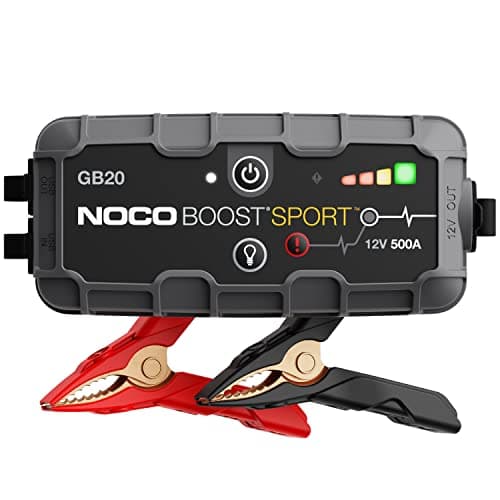
NOCO Boost Sport GB20
NOCO · Best for motorcycles, atvs and small engines
The smallest pack in the range and the right one for powersports: 500 peak amps, 2.1 lb, and a gas rating that stops at 4.0 liters — which is all a bike or a quad ever asks for.
Published specifications
What works
- 2.1 lb — light enough to live under a motorcycle seat or in an ATV storage box, which is the whole point
- 500 peak amps is correctly sized for powersports batteries rather than wildly over them
- Same IP65 enclosure and reverse-polarity protection as the larger packs
- 24 Wh, so it flies in carry-on baggage like the rest of the range
What does not
- The 4.0 L gas ceiling rules out most cars, so it is not a do-everything pack
- NOCO states diesel is not recommended at all for this model — read that as a hard limit
- Small reserve, so cold-weather attempts eat into it quickly
Skip it if
Do not buy it as your car's pack as well. NOCO's own rating stops at 4.0 L gas and says not recommended for diesel, and a bike pack asked to start a car is exactly the wrong economy.
#ad Affiliate link · Price as of October 17, 2026
Raw specifications: NOCO’s own page for the NOCO Boost Sport GB20.
If your EV sits for long periods — a second car, a vacation home, a winter where you barely drive — the useful tool is a maintainer rather than a pack, kept on the 12-volt battery if your manual permits it. Check that first: a few manufacturers restrict external charging of the 12-volt battery while the car is connected, and the manual is the only authority on your car. How long can a car sit before the battery dies covers the timescale that matters.
Key takeaways
- Every EV has a 12-volt battery, and that is the one that strands people.
- A standard jump pack fixes a flat 12-volt battery on an EV, exactly as on a gas car.
- The high-voltage traction battery cannot be jump started. Orange cabling is never touched.
- A full traction battery does not help a dead 12-volt battery, because the contactors cannot close.
- Find your designated jump points in the manual before you need them — a dead 12 V may lock the hood release.
- An EV needs far less pack than a gas car: there is no engine to crank, so buy for weight and size.
- Do not use your EV to jump another car. Several makers prohibit it outright.
How we sourced this
Every figure on this page came from one of the following. Where a manufacturer or regulator does not publish a number, we say so rather than estimate it.
Common questions
- Can you jump start an electric car?
- You can jump start its 12-volt battery, which is the part that actually fails and the reason an EV can be completely immobile with a full traction battery. You cannot jump start the high-voltage traction battery, and no trunk tool interacts with it.
- Do jump starters work on electric cars?
- Yes. A normal 12-volt lithium pack is all that is needed, and a small one is plenty, because there is no engine to crank — the pack only has to bring the low-voltage system up until the car boots and closes its contactors.
- Why does an electric car need a 12-volt battery?
- Because the computers, lights, locks and the contactors that connect the traction battery all run on 12 volts. Those contactors are open until the car wakes up, so the big battery is isolated by design and cannot help itself if the small one is flat.
- Can I use my EV to jump start another car?
- No — several manufacturers prohibit it. The DC-DC converter that maintains your 12-volt system is not built to feed hundreds of amps into someone else's starter, and the risk of damage is yours. Carry a jump pack and use that on the other car instead.
- Where is the 12-volt battery on an electric car?
- It varies: under a front-compartment liner, under the hood, or in the trunk, and many EVs provide dedicated external jump terminals instead of direct access. Find yours in the manual now, because a flat 12-volt battery can disable the hood release you would need to reach it.
More in Jump Starters
A jump pack is the one trunk tool that turns a tow truck into a five-minute inconvenience. This is how to size one, and which ones are worth the space.
Read next
Best for an EV
Best for a Tesla
Why peak amps are the wrong spec for an EV, what a pack is actually doing when a Tesla will not wake up, and the three we would keep in the frunk.
Best for Hybrids
Best for Hybrid Cars
Why hybrids need a modest pack, why their 12-volt battery fails so often, and the safety line you never cross.
How to
How to Use One
The full sequence for a lithium jump pack, plus what to do when the first attempt does not work and when to stop trying.
Best for a compact SUV
Best for a CR-V
Sized to the CR-V's four-cylinder and hybrid engines, with the argument for buying the smaller, lighter pack rather than the biggest one you can afford.
Found something out of date, or a figure you can source better than we did? Tell us — corrections get read first. Our methodology explains how picks are made, and contact is one click away.