Road Trip & Travel
The best battery chargers for RV batteries
An RV has two battery problems, not one, and the converter built into the coach only half-solves either.

Disclosure: we earn a commission if you buy through the Amazon links on this page, at no extra cost to you. Commission never decides a verdict or a ranking position — read our editorial policy and affiliate disclosure.
How we assessed these: picks are selected from manufacturer specifications, current retailer listings and published owner feedback — not from hands-on testing of every unit. Where a manufacturer does not publish a figure, it is left out rather than estimated.
Short answer
For an RV house battery, buy the NOCO GENIUS10. Its published 10-amp output and capacity range up to 230 Ah covers deep-cycle coach batteries that a car charger cannot — the GENIUS5 stops at 120 Ah. Keep a smaller unit or a solar maintainer on the chassis battery, which is a separate problem.
Quick picks
Tap any row to jump to the full write-up. Scoring criteria are published in full on our methodology page.
| # | Product | Best for | Our read | Price |
|---|---|---|---|---|
| 1 | 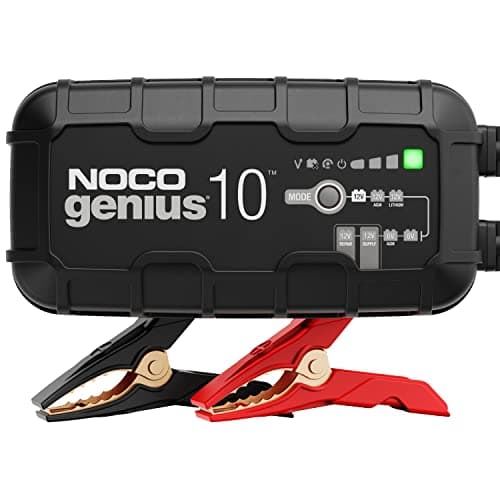 NOCO GENIUS10 Best overall for an RV house battery | Several vehicles or a deep-cycle bank | 10 A up to 230 Ah, 6 V and 12 V, -4 to 104 F | $99.95View on Amazon #ad Affiliate link · Price as of October 16, 2026 |
| 2 |  NOCO GENIUS5 Best for the chassis battery | One car, charging and maintaining | 5 A up to 120 Ah, holds indefinitely, 1.5 lb | $69.95View on Amazon #ad Affiliate link · Price as of October 16, 2026 |
| 3 | 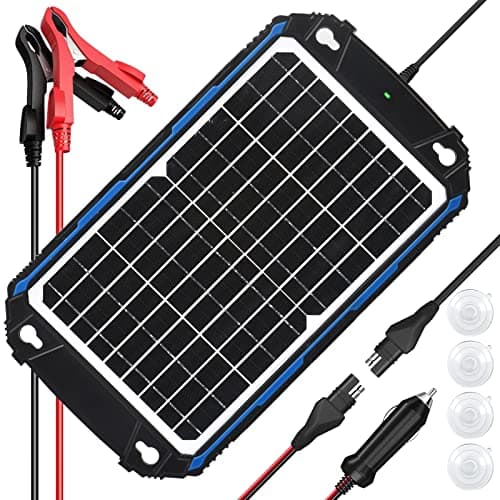 SUNER POWER 12W Solar Battery Maintainer Pro Best for a coach in open storage | Vehicles stored away from an outlet | No outlet needed; offsets drain over a long layup | $59.99View on Amazon #ad Affiliate link · Price as of October 16, 2026 |
| 4 | 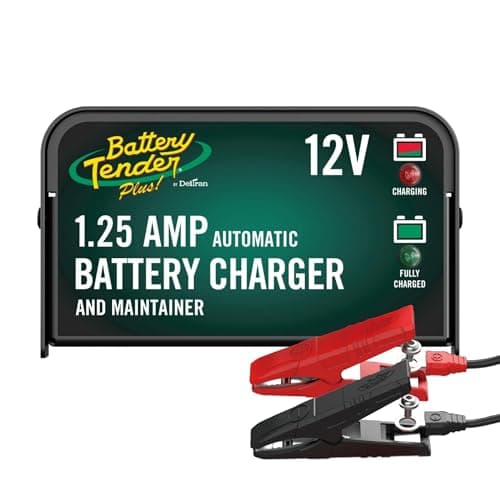 Battery Tender Plus 12V 1.25A Best set-and-forget storage maintainer | Long-term storage on a car battery | 1.25 A, flooded, AGM and gel, 10-year warranty | $58.95View on Amazon #ad Affiliate link · Price as of October 16, 2026 |
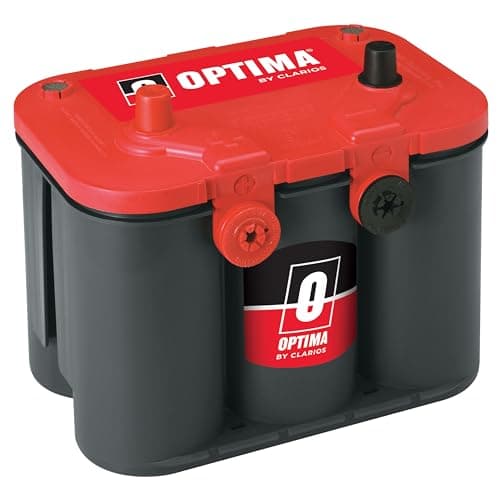
The first thing to establish about an RV is that it has two completely different battery jobs. The chassis battery starts the engine: it is a conventional starting battery of roughly car or truck size, built for a short enormous burst. The house battery or bank runs the lights, the water pump, the fridge control board and the furnace fan: it is deep-cycle, usually larger, and designed to be run down and refilled repeatedly.
They fail differently and they want different treatment. The classic RV story — the coach came out of storage, the lights work and the engine will not turn over — is the chassis battery dying while the converter dutifully looked after the house bank. Treating the two as one problem is the mistake behind most of them.
Capacity range is the number that rules chargers out
| Charger | Current | Capacity range | Voltages | Role it fits |
|---|---|---|---|---|
| NOCO GENIUS2 | 2 A | Up to 40 Ah | 6 V and 12 V | Too small for either RV battery; powersports unit |
| NOCO GENIUS5 | 5 A | Up to 120 Ah | 6 V and 12 V | Chassis battery, or a single small house battery |
| NOCO GENIUS10 | 10 A | Up to 230 Ah | 6 V and 12 V | House battery or deep-cycle bank |
| Battery Tender Plus | 1.25 A | Automotive up to 80 Ah | 12 V | Storage maintainer on the chassis battery |
All figures are each manufacturer's own published specifications. The role column is our reading of those figures against typical RV battery sizes, not a manufacturer recommendation — check your own battery's amp-hour rating against the charger's published range before buying.
NOCO's own product copy makes the distinction explicit: the GENIUS5's stated limitation is that it is not enough charger for reviving deep-cycle RV or marine batteries, and the GENIUS10's 230 Ah range is the published answer. Many RVs also run a pair of 6-volt golf-cart batteries in series for the house bank, which is the other reason the GENIUS line is the sensible family here — it does 6 volts as well as 12.
Why the built-in converter is not the whole answer
Most RVs have a converter or converter-charger that feeds the house bank when the coach is on shore power. That is genuinely useful and it is why house batteries usually survive better than chassis batteries. What it typically does not do is charge the chassis battery, and older converters run a fixed output rather than a staged smart-charge profile, which means a battery that is kept near full but not properly finished.
A portable smart charger covers both gaps. Used on the chassis battery it stops the no-start-after-storage story; used on the house bank it finishes a charge the converter left incomplete, and its chemistry settings respect whether your bank is flooded, AGM or lithium. Starting versus deep-cycle batteries explains why the two want different profiles, and what amp battery charger do I need has the sizing arithmetic.
The storage problem, which is most of the year
A coach that is used for eight weekends and stored for the rest of the year spends most of its life discharging slowly. Self-discharge plus whatever is still wired in — a propane detector, an alarm, a radio memory — will flatten both batteries over a winter, and a lead-acid battery left discharged sulfates permanently.
ODYSSEY's own storage guidance is the clearest statement of the two options: leave the battery on a maintainer-type charger that fights the current drains, or simply disconnect the battery cables, because drains cannot damage a battery that is not connected. Which you pick comes down to whether shore power reaches the storage spot.
- Stored with shore power. Easiest case. Leave a low-current maintainer on the chassis battery and let the converter handle the house bank, checking the house bank's state before each trip.
- Stored on a lot with no power. A solar maintainer offsets drain on a charged battery, which is exactly the storage-lot problem. It will not recover a flat bank and it does nothing under snow, so charge everything fully before the coach goes away.
- Stored for a full season with no power at all. Charge both batteries to full, then disconnect them. It is free and it works, at the cost of resetting clocks and presets. Should you disconnect a car battery when storing covers the trade-offs.
- Freezing storage. A full battery resists freezing; a discharged one can freeze and rupture. Never leave either battery flat over a northern winter.
What belongs in the coach, as opposed to the garage
A charger is a shore-power and garage tool. On the road, the equivalent insurance is a lithium jump pack sized for the chassis engine, because a charger needs an outlet and a campground pedestal is not always where the problem happens. Jump starters for an RV covers that half of the problem, and the road trip car kit is the wider list.
The other item worth carrying is a multimeter. Knowing within a minute whether the chassis battery is at 12.6 volts or 11.9 is the difference between a diagnosis and a guess, and it is the cheapest tool in this entire category. How to tell if a car battery is bad covers the readings.
The picks in full
1. Best overall for an RV house battery
NOCO GENIUS10
NOCO · Best for several vehicles or a deep-cycle bank
Twice the current of the GENIUS5 and nearly twice the capacity range — 10 amps up to 230 Ah, which is where RV, marine and multi-vehicle households land.
Published specifications
What works
- 10 A halves the charge time on a flat car battery against a 5 A unit
- The 230 Ah range covers deep-cycle RV and marine batteries the GENIUS5 cannot
- Same -4 °F cold rating and 3-year warranty as the smaller GENIUS units
What does not
- 10 A into a small motorcycle battery is more current than it wants — use a 1 A or 2 A unit there
- Heavier and pricier than a GENIUS5 for a household with one car
Skip it if
Not the right charger for a single motorcycle, ATV or lawn-tractor battery. Small batteries want small current.
#ad Affiliate link · Price as of October 16, 2026
Raw specifications: NOCO’s own page for the NOCO GENIUS10.
2. Best for the chassis battery
NOCO GENIUS5
NOCO · Best for one car, charging and maintaining
The single most useful charger for one vehicle: 5 amps, 6 V and 12 V, batteries up to 120 Ah, and it can be left connected indefinitely.
Published specifications
What works
- 5 A recharges a car battery overnight and then holds it — one unit does both jobs
- Rated down to -4 °F, so it works in an unheated garage
- The 77-inch cable reaches from a wall outlet to most engine bays without an extension
- 3-year warranty, against 1 year on the jump-starter line
What does not
- 5 A is slow for a deeply discharged large battery — a 100 Ah battery is an all-nighter
- The 120 Ah ceiling rules out larger deep-cycle banks
Skip it if
Not enough charger if you are reviving deep-cycle RV or marine batteries. Step up to the GENIUS10 and its 230 Ah range.
#ad Affiliate link · Price as of October 16, 2026
Raw specifications: NOCO’s own page for the NOCO GENIUS5.
3. Best for a coach in open storage
SUNER POWER 12W Solar Battery Maintainer Pro
SUNER POWER · Best for vehicles stored away from an outlet
For the boat, RV or seasonal vehicle parked where there is no power — a weatherproof 12-watt panel with its own MPPT charge controller, sized to offset parasitic drain rather than to charge from flat.
This manufacturer does not publish a full specification table for this model on its own site. Rather than repeat figures we cannot source, the assessment below is limited to what the product category and the retailer listing genuinely establish.
What works
- Needs no outlet, which is the entire point for a boat on a trailer or a car in long-term storage
- Offsets the parasitic draw that flattens a stored battery over months
- The charge controller is built in, so there is no separate regulator to buy or wire
- Nothing to plug in means nothing to forget
What does not
- Output depends on sun; a shaded or snow-covered panel does nothing
- It maintains a charged battery — it is not a way to recover a flat one
- 12 watts is a maintenance-scale panel, so it will not keep up with a parasitic fault
- The brand publishes no specification sheet of its own, so there are no manufacturer-sourced figures to put in a table
Skip it if
Not a replacement for a wall charger. If an outlet reaches the vehicle, a plug-in maintainer is more reliable and cheaper.
#ad Affiliate link · Price as of October 16, 2026
4. Best set-and-forget storage maintainer
Battery Tender Plus 12V 1.25A
Battery Tender · Best for long-term storage on a car battery
The storage-maintainer benchmark: 1.25 amps, automotive batteries up to 80 Ah, a four-step program and a 10-year warranty behind it.
Published specifications
What works
- A 10-year warranty is the longest in this category by a wide margin
- 1.25 A is low enough to leave connected through a winter without heat build-up
- Covers flooded, AGM and gel without a chemistry switch to get wrong
What does not
- 1.25 A is a maintainer current — it will not revive a deeply flat battery quickly
- The 80 Ah ceiling rules out large truck and deep-cycle batteries
- No 6 V mode on the standard Plus; that is a different model in the line
Skip it if
Not the unit for recovering a flat battery on a deadline. Buy it for the car that sits, not the car that stranded you this morning.
#ad Affiliate link · Price as of October 16, 2026
Raw specifications: Battery Tender’s own page for the Battery Tender Plus 12V 1.25A.
Key takeaways
- An RV has two battery problems: a starting chassis battery and a deep-cycle house bank.
- The GENIUS10's published 230 Ah range covers house batteries the 120 Ah GENIUS5 cannot.
- 6-volt support matters, because many house banks are a pair of 6-volt batteries in series.
- The built-in converter usually ignores the chassis battery — that is the no-start-after-storage story.
- Set the chemistry: flooded, AGM, gel and lithium all want different profiles.
- For storage, maintain or disconnect. Never let either battery sit discharged.
How we sourced this
Every figure on this page came from one of the following. Where a manufacturer or regulator does not publish a number, we say so rather than estimate it.
- NOCO GENIUS10 published specifications
- NOCO GENIUS10 product page — start-voltage sensor, Force Mode, pulse repair
- NOCO GENIUS5 published specifications
- NOCO GENIUS2 published specifications
- Battery Tender Plus 12V 1.25A product page
- Battery Tender 12V 5W mountable solar battery charger (021-1172) product page
- ODYSSEY Battery — frequently asked questions (winter storage, parasitic drain, maintainer use)
Common questions
- What size battery charger do I need for an RV house battery?
- Match the charger's published capacity range to the battery's amp-hour rating. A 10-amp charger with a 230 Ah range, such as the NOCO GENIUS10, covers most single deep-cycle house batteries. Large multi-battery banks are better served by a dedicated multi-bank converter-charger.
- Can I use a car battery charger on an RV battery?
- On the chassis battery, yes — it is a conventional starting battery. On a deep-cycle house battery, only if the charger's capacity range covers it. A typical car charger stops around 120 Ah, which many house batteries exceed.
- Does the RV converter charge the chassis battery?
- Usually not. Most converters feed the house bank only, which is why the common failure after storage is a dead chassis battery in a coach whose interior lights work perfectly. Put a maintainer on the chassis battery separately.
- How do I keep RV batteries charged in storage?
- With shore power, leave a maintainer connected. Without it, a solar maintainer will offset parasitic drain on batteries that are already full. For a long layup with no power at all, charge both batteries fully and disconnect the cables.
More in Road Trip & Travel
What changes when the nearest parts store is four hours away, the pack has to survive a hot trunk, and the airline has an opinion about your lithium battery.
Read next
Best for RVs
Best for RVs
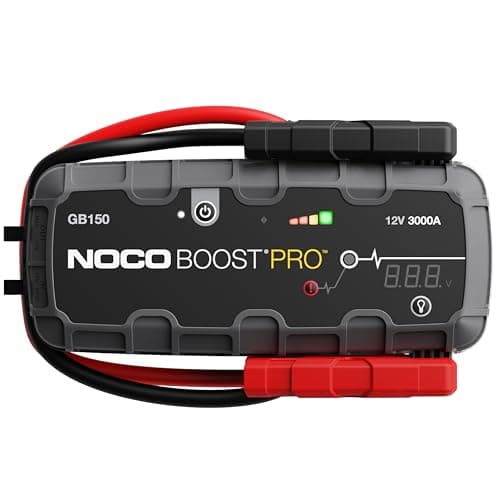
Packs sized for motorhome chassis engines, why the diesel rating is the column that matters, and where the house battery fits in.
Best for marine batteries
Best for Marine Batteries
Published capacity ranges against real deep-cycle sizes, why the chemistry setting matters more here than on a car, and what to do when the boat is on a trailer with no power.
Guide
Starting vs Deep Cycle
What separates a cranking battery from a deep-cycle one, what dual-purpose genuinely means, and which charger each needs.
Guide
Disconnecting for Storage
When pulling the negative terminal is the right call, what it costs you in settings and relearns, and why a maintainer beats it whenever power reaches the vehicle.
Found something out of date, or a figure you can source better than we did? Tell us — corrections get read first. Our methodology explains how picks are made, and contact is one click away.