Tire Inflators
How many watts does a tire inflator use?
The answer runs from about 100 watts to about 360 — and the gap is exactly why some inflators plug into a socket and others clamp onto the battery.
Disclosure: we earn a commission if you buy through the Amazon links on this page, at no extra cost to you. Commission never decides a verdict or a ranking position — read our editorial policy and affiliate disclosure.
How we assessed these: picks are selected from manufacturer specifications, current retailer listings and published owner feedback — not from hands-on testing of every unit. Where a manufacturer does not publish a figure, it is left out rather than estimated.
Short answer
A small 12-volt socket inflator draws around 100 watts — AstroAI publishes a 100-watt maximum and about 8 amps for its 100 PSI model. A clamp-on portable compressor draws far more: VIAIR publishes 20 amps for the 88P and 30 amps for the 400P, which at 12 volts is 240 and 360 watts. That gap is the reason the bigger units skip the accessory socket entirely.
Manufacturers usually publish amps rather than watts, so the arithmetic is on you. At 12 volts the conversion is simple: watts equal amps multiplied by 12. Every figure below is the maker's own published amp draw, converted.
Quick picks
Tap any row to jump to the full write-up. Scoring criteria are published in full on our methodology page.
| # | Product | Best for | Our read | Price |
|---|---|---|---|---|
| 1 | AstroAI 12V Tire Inflator The socket-powered baseline | The cheapest inflator still worth owning | 100 W maximum, about 8 A, per AstroAI | Check price on Amazon #ad Affiliate link · We show no price here; Amazon shows the current one |
| 2 |  VIAIR 88P Portable Compressor Where clamps become necessary | Truck, SUV and off-road tires | 20 A at 12 V, 45 A inrush — 240 W | Check price on Amazon #ad Affiliate link · We show no price here; Amazon shows the current one |
| 3 | VIAIR 400P Portable Compressor The high-draw end | Airing back up after a trail | 30 A at 12 V, 81 A inrush — 360 W | Check price on Amazon #ad Affiliate link · We show no price here; Amazon shows the current one |
| 4 | 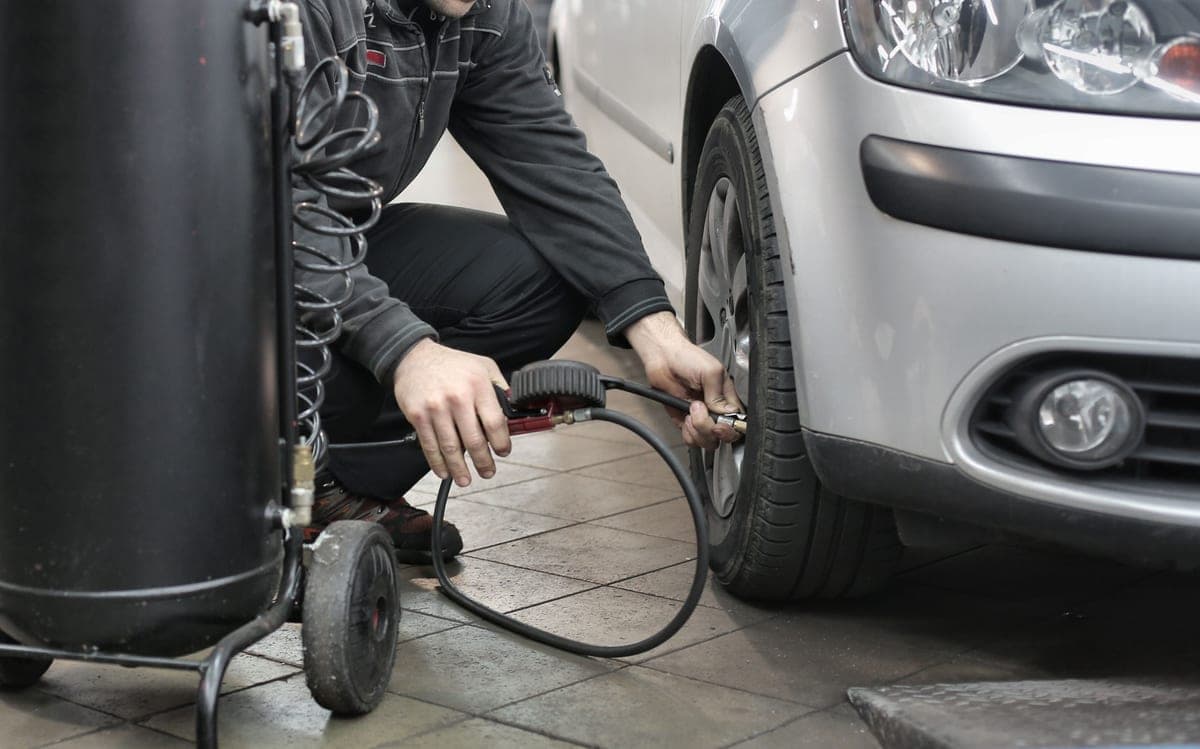 DEWALT DCC020IB 20V MAX Inflator The one that sidesteps the question | Anyone already on DEWALT 20V batteries | Tool battery, 12 V socket or wall outlet | Check price on Amazon #ad Affiliate link · We show no price here; Amazon shows the current one |
The published numbers
| Unit | Published draw | Watts at 12 V | Supply |
|---|---|---|---|
| AstroAI 12V inflator | About 8 A, 100 W maximum | 100 W (as published) | 12 V accessory socket |
| VIAIR 88P | 20 A maximum, 45 A inrush | 240 W | Battery clamps |
| VIAIR 400P | 30 A maximum at 12 V, 81 A inrush | 360 W | Battery clamps |
| VIAIR 400P on 24 V | 15 A maximum | 360 W at 24 V | Battery clamps |
| Fanttik X8 APEX | 28.8 Wh battery, 40 minutes stated runtime | About 43 W average | Internal battery |
Draw figures are each manufacturer's own published specification, linked under Sources. The watt columns are arithmetic from those figures, not separate measurements — and the Fanttik figure is an average over its stated runtime, not a peak.
Why inrush current is the number that matters
A compressor motor draws far more current in the instant it starts turning than it does while running. VIAIR publishes this separately: 45 amps of inrush at 0 PSI on the 88P, and 81 amps on the 400P. The running figure is what heats the wiring; the inrush figure is what pops a fuse.
This is the whole reason the larger portable compressors ship with battery clamps rather than a socket plug. A vehicle's 12-volt accessory circuit is fused for accessories, and an 81-amp surge is not an accessory. Connecting at the battery posts bypasses that circuit entirely, which is a design decision rather than an inconvenience.
What this means for running one off a power station
People ask this because a jump pack or power station sitting in the trunk looks like a convenient supply. The answer depends on which output you mean.
- A 12 V accessory output on a jump pack will run a small socket inflator at roughly 100 watts if the pack's output is rated for the current. Check the pack's published output amps against the inflator's draw before assuming.
- A household AC outlet on a power station will run a 110 V inflator such as the DEWALT DCC020IB directly. Note that most jump starters advertising AC have an AC *charger* — an input — not an outlet. Jump starters with an AC outlet untangles that.
- Neither will usefully run a 30 A clamp-on compressor. At 360 watts and 81 amps of inrush, that wants a vehicle battery, which is what it is designed to clamp onto.
- A jump starter with a built-in compressor sidesteps the question by putting both in one housing. Jump starters with an air compressor covers the trade.
Does the power draw flatten your car battery?
Not in any realistic single use, and this is worth saying plainly because it is a common worry. Even the 400P at 30 amps, run for ten minutes, is drawing a small fraction of a car battery's stored energy. A healthy battery does not notice it.
The sensible precaution is to run the engine while you work, which keeps the alternator supplying the compressor rather than the battery. The exception is the one case where it genuinely matters: a battery that is already weak. If the battery is marginal, a long inflation session on a stopped engine is not where you want to find out. Why car batteries die in cold weather covers how much margin a cold battery has actually lost.
How power draw relates to speed
Loosely, and not as directly as you would hope. More electrical power into the motor does generally mean more air out, which is why the 30-amp 400P moves 2.30 CFM against the 20-amp 88P's 1.97. But efficiency varies, and a high-draw unit is not automatically a fast one.
The figure to compare is still air flow in CFM, not watts. Watts tell you how to power the thing; CFM tells you how long you will be standing there. Tire inflator PSI ratings covers why the pressure number on the box answers neither question.
The picks
1. The socket-powered baseline
AstroAI 12V Tire Inflator
AstroAI · Best for the cheapest inflator still worth owning
A plain 12 V socket-powered inflator with a digital gauge and auto-shutoff — the baseline that covers a car's tires with no battery to maintain.
This manufacturer does not publish a full specification table for this model on its own site. Rather than repeat figures we cannot source, the assessment below is limited to what the product category and the retailer listing genuinely establish.
What works
- Powered from the 12 V socket, so it works whenever the car does
- Nothing to keep charged, which means it is never flat when the tire is
- Digital preset shutoff at the target pressure
What does not
- The cord limits where you can work, and reaching a rear tire can be tight
- Small-motor inflators in this tier run hot; large tires need rest intervals
- Gauge accuracy in this class varies unit to unit, so verify against a separate gauge
Skip it if
Not the pick if you regularly air down and back up for trails, or run light-truck tires. That is dedicated-compressor work.
#ad Affiliate link · We show no price here; Amazon shows the current one
2. Where clamps become necessary
VIAIR 88P Portable Compressor
VIAIR · Best for truck, suv and off-road tires
A battery-clamp compressor built for the tire sizes socket-powered units cannot handle without stopping to cool down.
Published specifications
What works
- Connects to the battery terminals rather than the 12 V socket, so socket fuse current is not the limit
- Built for larger tires and repeated fills — the duty cycle is the whole reason to buy it
- Metal body and a real air hose rather than a molded plastic assembly
What does not
- The battery-clamp connection means popping the hood every time
- Bigger and heavier than any glovebox inflator
- Overkill, and slower to set up, for a routine cold-morning top-up
Skip it if
Not the pick if you drive a sedan and just want to correct 4 PSI once a month. That is what a socket inflator is for.
#ad Affiliate link · We show no price here; Amazon shows the current one
3. The high-draw end
VIAIR 400P Portable Compressor
VIAIR · Best for airing back up after a trail
A step up from the 88P for people who air down deliberately: 150 PSI, a published 33 percent duty cycle at 100 PSI, and a 25-foot hose that reaches all four corners.
Published specifications
- Maximum working pressure
- 150 PSI source
- Air flow
- 2.30 CFM at 0 PSI source
- Duty cycle
- 33% at 100 PSI source
- Supply
- 12 V or 24 V, battery clamps source
- Maximum amp draw
- 30 A at 12 V, 15 A at 24 V source
- Inrush current
- 81 A at 0 PSI (PN 40043) source
- Ingress protection
- IP54 source
- Weight
- 10.40 lb source
- Power cord / air hose
- 8 ft / 25 ft source
What works
- Battery-clamp connection, so the 12 V socket's fuse is not the ceiling on throughput
- A published duty cycle — 33 percent at 100 PSI — which almost nothing in this category gives you
- 25 feet of air hose reaches every corner of a vehicle from one hookup
- Metal construction and a real air hose rather than a molded plastic assembly
What does not
- 10.40 lb and the bulk that goes with it — dedicated recovery-gear territory, not a glovebox tool
- 30 A at 12 V rules out any accessory socket; it is battery clamps or nothing
- Slower to set up than a socket inflator for a routine cold-morning top-up
Skip it if
Overkill for a car that needs 4 PSI once a month. That is a socket inflator's job, and this is a lot of equipment to carry for it.
#ad Affiliate link · We show no price here; Amazon shows the current one
4. The one that sidesteps the question
DEWALT DCC020IB 20V MAX Inflator
DEWALT · Best for anyone already on dewalt 20v batteries
Three power sources in one body — 20V MAX battery, 12 V socket or 110 V wall — with a digital gauge and auto-shutoff, which is what makes an inflator usable everywhere.
Published specifications
What works
- The 12 V socket option means a dead tool battery never leaves you stranded
- A threaded chuck screws onto the valve stem instead of clamping — the difference between a solid seal and a hissing one
- Set-and-walk-away auto-shutoff at your target pressure
- High-volume mode handles air mattresses and inflatables, not just tires
What does not
- Sold as a bare tool — battery, charger and AC adapter are separate purchases
- Bigger and heavier than a pocket 12 V inflator, so it wants trunk space
Skip it if
Not the pick if you own no DEWALT batteries and only ever top up car tires. A plain 12 V inflator is smaller and cheaper for that job.
#ad Affiliate link · We show no price here; Amazon shows the current one
Raw specifications: DEWALT’s own page for the DEWALT DCC020IB 20V MAX Inflator.
Key takeaways
- A socket inflator is roughly 100 watts; AstroAI publishes 100 W and about 8 A for its 100 PSI unit.
- Clamp-on compressors are 240 to 360 watts — VIAIR publishes 20 A and 30 A at 12 volts.
- Inrush current, not running current, is what the accessory-socket fuse cannot survive.
- Never rewire a clamp-on compressor to a socket plug; the clamps are the specification.
- Watts tell you how to power it. CFM tells you how fast it fills.
How we sourced this
Every figure on this page came from one of the following. Where a manufacturer or regulator does not publish a number, we say so rather than estimate it.
Common questions
- How many watts does a tire inflator use?
- A 12-volt socket inflator uses around 100 watts — AstroAI publishes a 100-watt maximum and about 8 amps for its 100 PSI model. A clamp-on portable compressor uses considerably more: VIAIR publishes 20 amps for the 88P and 30 amps for the 400P, which at 12 volts is 240 and 360 watts respectively.
- How many amps does a tire inflator draw?
- Around 8 amps for a small socket-powered unit, and 20 to 30 amps for a clamp-on portable compressor. Inrush current at startup is much higher again: VIAIR publishes 45 amps for the 88P and 81 amps for the 400P, which is why those units connect at the battery rather than through an accessory socket.
- Can I run a tire inflator off a power station?
- A small 12-volt socket inflator at about 100 watts will run from a 12-volt accessory output if that output is rated for the current, and a 110-volt inflator will run from a household AC outlet on a power station. A 30-amp clamp-on compressor will not — it is designed to clamp directly onto a vehicle battery.
- Will using a tire inflator drain my car battery?
- Not meaningfully in a single use. Even a 30-amp compressor run for ten minutes draws a small fraction of a healthy car battery's stored energy. Running the engine while you inflate removes the question entirely, and is worth doing if the battery is already weak.
More in Tire Inflators
The cheapest tool that prevents the second-most-common roadside stop. Here is which type fits your tires, and the two specs that actually matter.
Read next
Guide
PSI Ratings Explained
Why a 150 PSI inflator is not faster than a 100 PSI one, what the rating genuinely limits, and the spec that decides how long you stand there.
Guide
Duty Cycle Explained
What duty cycle means, why it decides whether an inflator can handle large tires, and what to infer when the manufacturer stays silent.
Head to head
12V vs Cordless
Socket power versus an internal battery, compared on reliability, convenience, cold-weather output and what happens when the car battery is also dead.
Head to head
Inflator vs Air Compressor
The tank is the dividing line: continuous small-volume work versus stored air for tools. Which one belongs in your trunk and which in your garage.
Best for Trucks & SUVs
For Trucks & SUVs
Battery-clamp compressors and heavy-duty units for light-truck and off-road tires, with the duty-cycle reasoning spelled out.
Found something out of date, or a figure you can source better than we did? Tell us — corrections get read first. Our methodology explains how picks are made, and contact is one click away.