Jump Starters
The best jump starters for a van
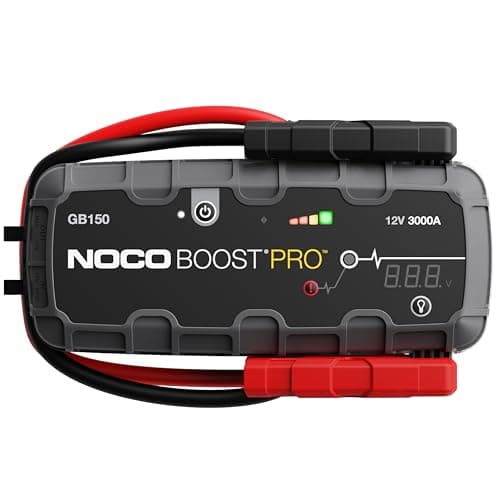
Cargo vans and conversions break two assumptions at once: the battery is rarely under the hood, and there is often more than one of them.

Disclosure: we earn a commission if you buy through the Amazon links on this page, at no extra cost to you. Commission never decides a verdict or a ranking position — read our editorial policy and affiliate disclosure.
How we assessed these: picks are selected from manufacturer specifications, current retailer listings and published owner feedback — not from hands-on testing of every pack on every engine. We publish no measured crank times, because we do not measure them.
Short answer
For most vans, buy the NOCO Boost HD GB70. Its published 6.0-liter diesel and 8.0-liter gas ratings cover a Sprinter's 3.0-liter diesel, a Transit's 3.5-liter EcoBoost and a ProMaster's 3.6-liter V6 with margin, and its 56 watt-hours give you repeat attempts. A gas-only cargo van can run the GB50 instead; a camper conversion is the one case for the much larger GBX155.
Quick picks
Tap any row to jump to the full write-up. Scoring criteria are published in full on our methodology page.
| # | Product | Best for | Our read | Price |
|---|---|---|---|---|
| 1 | 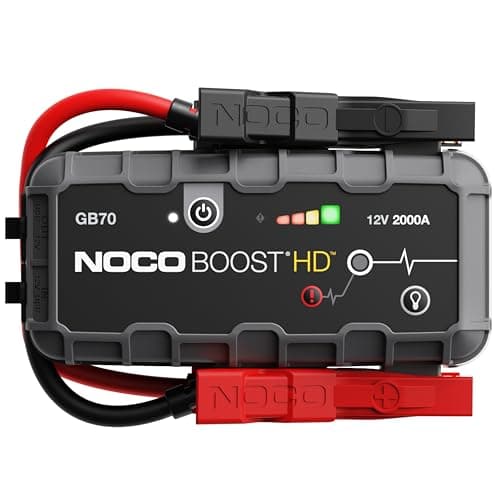 NOCO Boost HD GB70 Best overall for a van | Diesel pickups and big V8s | 6.0 L diesel rating covers a Sprinter; 56 Wh covers repeat attempts | $194.99View on Amazon #ad Affiliate link · Price as of October 17, 2026 |
| 2 | 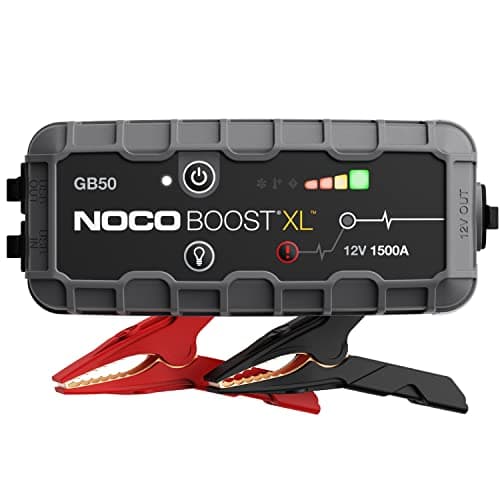 NOCO Boost Plus GB50 Best for a gas cargo van | V6 and small V8 gas engines | 7.0 L gas rating, 2.71 lb, fits a door pocket | $149.95View on Amazon #ad Affiliate link · Price as of October 17, 2026 |
| 3 | 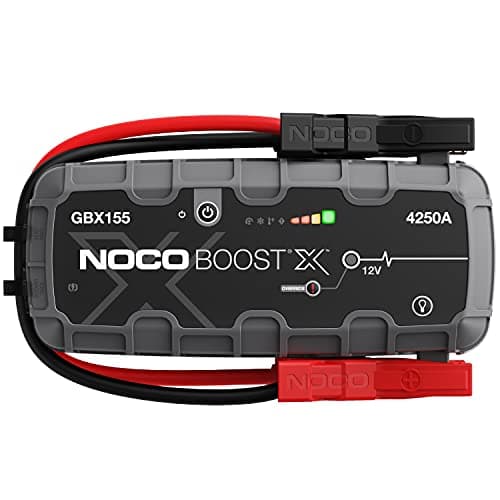 NOCO Boost X GBX155 Best for a camper conversion | Doubling as a serious power bank | 99 Wh of reserve that also runs a laptop and a phone for days | $369.95View on Amazon #ad Affiliate link · Price as of October 17, 2026 |
| 4 | 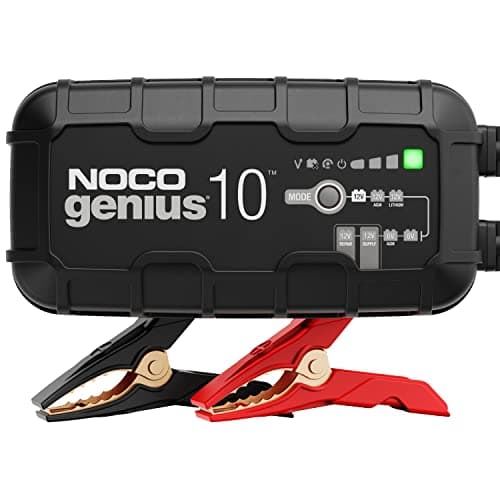 NOCO GENIUS10 The other half of the answer | Several vehicles or a deep-cycle bank | 10 A and a 230 Ah capacity range for a house or second battery | $99.95View on Amazon #ad Affiliate link · Price as of October 17, 2026 |
A van is not a big car, and it is not a pickup either. The engines are mostly modest — 2.0 to 3.6 liters covers the common gas and diesel fitments in a Sprinter, Transit or ProMaster — so raw peak amps is rarely the constraint. What is different is everything around the engine: the starting battery is frequently under the driver's seat, under a step or in a box behind the cab rather than under the hood, and anything built out as a camper has a second battery system that a jump pack must never be connected to.
The ratings, against the engines vans actually use
| Pack | Peak amps | Gas rating | Diesel rating | Weight |
|---|---|---|---|---|
| NOCO GB40 | 1,000 A | Up to 6.0 L | Up to 3.0 L | 2.45 lb |
| NOCO GB50 | 1,500 A | Up to 7.0 L | Up to 4.5 L | 2.71 lb |
| NOCO GB70 | 2,000 A | Up to 8.0 L | Up to 6.0 L | 4.18 lb |
| NOCO GBX155 | 4,250 A | 99 Wh reserve | Published as a 10 L / 8.0 L class pack | 5.82 lb |
Figures are NOCO's own published specifications. Engine sizes quoted in the text are vehicle facts; matching them to a rating is our reading, not a figure published by Mercedes-Benz, Ford or Stellantis.
Read that table and the GB40 looks adequate for a 3.0-liter Sprinter diesel, because 3.0 is exactly its published diesel ceiling. Sitting on a ceiling is the one thing we tell readers not to do. A van is also heavier, usually older, and far more likely to be carrying a tired battery than a commuter car, so the GB50 at 4.5 liters of diesel is the first pack we would actually recommend and the GB70 at 6.0 liters is the one we would buy. What size jump starter do I need explains the margin rule.
Cable reach is the spec nobody lists
On a car, clamp length is irrelevant — you stand at the fender and reach the terminals. On a van it decides whether the pack works at all. If the battery is under the driver's seat, you are kneeling in the door opening with the pack on the floor mat; if it is in a box behind the cab, you may be working from inside the load area. Before you buy anything, find your battery, and then check that you can physically place the pack where its clamps will reach without stretching the leads taut. A stretched clamp pops off under load, and a clamp that pops off under load is a spark at a battery.
This is also why the heaviest pack in the article is not automatically the most awkward. The GB70 at 4.18 lb sits on a floor mat perfectly happily. What you do not want is a lead-acid station you have to hold at an angle in a doorway, which is part of why we keep the one-box combo units off this particular list — see jump starters with an air compressor if you want that trade-off anyway.
Camper conversions: two battery systems, one pack
A conversion van has a starting battery and a house bank, and they do different jobs. The starting battery turns the engine; the house bank runs the fridge, the lights and the inverter. A jump starter is only ever for the starting battery. It is not a charger for the house bank, it is not a solution to a flat house bank, and connecting it to a lithium house system is a good way to turn a cheap evening into an expensive one.
The honest kit for a conversion is two tools, not one. A pack for the engine — this is where the GBX155's 99 watt-hours earn their place, because it doubles as a USB-C power bank that will run a laptop and recharge phones for days off-grid, which no smaller pack does — plus a real charger for the bank. The GENIUS10 publishes a 230 amp-hour capacity range and a 10-amp output, which is the right size for a house battery rather than a starting battery. The best battery chargers for RV batteries is the page for that half of the problem, and starting versus deep-cycle batteries explains why one charger is not both.
Three van-specific habits worth having
- Know your jump points before the first failure. Many vans publish a remote positive post in the engine bay precisely because the battery is buried. Find it on a dry afternoon, not at a loading dock in the rain.
- Keep the pack in the cab, not the load area. A pack buried under cargo is a pack you cannot reach, and a pack baking against a steel roof all summer loses capacity — jump starter storage and heat covers what that costs.
- Charge it on a schedule you will actually keep. A van that sits between jobs is a van whose jump pack also sits. How to charge a jump starter sets out an interval that works.
The picks
1. Best overall for a van
NOCO Boost HD GB70
NOCO · Best for diesel pickups and big v8s
The one to buy if you drive a diesel: 2,000 peak amps, a 6.0-liter diesel rating and 56 watt-hours, which is the smallest pack with real margin on a cold diesel.
Published specifications
What works
- The 6.0 L diesel rating covers the common 3.0 L and 6.7 L light-truck diesels with margin
- 56 Wh is still comfortably under the 100 Wh carry-on threshold, so it flies as hand luggage
- 12 V 15 A accessory output, and a 400-lumen light that is genuinely usable roadside
- 12 V / 3 A fast charge brings it back in about three hours
What does not
- 4.18 lb — noticeably heavier than the compact packs, and it wants a dedicated spot
- Overkill for a commuter four-cylinder; you are paying for headroom you will not use
Skip it if
Not the one to buy if you only ever start a four-cylinder commuter. Buy diesel headroom when you have a diesel.
#ad Affiliate link · Price as of October 17, 2026
Raw specifications: NOCO’s own page for the NOCO Boost HD GB70.
2. Best for a gas cargo van
NOCO Boost Plus GB50
NOCO · Best for v6 and small v8 gas engines
The middle rung: 1,500 peak amps and 35 watt-hours for a quarter-pound more than the GB40, which is the cheapest headroom in the range.
Published specifications
What works
- A full liter more gas headroom than the GB40 for 0.26 lb more weight
- 35 Wh still clears the 100 Wh carry-on limit with room to spare
- Doubles the flashlight output over the GB40 at 200 lumens
What does not
- Overlaps awkwardly with the GBX45, which is lighter and charges over USB-C
- Still short of the 6.0 L diesel rating a modern diesel pickup wants
Skip it if
Skip it if convenience matters more than amps — the GBX45 is lighter and takes USB-C Power Delivery, and the GB50's edge is raw current.
#ad Affiliate link · Price as of October 17, 2026
Raw specifications: NOCO’s own page for the NOCO Boost Plus GB50.
3. Best for a camper conversion
NOCO Boost X GBX155
NOCO · Best for doubling as a serious power bank
99 watt-hours with USB-C Power Delivery in and out — the largest pack in the range that still clears the 100 Wh carry-on limit, and the one that genuinely works as a power bank.
Published specifications
What works
- 99 Wh is deliberately just under the 100 Wh airline threshold — the most capacity you can carry on without asking anyone
- USB-C Power Delivery at up to 20 V / 3 A charges laptops, not just phones
- 4,250 peak amps with an 8.0 L diesel rating covers almost any light vehicle
- 500-lumen light, which is a genuinely usable work light
What does not
- 5.82 lb — heavier than most people expect from something sold partly as a power bank
- Priced as a premium jump starter, so it is an expensive way to buy 99 Wh of USB power alone
- A dedicated power bank of the same capacity is smaller, lighter and cheaper
Skip it if
Skip it if you mainly want to charge devices. A purpose-built power bank does that better for less, and this pack's premium is in the cranking hardware you would not be using.
#ad Affiliate link · Price as of October 17, 2026
Raw specifications: NOCO’s own page for the NOCO Boost X GBX155.
4. The other half of the answer
NOCO GENIUS10
NOCO · Best for several vehicles or a deep-cycle bank
Twice the current of the GENIUS5 and nearly twice the capacity range — 10 amps up to 230 Ah, which is where RV, marine and multi-vehicle households land.
Published specifications
What works
- 10 A halves the charge time on a flat car battery against a 5 A unit
- The 230 Ah range covers deep-cycle RV and marine batteries the GENIUS5 cannot
- Same -4 °F cold rating and 3-year warranty as the smaller GENIUS units
What does not
- 10 A into a small motorcycle battery is more current than it wants — use a 1 A or 2 A unit there
- Heavier and pricier than a GENIUS5 for a household with one car
Skip it if
Not the right charger for a single motorcycle, ATV or lawn-tractor battery. Small batteries want small current.
#ad Affiliate link · Price as of October 17, 2026
Raw specifications: NOCO’s own page for the NOCO GENIUS10.
If the van is a work vehicle that has needed a jump more than once, the pack is not the fix. A van's battery leads a harder life than a car's — short runs, big accessory loads, long idle periods between jobs — and that is a charger-and-battery conversation. How to tell if a car battery is bad is the five-minute version, and jump starter versus battery charger explains which tool solves which problem.
Key takeaways
- The GB70 is the van pick: a 6.0-liter diesel rating covers a Sprinter with real margin.
- A gas-only cargo van can run the GB50 at 2.71 lb and lose nothing that matters.
- The GB40's 3.0-liter diesel ceiling is exactly a Sprinter's displacement — that is a ceiling, not a recommendation.
- Find your battery first. In many vans it is under a seat or behind the cab, and clamp reach decides the purchase.
- A jump starter is for the starting battery only — never the house bank in a conversion.
- A camper build wants both a pack and a real charger; the GBX155 and the GENIUS10 are that pairing.
- Keep the pack in the cab, charged on a schedule, not buried under cargo.
How we sourced this
Every figure on this page came from one of the following. Where a manufacturer or regulator does not publish a number, we say so rather than estimate it.
Common questions
- What size jump starter do I need for a Sprinter van?
- A diesel Sprinter runs a 2.0 or 3.0-liter engine, so you want a pack whose published diesel rating clears 3.0 liters with margin. The GB50 is rated to 4.5 liters of diesel and the GB70 to 6.0 liters; the GB70 is the one we would buy, because a van battery is usually older and harder-worked than a car's.
- Can I jump start a van with a portable jump starter?
- Yes. Van engines are mostly 2.0 to 3.6 liters, which is well within a mid-size lithium pack's published rating. The complication is not the engine, it is finding the battery — in many vans it sits under the driver's seat or behind the cab rather than under the hood.
- Can a jump starter charge my camper van house battery?
- No, and you should not try. A jump starter delivers a short high-current burst for an engine; a house bank needs a sustained regulated charge over hours from a proper charger. Connect the pack to the starting battery only.
- Where is the battery in a cargo van?
- It varies by model and build. Common locations are under the driver's seat, under a step in the door opening, in a box behind the cab, or conventionally under the hood. Many vans also publish a remote positive jump post in the engine bay — find yours before you need it.
- Do I need a bigger jump starter for a high-roof van?
- No. Roof height changes nothing about starting current; the engine decides the pack. What a bigger van does change is where you can stand and how far the clamps have to reach, which is a layout question rather than an amps question.
More in Jump Starters
A jump pack is the one trunk tool that turns a tow truck into a five-minute inconvenience. This is how to size one, and which ones are worth the space.
Read next
Best for a Silverado 1500
Best for a Silverado 1500
Matched to the Silverado 1500's engine lineup using NOCO's published liter ratings — including the Duramax diesel and the one-box option that also inflates a tire.
Best for Diesel Trucks
For Diesel Trucks
Packs with a published diesel rating that actually covers a 3.0 L to 6.7 L light-truck engine, with margin for a cold morning.
Best for RVs
Best for RVs
Packs sized for motorhome chassis engines, why the diesel rating is the column that matters, and where the house battery fits in.
Best for RV batteries
Best for RV Batteries
House battery against chassis battery, why published capacity range decides the charger, and what to do with a coach that sits in storage for seven months.
Found something out of date, or a figure you can source better than we did? Tell us — corrections get read first. Our methodology explains how picks are made, and contact is one click away.