Jump Starters
Can a jump starter charge a car battery?
The two tools look like they do the same job through the same clamps. They are built around opposite requirements, and one cannot substitute for the other.

Disclosure: we earn a commission if you buy through the Amazon links on this page, at no extra cost to you. Commission never decides a verdict or a ranking position — read our editorial policy and affiliate disclosure.
Short answer
No. A jump starter cannot meaningfully charge a car battery. It is built to deliver a very large current for a few seconds, while charging requires a small regulated current held steady for hours. Leaving a pack connected puts back a trickle, which sometimes helps a start attempt, but it will not refill a battery.
This is probably the most common misunderstanding in the category, and it is an understandable one. Both tools clamp to the same two posts, both are sold in the same aisle, and both make a dead car start. But they are engineered around opposite requirements, and the difference is not a matter of degree — a pack is not just a slow charger or a charger a fast pack.
The two jobs, side by side
| Jump starter | Battery charger | |
|---|---|---|
| Current delivered | Hundreds to thousands of amps | 1 to 10 amps, typically |
| Duration | Two to five seconds | Two to twenty hours |
| Power source | Its own internal battery | A wall outlet |
| What it is doing | Replacing the battery during cranking | Putting energy back into the battery |
| Energy moved | A few watt-hours | Several hundred watt-hours |
| Leaves the battery | Still discharged | Full, and conditioned |
Current and duration figures are the normal design envelope of each tool class, taken from the published specifications of the products we recommend — see Sources.
Look at the last row, because that is the one with consequences. After a successful jump the battery in your car is exactly as discharged as it was five seconds earlier. Nothing has been added to it. The engine is running, so the alternator starts working, and whether the battery recovers now depends entirely on how long you drive and how healthy the alternator and the battery are.
What a pack does put back
Not nothing, which is why the myth persists. Connect a pack to a flat battery and leave it for a few minutes without cranking, and a small amount of energy flows from the pack's lithium cells into the car's lead-acid battery, because the pack sits at a higher voltage. That is a real effect and it is genuinely useful: it is why the standard advice for a very flat battery is to wait two or three minutes with the clamps on before turning the key.
But look at the scale. A compact pack holds 24 watt-hours. A typical car battery holds somewhere in the region of 500 to 700 watt-hours when full. Even if a pack could transfer all of its energy with no losses, it could not refill a flat car battery — and it cannot, because the transfer is slow and unregulated and the pack has to keep enough in reserve to actually crank. Jump starter mAh versus watt-hours explains the capacity units, and will a jump starter start a dead battery covers how low is too low.
Driving is not charging either, really
The other half of this myth is that a twenty-minute drive after a jump will sort the battery out. An alternator is a maintenance device: it is sized to replace what the engine and accessories consume plus a modest surplus, not to bulk-charge a flat battery. Depending on the car, the load and the state of the battery, recovering a deeply discharged battery by driving can take hours of running, and on a short commute it may never happen at all.
Which produces the familiar pattern: jumped on Monday, jumped again on Wednesday, new battery on Saturday — when the battery might have been fine if it had spent Monday night on a charger. How long to charge a car battery has the hours-by-amperage table, and jump starter versus battery charger is the full comparison of the two tools.
The combo units that genuinely do both
Some products do span the gap, and they are worth knowing about. The Schumacher SC1281 is a wall-powered charger first — 2 to 6 amps of microprocessor-controlled charging with a desulfation mode and a built-in battery and alternator tester — and it adds a 30-amp boost and a 100-amp engine-start assist on top. That is a charger that can help you start, not a pack that can charge, and the distinction shows up in the one thing it needs: a 120-volt outlet. It is a garage tool, not a roadside one.
Lead-acid jump stations like the DEWALT DXAEJ14 blur the line the other way, with their own charging circuitry and a 12-volt output, but the output is for running accessories rather than charging another battery, and the unit itself still has to be plugged in to refill. The clean mental model is: if it is useful at the roadside it is not charging anything, and if it is charging something it is plugged into a wall.
What to buy, depending on the problem
- A car that stranded you once. Buy a pack. That is exactly its job, and the five minutes it saves is the whole reason the category exists — are portable jump starters worth it makes the case.
- A battery that keeps going flat. Buy a charger. A 5-amp smart charger covers a single car battery up to 120 amp-hours and will recover a deeply discharged one overnight.
- Several vehicles, or a deep-cycle bank. Buy 10 amps. The GENIUS10's published 230 amp-hour range is the difference between charging a car battery and charging a house battery — see the best deep-cycle battery chargers.
- A vehicle that sits for weeks. Buy a maintainer, not a charger. Different job again, and battery charger versus maintainer is the page for it.
The picks
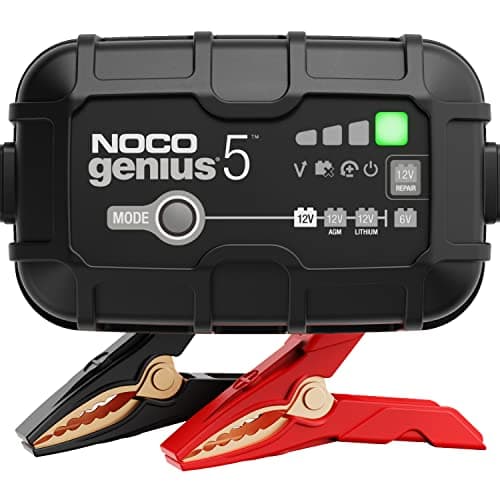
1. Best charger for one car
NOCO GENIUS5
NOCO · Best for one car, charging and maintaining
The single most useful charger for one vehicle: 5 amps, 6 V and 12 V, batteries up to 120 Ah, and it can be left connected indefinitely.
Published specifications
What works
- 5 A recharges a car battery overnight and then holds it — one unit does both jobs
- Rated down to -4 °F, so it works in an unheated garage
- The 77-inch cable reaches from a wall outlet to most engine bays without an extension
- 3-year warranty, against 1 year on the jump-starter line
What does not
- 5 A is slow for a deeply discharged large battery — a 100 Ah battery is an all-nighter
- The 120 Ah ceiling rules out larger deep-cycle banks
Skip it if
Not enough charger if you are reviving deep-cycle RV or marine batteries. Step up to the GENIUS10 and its 230 Ah range.
#ad Affiliate link · Price as of October 17, 2026
Raw specifications: NOCO’s own page for the NOCO GENIUS5.
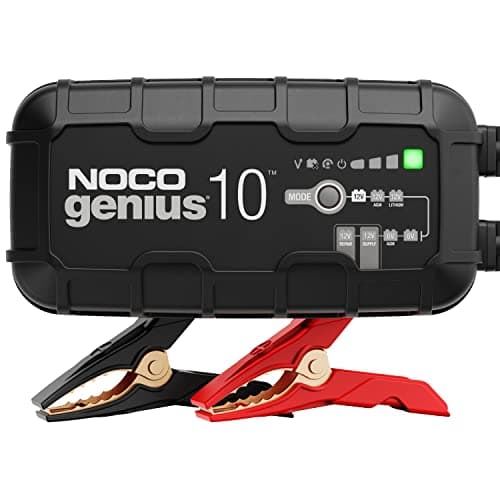
2. Best for several vehicles
NOCO GENIUS10
NOCO · Best for several vehicles or a deep-cycle bank
Twice the current of the GENIUS5 and nearly twice the capacity range — 10 amps up to 230 Ah, which is where RV, marine and multi-vehicle households land.
Published specifications
What works
- 10 A halves the charge time on a flat car battery against a 5 A unit
- The 230 Ah range covers deep-cycle RV and marine batteries the GENIUS5 cannot
- Same -4 °F cold rating and 3-year warranty as the smaller GENIUS units
What does not
- 10 A into a small motorcycle battery is more current than it wants — use a 1 A or 2 A unit there
- Heavier and pricier than a GENIUS5 for a household with one car
Skip it if
Not the right charger for a single motorcycle, ATV or lawn-tractor battery. Small batteries want small current.
#ad Affiliate link · Price as of October 17, 2026
Raw specifications: NOCO’s own page for the NOCO GENIUS10.
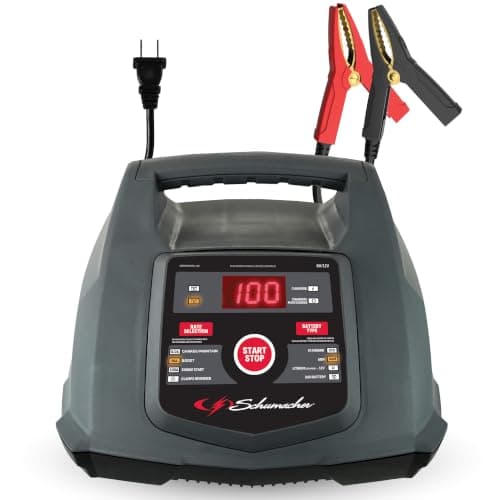
3. Charger with a start-assist
Schumacher SC1281
Schumacher · Best for fast charging plus engine-start assist
A shop-style charger for the garage: a 6-amp automatic charge, a 30-amp boost and a 100-amp engine start, for people who would rather fix the battery than carry a pack.
Published specifications
- Charging current
- 2 A to 6 A, microprocessor-controlled source
- Boost charge
- 30 A source
- Engine start
- 100 A source
- Battery voltages
- 6 V and 12 V, detected automatically source
- Input voltage
- 120 V AC — must stay plugged in source
- Chemistries
- Standard lead-acid, AGM and gel source
- Reconditioning
- Desulfation mode source
- Testing
- Built-in battery and alternator tester source
- Safety
- Reverse-polarity protection, automatic shutoff source
What works
- A 30 A boost charge puts a flat battery back in hours rather than overnight
- 100 A engine start covers the case where the battery is too far gone to take a charge quickly
- Automatic 6 V / 12 V detection reduces the chance of selecting the wrong mode
- The built-in battery and alternator tester tells you whether charging is even the right answer
What does not
- Mains-powered and bulky — a garage tool, not a trunk tool
- High-current charging is harder on an ageing battery than a slow charge
- Engine-start mode is no substitute for a portable pack away from home
Skip it if
Useless on the roadside — there is no outlet on the shoulder of a highway. This is the home half of the problem; a lithium pack is the away half.
#ad Affiliate link · Price as of October 17, 2026
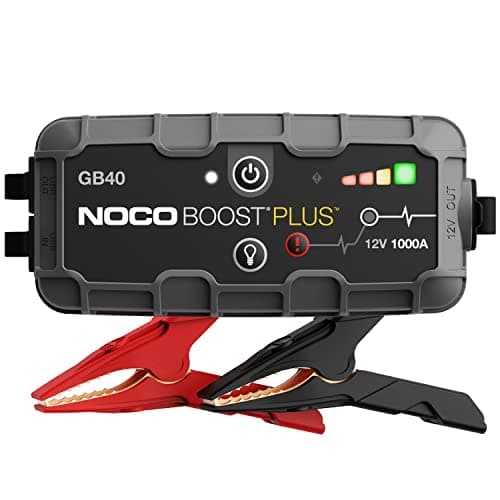
4. The pack to keep as well
NOCO Boost Plus GB40
NOCO · Best for most cars and small suvs
The default answer for a four- or six-cylinder car: 1,000 peak amps, 24 watt-hours, and light enough that it actually stays in the trunk.
Published specifications
What works
- 24 Wh sits far under the 100 Wh carry-on threshold, so flying with it needs no airline approval
- 2.45 lb and pocketable — the size that decides whether a tool is still in the trunk six months later
- IP65 enclosure, so a wet shoulder in the rain is not a problem
- Reverse-polarity protection means a backwards clamp does not spark
What does not
- 1,000 peak amps runs out of headroom above a 6.0 L gas engine
- The 3.0 L diesel ceiling rules out most modern diesel pickups
- 24 Wh is a small reserve — it is a jump starter, not a power bank substitute
Skip it if
Not the one to buy if you drive a diesel pickup or a big V8. You would be at the edge of its rating on a cold morning, which is exactly when you want margin.
#ad Affiliate link · Price as of October 17, 2026
Raw specifications: NOCO’s own page for the NOCO Boost Plus GB40.
Key takeaways
- A jump starter cannot charge a car battery. It moves a few watt-hours; a battery holds several hundred.
- After a successful jump the car's battery is exactly as flat as it was before.
- Leaving a pack connected for two or three minutes does raise terminal voltage and does help a hard start.
- An alternator is a maintenance device, not a bulk charger — short drives will not recover a deeply discharged battery.
- A 5-amp smart charger covers a single car; 10 amps covers several vehicles or a deep-cycle bank.
- Combo units that truly charge need a wall outlet, which makes them garage tools.
- Own both. The pack handles the five minutes; the charger handles the cause.
How we sourced this
Every figure on this page came from one of the following. Where a manufacturer or regulator does not publish a number, we say so rather than estimate it.
- NOCO GB40 published specifications
- NOCO Boost Plus GB40 product page — jump starts per charge and USB recharge time
- NOCO GENIUS5 published specifications
- NOCO GENIUS10 published specifications
- Schumacher SC1281 battery charger and engine starter product page
- DEWALT DXAEJ14 published product information (Baccus Global, DEWALT licensee)
Common questions
- Can a jump starter charge a car battery?
- No, not in any useful sense. A compact pack holds about 24 watt-hours while a car battery holds several hundred, and the pack is built to dump current for seconds rather than supply a regulated current for hours. Use a charger for charging.
- Will leaving a jump starter connected charge my battery?
- It transfers a small trickle, because the pack sits at a higher voltage than the flat battery. That is enough to make a hard start easier and nowhere near enough to refill the battery. Two to three minutes is the useful window; leaving it for an hour achieves little more.
- Does driving after a jump start recharge the battery?
- Partially, and slowly. An alternator is sized to replace what the car is using plus a small surplus, not to bulk-charge a flat battery. Recovering a deeply discharged battery by driving can take hours of running, and on short trips it may never finish.
- Do I need both a jump starter and a battery charger?
- If you keep a car for more than a year or two, yes. The pack solves the five minutes when you are stuck; the charger solves the reason you were stuck. Buying only the pack means treating the same symptom repeatedly until the battery fails for good.
- Can a jump starter charge another jump starter?
- Some packs with USB-C Power Delivery output can charge another USB-C device, including another pack, but it is a slow and lossy way to do it. Charge each pack from a wall outlet and keep them both topped up on a schedule instead.
More in Jump Starters
A jump pack is the one trunk tool that turns a tow truck into a five-minute inconvenience. This is how to size one, and which ones are worth the space.
Read next
Head to head
Jump Starter vs Charger
The away-from-home tool against the at-home tool, which to buy first, and how to tell which your situation actually calls for.
Guide
Will It Start a Dead Battery?
The difference between a discharged battery and a failed one, what a pack can and cannot do about each, and how to tell which you have.
Guide
How Long to Charge
A charge-time table by amps and capacity, the arithmetic behind it, and why the final stage is always slower than the calculation suggests.
Best for a deep-cycle bank
Best for Deep Cycle
Chosen on published capacity range and chemistry support — the two figures that separate a deep-cycle charger from a car charger with ambition.
Found something out of date, or a figure you can source better than we did? Tell us — corrections get read first. Our methodology explains how picks are made, and contact is one click away.