Battery Chargers
The best deep cycle battery chargers
The spec that matters is the published capacity range, because a 5-amp charger on a 200 amp-hour bank is not slow — it is inadequate.

Disclosure: we earn a commission if you buy through the Amazon links on this page, at no extra cost to you. Commission never decides a verdict or a ranking position — read our editorial policy and affiliate disclosure.
How we assessed these: picks are selected from manufacturer specifications, current retailer listings and published owner feedback — not from hands-on testing of every charger on every battery chemistry. We publish no measured charge curves, because we do not measure them.
Short answer
For most deep-cycle banks, buy the NOCO GENIUS10. It publishes 10 amps of output and a 230 amp-hour capacity range across 6-volt and 12-volt batteries, which covers a single large house battery or a modest pair. Below about 120 amp-hours the GENIUS5 is enough; if the bank needs reconditioning, the Schumacher SC1281 adds a desulfation mode.
Quick picks
Tap any row to jump to the full write-up. Scoring criteria are published in full on our methodology page.
| # | Product | Best for | Our read | Price |
|---|---|---|---|---|
| 1 | 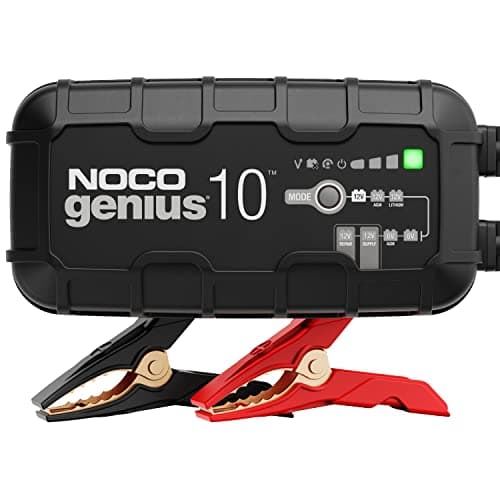 NOCO GENIUS10 Best overall for deep cycle | Several vehicles or a deep-cycle bank | 10 A and a published 230 Ah capacity range, 6 V and 12 V | $99.95View on Amazon #ad Affiliate link · Price as of October 17, 2026 |
| 2 | 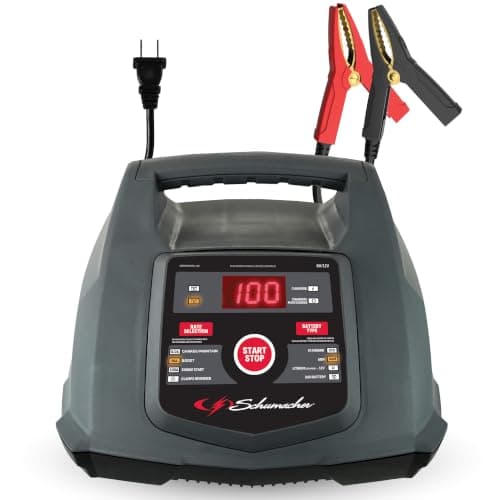 Schumacher SC1281 Best with a desulfation mode | Fast charging plus engine-start assist | 2 to 6 A, 30 A boost, built-in battery and alternator tester | $89.99View on Amazon #ad Affiliate link · Price as of October 17, 2026 |
| 3 | 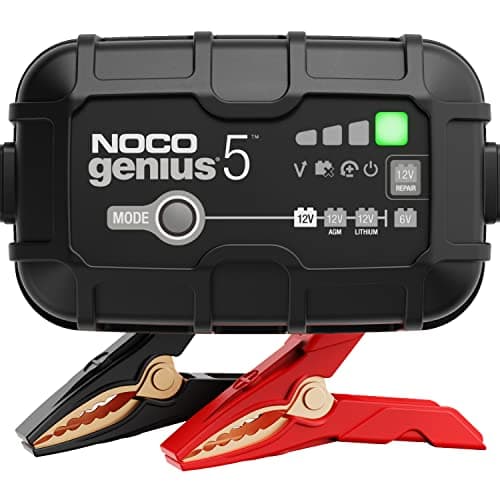 NOCO GENIUS5 Best for a single modest bank | One car, charging and maintaining | 5 A, up to 120 Ah, 1.5 lb, 77 in of cable | $69.95View on Amazon #ad Affiliate link · Price as of October 17, 2026 |
| 4 | 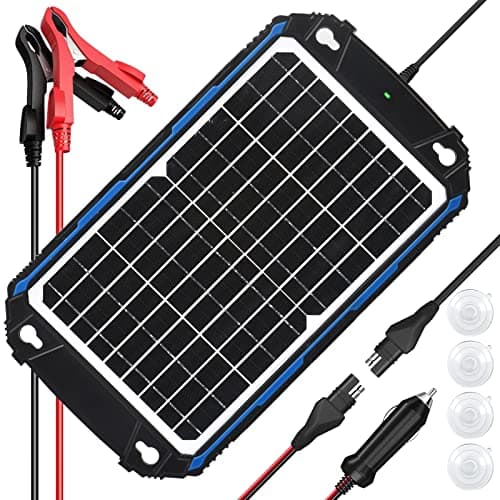 SUNER POWER 12W Solar Battery Maintainer Pro Best for a bank with no outlet | Vehicles stored away from an outlet | 12 W of solar for a trailer or boat parked away from power | $59.99View on Amazon #ad Affiliate link · Price as of October 17, 2026 |
A deep-cycle battery is built for a different life than a starting battery. A starting battery delivers a huge current for two seconds and is then immediately topped back up by the alternator; it is never meant to be run down. A deep-cycle battery is designed to be discharged substantially and recharged, over and over — which means the charger is not an occasional rescue tool but the thing that determines how long the bank lasts. Starting versus deep-cycle batteries is the full explanation of the difference.
Capacity range is the spec to buy on
The figure to find on the box is the published capacity range in amp-hours, not the amp output. They are related but not the same thing, and the capacity range is the manufacturer telling you the size of battery the charger is designed to finish. A charger whose range stops at 120 amp-hours put on a 200 amp-hour bank will run for a very long time and may never complete its absorption stage properly, which is exactly the condition that shortens a deep-cycle battery's life.
| Charger | Charging current | Published capacity range | Voltages | Chemistries |
|---|---|---|---|---|
| NOCO GENIUS10 | 10 A DC | Up to 230 Ah | 6 V and 12 V | Lead-acid and lithium settings, per NOCO |
| Schumacher SC1281 | 2 A to 6 A, with a 30 A boost | Not published as an Ah range | 6 V and 12 V, auto-detected | Standard lead-acid, AGM and gel |
| NOCO GENIUS5 | 5 A DC | Up to 120 Ah | 6 V and 12 V | Lead-acid and lithium settings, per NOCO |
| NOCO GENIUS2 | 2 A DC | Up to 40 Ah | 6 V and 12 V | Lead-acid and lithium settings, per NOCO |
Figures are each maker's own published specifications, linked in Sources. Where a maker does not publish an amp-hour range, the cell says so rather than carrying our estimate.
The useful rule of thumb that falls out of this: size the charger at roughly a tenth of the bank's amp-hour rating and you will be in sensible territory. A 100 amp-hour battery wants about 10 amps; a 40 amp-hour battery is happy on 2 to 5. Going well below that is slow and incomplete; going far above it stresses a lead-acid battery. What amp battery charger do I need works through that arithmetic for starting batteries, and the same logic applies here with bigger numbers.
Chemistry matters more on a deep-cycle bank
Flooded lead-acid, AGM and lithium all want different charge voltages, and a deep-cycle bank is where getting it wrong costs real money. An AGM battery charged on a flooded profile is overcharged; a flooded battery charged on an AGM profile is chronically undercharged and sulfates. A lithium bank on a lead-acid profile may never reach full at all, or may be fed an absorption voltage it should not see.
So the chemistry selector is not a convenience feature on this class of charger — it is the feature. NOCO publishes distinct modes across its GENIUS line and the Schumacher publishes support for standard lead-acid, AGM and gel. Before you buy either, find out what your bank actually is: a label on the battery, or the specification sheet for the model. The best AGM battery chargers covers that chemistry specifically.
When the Schumacher is the better buy
The SC1281's headline is lower than the GENIUS10's — 2 to 6 amps of microprocessor-controlled charging rather than a flat 10 — but it brings three things the NOCO does not. It has a desulfation mode for a battery that has been left discharged, a 30-amp boost stage, and a built-in battery and alternator tester that tells you whether the bank is worth charging at all. For a neglected deep-cycle battery, that combination is more useful than two extra amps.
The honest limit is that it must stay plugged into a 120-volt outlet to do anything — this is a garage and dock tool rather than a portable one. And a desulfation mode is not magic: it recovers some capacity from some batteries some of the time. Battery desulfation, explained is deliberately unsentimental about how much.
Banks with no outlet nearby
A great many deep-cycle batteries live somewhere without power: a trailer in a side yard, a boat on a mooring, a camper at the back of a lot. For those, the right tool is not a bigger charger but a solar maintainer, which replaces the slow parasitic drain that flattens a stored bank over months rather than bulk-charging it.
Be clear about what that is and is not. A 12-watt solar panel is a maintainer, and it will keep a healthy bank topped up through a winter. It will not recover a deeply discharged 200 amp-hour battery, and nothing of that size will. The best solar battery maintainers covers the category, and the best battery chargers for RV batteries covers the mains-powered version of the same problem.
The picks
1. Best overall for deep cycle
NOCO GENIUS10
NOCO · Best for several vehicles or a deep-cycle bank
Twice the current of the GENIUS5 and nearly twice the capacity range — 10 amps up to 230 Ah, which is where RV, marine and multi-vehicle households land.
Published specifications
What works
- 10 A halves the charge time on a flat car battery against a 5 A unit
- The 230 Ah range covers deep-cycle RV and marine batteries the GENIUS5 cannot
- Same -4 °F cold rating and 3-year warranty as the smaller GENIUS units
What does not
- 10 A into a small motorcycle battery is more current than it wants — use a 1 A or 2 A unit there
- Heavier and pricier than a GENIUS5 for a household with one car
Skip it if
Not the right charger for a single motorcycle, ATV or lawn-tractor battery. Small batteries want small current.
#ad Affiliate link · Price as of October 17, 2026
Raw specifications: NOCO’s own page for the NOCO GENIUS10.
2. Best with a desulfation mode
Schumacher SC1281
Schumacher · Best for fast charging plus engine-start assist
A shop-style charger for the garage: a 6-amp automatic charge, a 30-amp boost and a 100-amp engine start, for people who would rather fix the battery than carry a pack.
Published specifications
- Charging current
- 2 A to 6 A, microprocessor-controlled source
- Boost charge
- 30 A source
- Engine start
- 100 A source
- Battery voltages
- 6 V and 12 V, detected automatically source
- Input voltage
- 120 V AC — must stay plugged in source
- Chemistries
- Standard lead-acid, AGM and gel source
- Reconditioning
- Desulfation mode source
- Testing
- Built-in battery and alternator tester source
- Safety
- Reverse-polarity protection, automatic shutoff source
What works
- A 30 A boost charge puts a flat battery back in hours rather than overnight
- 100 A engine start covers the case where the battery is too far gone to take a charge quickly
- Automatic 6 V / 12 V detection reduces the chance of selecting the wrong mode
- The built-in battery and alternator tester tells you whether charging is even the right answer
What does not
- Mains-powered and bulky — a garage tool, not a trunk tool
- High-current charging is harder on an ageing battery than a slow charge
- Engine-start mode is no substitute for a portable pack away from home
Skip it if
Useless on the roadside — there is no outlet on the shoulder of a highway. This is the home half of the problem; a lithium pack is the away half.
#ad Affiliate link · Price as of October 17, 2026
3. Best for a single modest bank
NOCO GENIUS5
NOCO · Best for one car, charging and maintaining
The single most useful charger for one vehicle: 5 amps, 6 V and 12 V, batteries up to 120 Ah, and it can be left connected indefinitely.
Published specifications
What works
- 5 A recharges a car battery overnight and then holds it — one unit does both jobs
- Rated down to -4 °F, so it works in an unheated garage
- The 77-inch cable reaches from a wall outlet to most engine bays without an extension
- 3-year warranty, against 1 year on the jump-starter line
What does not
- 5 A is slow for a deeply discharged large battery — a 100 Ah battery is an all-nighter
- The 120 Ah ceiling rules out larger deep-cycle banks
Skip it if
Not enough charger if you are reviving deep-cycle RV or marine batteries. Step up to the GENIUS10 and its 230 Ah range.
#ad Affiliate link · Price as of October 17, 2026
Raw specifications: NOCO’s own page for the NOCO GENIUS5.
4. Best for a bank with no outlet
SUNER POWER 12W Solar Battery Maintainer Pro
SUNER POWER · Best for vehicles stored away from an outlet
For the boat, RV or seasonal vehicle parked where there is no power — a weatherproof 12-watt panel with its own MPPT charge controller, sized to offset parasitic drain rather than to charge from flat.
This manufacturer does not publish a full specification table for this model on its own site. Rather than repeat figures we cannot source, the assessment below is limited to what the product category and the retailer listing genuinely establish.
What works
- Needs no outlet, which is the entire point for a boat on a trailer or a car in long-term storage
- Offsets the parasitic draw that flattens a stored battery over months
- The charge controller is built in, so there is no separate regulator to buy or wire
- Nothing to plug in means nothing to forget
What does not
- Output depends on sun; a shaded or snow-covered panel does nothing
- It maintains a charged battery — it is not a way to recover a flat one
- 12 watts is a maintenance-scale panel, so it will not keep up with a parasitic fault
- The brand publishes no specification sheet of its own, so there are no manufacturer-sourced figures to put in a table
Skip it if
Not a replacement for a wall charger. If an outlet reaches the vehicle, a plug-in maintainer is more reliable and cheaper.
#ad Affiliate link · Price as of October 17, 2026
Key takeaways
- Buy on the published capacity range in amp-hours, not just the amp output.
- The GENIUS10 publishes 230 Ah and 10 A — the right size for a single large house battery or a modest pair.
- Roughly a tenth of the bank's amp-hour rating is a sensible charger size.
- A charger whose range stops short of your bank may never complete its absorption stage, which shortens battery life.
- The chemistry selector is the feature on this class of charger, not a convenience.
- For a neglected bank, the Schumacher's desulfation mode and built-in tester beat two extra amps.
- A bank with no outlet wants a solar maintainer — which maintains, and does not recover a flat battery.
How we sourced this
Every figure on this page came from one of the following. Where a manufacturer or regulator does not publish a number, we say so rather than estimate it.
- NOCO GENIUS10 published specifications
- NOCO GENIUS10 product page — start-voltage sensor, Force Mode, pulse repair
- NOCO GENIUS5 published specifications
- NOCO GENIUS2 published specifications
- Schumacher SC1281 battery charger and engine starter product page
- Battery Tender 12V 5W mountable solar battery charger (021-1172) product page
Common questions
- What is the best charger for a deep cycle battery?
- The NOCO GENIUS10 for most banks: 10 amps of output and a published 230 amp-hour capacity range across 6-volt and 12-volt batteries, with chemistry-specific modes. Below about 120 amp-hours the GENIUS5 is sufficient and lighter.
- Can I use a car battery charger on a deep cycle battery?
- Only if its published capacity range covers your bank and it has the right chemistry setting. A 2-amp car charger on a 200 amp-hour bank will run for days and may never finish properly, which is the condition that shortens a deep-cycle battery's life.
- What amp charger do I need for a 100Ah battery?
- About 10 amps is the standard rule of thumb — roughly a tenth of the amp-hour rating. That is what makes the GENIUS10 a natural fit for a single 100 amp-hour house battery, with range left over for a larger one.
- Do deep cycle batteries need a special charger?
- They need a charger sized for their capacity with a profile matched to their chemistry, which in practice means a smart multi-stage charger rather than an old unregulated one. AGM, flooded and lithium banks all want different charge voltages, and getting that wrong is expensive on a battery this size.
- Can a solar panel charge a deep cycle battery?
- A small solar panel maintains one; it does not recover one. A 12-watt panel will hold a healthy bank through a winter against parasitic drain, which is exactly the right job for a trailer or boat parked away from power. It will not refill a deeply discharged battery.
More in Battery Chargers
A jump pack gets you moving. A charger is how you stop needing one. This is the home half of the problem.
Read next
Guide
Starting vs Deep Cycle
What separates a cranking battery from a deep-cycle one, what dual-purpose genuinely means, and which charger each needs.
Best for RV batteries
Best for RV Batteries
House battery against chassis battery, why published capacity range decides the charger, and what to do with a coach that sits in storage for seven months.
Guide
What Amp Do I Need?
Charge current sizing by battery capacity, with the 10% guideline shown in full and manufacturer capacity ranges to verify against.
Best AGM Chargers
Best AGM Chargers
Chargers with a genuine AGM mode, what changes about the charge voltage, and how to tell which chemistry your car actually has.
Found something out of date, or a figure you can source better than we did? Tell us — corrections get read first. Our methodology explains how picks are made, and contact is one click away.