Road Trip & Travel
The best tire inflators for travel
A rental car, a borrowed socket, a campground at midnight. Travel is where the assumptions behind a cheap inflator fall apart.

Disclosure: we earn a commission if you buy through the Amazon links on this page, at no extra cost to you. Commission never decides a verdict or a ranking position — read our editorial policy and affiliate disclosure.
How we assessed these: picks are selected from manufacturer specifications, current retailer listings and published owner feedback — not from hands-on testing of every unit. Where a manufacturer does not publish a figure, it is left out rather than estimated.
Short answer
For travel, buy the Fanttik X8 Apex. It runs off its own 28.8 watt-hour battery, so it does not need a working accessory socket in a car you do not own, it recharges from the same USB-C charger as your phone, and at 1.74 lb it fits in a carry-on under the airline lithium limits.
Quick picks
Tap any row to jump to the full write-up. Scoring criteria are published in full on our methodology page.
| # | Product | Best for | Our read | Price |
|---|---|---|---|---|
| 1 | 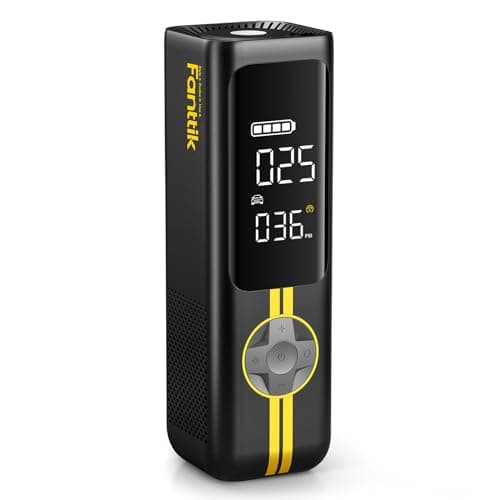 Fanttik X8 Apex Best overall for travel | Cordless top-ups from a glovebox | 28.8 Wh own battery, 1.74 lb, USB-C, 150 PSI | $69.99$89.99View on Amazon #ad Affiliate link · Price as of October 16, 2026 |
| 2 | 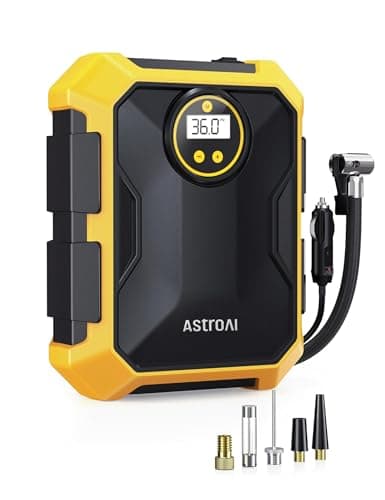 AstroAI 12V Tire Inflator Best backup that cannot go flat | The cheapest inflator still worth owning | Runs from any 12 V socket, nothing to charge | $23.99$27.99View on Amazon #ad Affiliate link · Price as of October 16, 2026 |
| 3 | 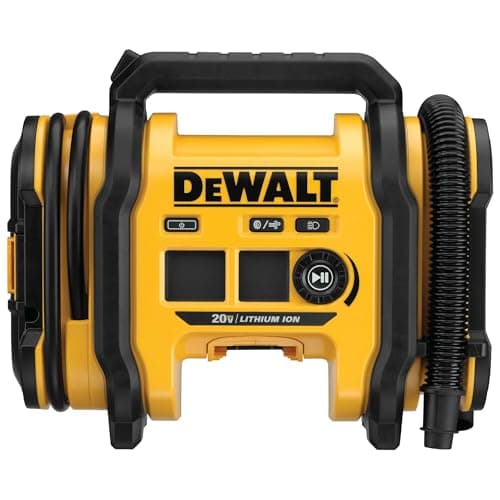 DEWALT DCC020IB 20V MAX Inflator Best if you travel with tool batteries | Anyone already on DEWALT 20V batteries | 20V MAX, 12 V DC or 110 V AC, threaded chuck | $141.79$179.00View on Amazon #ad Affiliate link · Price as of October 16, 2026 |
| 4 | 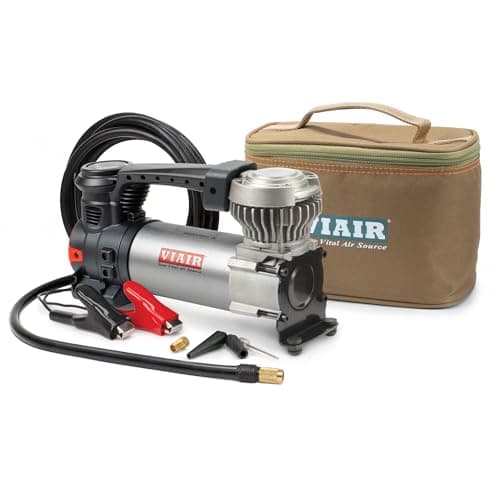 VIAIR 88P Portable Compressor Best for a trailer or a loaded road trip | Truck, SUV and off-road tires | 120 PSI, 25-minute duty cycle, IP53, 4.75 lb | $89.89$103.95View on Amazon #ad Affiliate link · Price as of October 16, 2026 |
Travel breaks three assumptions that a tire inflator for your own driveway is allowed to make. You will have a working 12-volt socket. You will have time and space to run a cord around a vehicle. And the inflator will have been charged recently, because it lives where you live. Away from home, none of those is reliable, and the inflator that suits a travel buyer is the one that depends on fewest of them.
That is why the cordless unit leads here even though a plain socket inflator is the better value at home. Independence from the vehicle is the whole feature.
The comparison that matters on the road
| Unit | Power source | Max pressure | Weight | Needs the car? |
|---|---|---|---|---|
| Fanttik X8 Apex | 28.8 Wh internal, USB-C recharge | 150 PSI | 1.74 lb | No |
| AstroAI 12V inflator | 12 V accessory socket | 100 PSI | Not published | Yes |
| DEWALT DCC020IB | 20V MAX, 12 V DC or 110 V AC | Not published | Not published | No, if you carry a tool battery |
| VIAIR 88P | 12 V battery clamps | 120 PSI | 4.75 lb | Yes, at the battery |
All figures are each manufacturer's own published specifications; rows marked not published are left as such rather than estimated. The last column is the question a traveler should ask first.
Fanttik publishes the figures that make the X8 Apex a travel tool rather than a gadget: 150 PSI maximum, a stated accuracy within 1 PSI, up to 40 minutes continuous runtime, a 56-second fill for a 215/55 R17 tire from 28 to 33 PSI, and USB-C recharging at up to 15 watts. The last of those is the quiet one — it means your phone charger refills it, so you are not carrying a proprietary brick.
Flying with it, which has real rules
A cordless inflator is a lithium battery, and lithium batteries are regulated in air travel. The FAA's PackSafe guidance and TSA's rules both work from watt-hours: spare and device batteries up to 100 watt-hours are generally permitted in carry-on baggage, batteries above 100 watt-hours need airline approval, and lithium batteries must travel in the cabin rather than in checked baggage.
At 28.8 watt-hours the X8 Apex sits comfortably inside the carry-on allowance, which is the practical reason it is the pick for someone who flies to a destination and rents a car. Always check with the airline — the rules are theirs to apply — and read flying with a jump starter for the same thresholds applied to the bigger lithium tool in the kit.
The case for carrying the cheap one as well
The failure mode of a cordless inflator is being flat, and travel is exactly when that happens — you used it on the outbound leg, you did not charge it at the hotel, and the tire is soft on the way home. A plain socket inflator cannot be flat, because its power source is whatever vehicle you are in. Carrying both is not redundancy for its own sake; it is covering two different failures.
If you are driving your own vehicle rather than flying, the socket unit is also the one that handles a long fill without worrying about the cell, because the car is supplying it. 12-volt versus cordless tire inflators is the full comparison, and does a tire inflator drain your battery covers what a long fill actually costs the car.
Towing changes the answer
A trailer, a camper or a boat on a trailer moves this out of pocket-inflator territory. Trailer tires often run higher pressures than car tires and there are more of them, and a small cordless unit will overheat before it finishes. The VIAIR 88P publishes 120 PSI maximum working pressure, 1.97 CFM at 0 PSI, a 25-minute duty cycle at 30 PSI and IP53 ingress protection — the duty cycle figure is the one almost nothing else in this category publishes.
It connects at the battery terminals rather than the socket, because its published 20-amp draw with a 45-amp inrush is more than an accessory circuit is built for. Tire inflators for RV tires covers the towing case properly, and tire inflator PSI explained covers how much pressure rating you actually need.
Four habits that make it work away from home
- Charge it the night before you leave, not the night you need it. The hotel room is the opportunity; the shoulder of a highway is not.
- Check pressures cold, before the first drive of the day. Pressure read after a highway run is high, and setting to the door placard figure while warm leaves you underinflated. What PSI your tires should be covers it.
- Find the rental car's placard before you need it. It is in the driver's door jamb, and the figure is specific to that vehicle and tire size, not to cars in general.
- Keep the USB-C cable and the adapters with the unit. A travel inflator and no cable is luggage. Everything lives in one pouch or it gets separated.
The picks in full
1. Best overall for travel
Fanttik X8 Apex
Fanttik · Best for cordless top-ups from a glovebox
A self-contained cordless inflator small enough to live in a door pocket, with a backlit digital gauge and a preset target pressure.
Published specifications
- Maximum pressure
- 150 PSI source
- Internal battery
- 28.8 Wh lithium-ion source
- Stated gauge accuracy
- ±1 PSI source
- Stated runtime
- Up to 40 minutes continuous source
- Stated fill time
- 56 seconds, 215/55 R17 from 28 to 33 PSI source
- Operating temperature
- 14 to 113 °F (-10 to 45 °C) source
- Weight
- 1.74 lb source
- Recharging
- USB-C, 15 W maximum source
- Work light
- 40 lumens source
- Preset modes
- 4 — bicycle, motorcycle, car, ball; PSI, kPa and bar source
- Warranty
- 12 months source
What works
- No cable to the car at all — it runs off its own internal battery
- Small enough that it stays in the vehicle, which is most of the battle
- Preset-and-stop pressure control avoids the overshoot you get chasing an analogue gauge
What does not
- An internal battery is one more thing to keep charged, and cold weather cuts into it
- Cordless inflators this size heat up on large tires; expect to work in stages
- Manufacturer duty-cycle figures for this class are not consistently published
Skip it if
Not the pick for light-truck or RV tires. Small cordless units are built for top-ups, not for taking a 35-inch tire from flat to 60 PSI.
#ad Affiliate link · Price as of October 16, 2026
2. Best backup that cannot go flat
AstroAI 12V Tire Inflator
AstroAI · Best for the cheapest inflator still worth owning
A plain 12 V socket-powered inflator with a digital gauge and auto-shutoff — the baseline that covers a car's tires with no battery to maintain.
This manufacturer does not publish a full specification table for this model on its own site. Rather than repeat figures we cannot source, the assessment below is limited to what the product category and the retailer listing genuinely establish.
What works
- Powered from the 12 V socket, so it works whenever the car does
- Nothing to keep charged, which means it is never flat when the tire is
- Digital preset shutoff at the target pressure
What does not
- The cord limits where you can work, and reaching a rear tire can be tight
- Small-motor inflators in this tier run hot; large tires need rest intervals
- Gauge accuracy in this class varies unit to unit, so verify against a separate gauge
Skip it if
Not the pick if you regularly air down and back up for trails, or run light-truck tires. That is dedicated-compressor work.
#ad Affiliate link · Price as of October 16, 2026
3. Best if you travel with tool batteries
DEWALT DCC020IB 20V MAX Inflator
DEWALT · Best for anyone already on dewalt 20v batteries
Three power sources in one body — 20V MAX battery, 12 V socket or 110 V wall — with a digital gauge and auto-shutoff, which is what makes an inflator usable everywhere.
Published specifications
What works
- The 12 V socket option means a dead tool battery never leaves you stranded
- A threaded chuck screws onto the valve stem instead of clamping — the difference between a solid seal and a hissing one
- Set-and-walk-away auto-shutoff at your target pressure
- High-volume mode handles air mattresses and inflatables, not just tires
What does not
- Sold as a bare tool — battery, charger and AC adapter are separate purchases
- Bigger and heavier than a pocket 12 V inflator, so it wants trunk space
Skip it if
Not the pick if you own no DEWALT batteries and only ever top up car tires. A plain 12 V inflator is smaller and cheaper for that job.
#ad Affiliate link · Price as of October 16, 2026
Raw specifications: DEWALT’s own page for the DEWALT DCC020IB 20V MAX Inflator.
4. Best for a trailer or a loaded road trip
VIAIR 88P Portable Compressor
VIAIR · Best for truck, suv and off-road tires
A battery-clamp compressor built for the tire sizes socket-powered units cannot handle without stopping to cool down.
Published specifications
- Maximum working pressure
- 120 PSI source
- Air flow
- 1.97 CFM at 0 PSI source
- Duty cycle
- 25 minutes at 30 PSI source
- Supply
- 12 V, battery clamps source
- Maximum amp draw
- 20 A source
- Inrush current
- 45 A at 0 PSI source
- Ingress protection
- IP53 source
- Operating temperature
- -4 to 158 °F source
- Tire size rating
- Up to 33 in source
- Weight
- 4.75 lb source
- Power cord / air hose
- 10 ft / 16 ft source
What works
- Connects to the battery terminals rather than the 12 V socket, so socket fuse current is not the limit
- Built for larger tires and repeated fills — the duty cycle is the whole reason to buy it
- Metal body and a real air hose rather than a molded plastic assembly
What does not
- The battery-clamp connection means popping the hood every time
- Bigger and heavier than any glovebox inflator
- Overkill, and slower to set up, for a routine cold-morning top-up
Skip it if
Not the pick if you drive a sedan and just want to correct 4 PSI once a month. That is what a socket inflator is for.
#ad Affiliate link · Price as of October 16, 2026
Key takeaways
- Travel breaks the assumption of a working socket in a car you own — independence is the feature.
- The X8 Apex's 28.8 Wh battery sits well inside the 100 Wh airline carry-on threshold.
- Lithium devices and spares belong in the cabin under FAA and TSA guidance, never in checked bags.
- Carry a plain socket inflator too: it cannot be flat, which is the cordless unit's failure mode.
- Towing moves you to a clamp-fed compressor with a published duty cycle.
- Check pressures cold, and find the placard in the door jamb of whatever you are driving.
How we sourced this
Every figure on this page came from one of the following. Where a manufacturer or regulator does not publish a number, we say so rather than estimate it.
- Fanttik X8 APEX tire inflator published specifications
- AstroAI 12V 100 PSI tire inflator product page
- DEWALT DCC020IB 20V MAX inflator product page
- VIAIR 88P portable compressor published specifications
- FAA PackSafe — Lithium Batteries (carry-on and checked rules, watt-hour limits)
- TSA — Lithium batteries with more than 100 watt hours
Common questions
- Can you take a tire inflator on a plane?
- A cordless one, in carry-on baggage, within the lithium limits. FAA PackSafe and TSA guidance permit batteries up to 100 watt-hours in the cabin, and lithium batteries must not be checked. The Fanttik X8 Apex's published 28.8 watt-hours is well inside that. Confirm with your airline, which applies the rules.
- What is the best tire inflator for a rental car?
- A cordless unit, because you cannot rely on a rental car's accessory socket being live with the engine off, and you do not want to be hunting for a socket in an unfamiliar cabin at night. A self-powered inflator works regardless of the vehicle.
- Do I need a tire inflator on a road trip if I have a spare?
- They solve different problems. A spare handles a tire that is damaged; an inflator handles the far more common case of a tire that is simply low, including the slow leak that would otherwise become a blowout. Most road trip tire problems are pressure, not punctures.
- Is a cordless tire inflator powerful enough for travel?
- For car tires, yes. Fanttik publishes 150 PSI maximum and a 56-second fill from 28 to 33 PSI on a 215/55 R17. Where small cordless units fall short is light-truck, RV and trailer tires, which need a clamp-fed compressor with a published duty cycle.
More in Road Trip & Travel
What changes when the nearest parts store is four hours away, the pack has to survive a hot trunk, and the airline has an opinion about your lithium battery.
Read next
Best Portable Tire Inflators
Best Portable Tire Inflators
Our main inflator roundup: socket, cordless, tool-battery and battery-clamp units, matched to the tires you actually run.
Best for RV Tires
Best for RV Tires
Why RV and trailer tires defeat small inflators, what throughput to look for, and the pressures that make this different from a car.
Guide
Flying With a Jump Starter
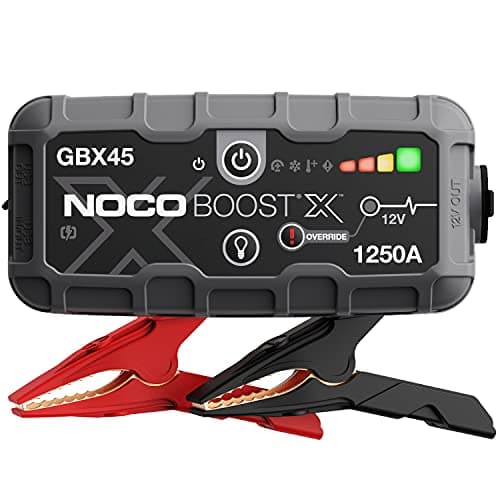
The FAA and TSA thresholds quoted from source, where every mainstream pack sits against them, and the rules airlines add on top.
Guide
Flat Tire on a Road Trip
The order of operations when a tire goes down away from home: getting safe, telling a slow leak from real damage, and what actually gets you to the next town.
Found something out of date, or a figure you can source better than we did? Tell us — corrections get read first. Our methodology explains how picks are made, and contact is one click away.