Road Trip & Travel
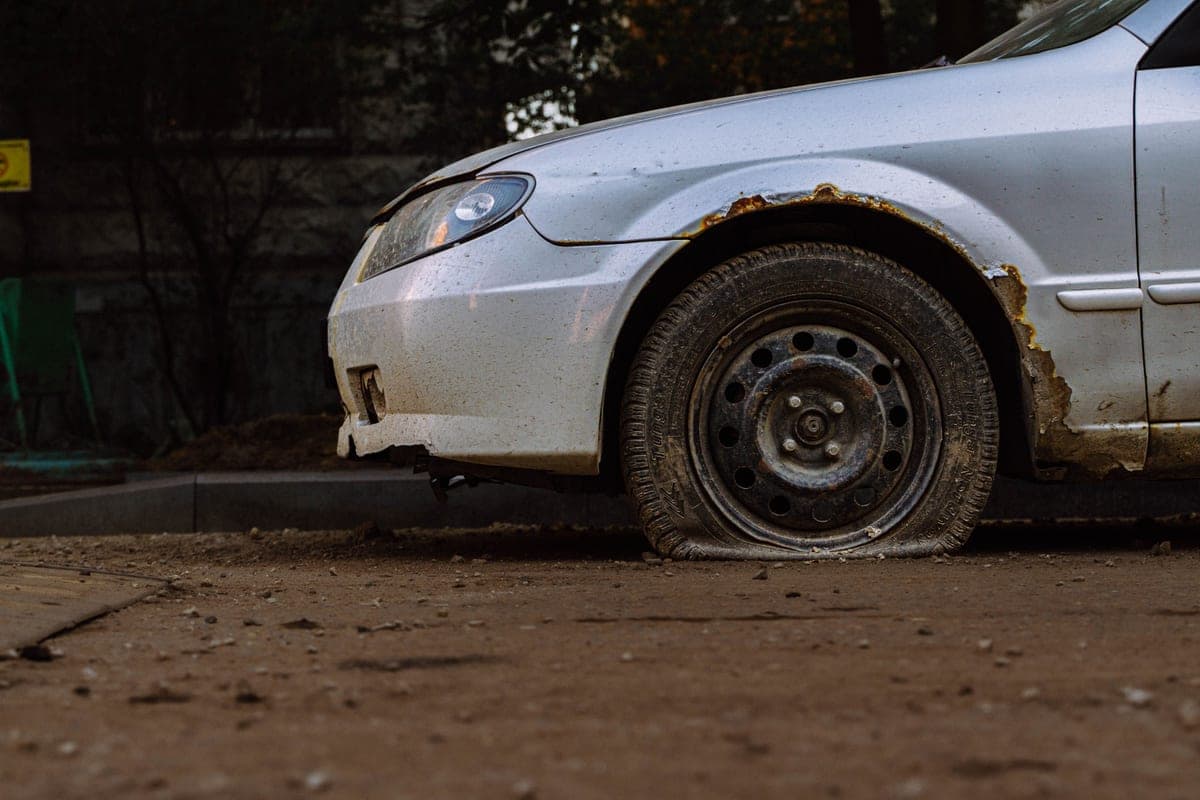
What to do if you get a flat tire on a road trip
Hundreds of miles from home, the decision tree is short — and the first branch is not about the tire at all.
Disclosure: we earn a commission if you buy through the Amazon links on this page, at no extra cost to you. Commission never decides a verdict or a ranking position — read our editorial policy and affiliate disclosure.
How we assessed these: picks are selected from manufacturer specifications, current retailer listings and published owner feedback — not from hands-on testing of every unit. Where a manufacturer does not publish a figure, it is left out rather than estimated.
Short answer
Get completely off the road first, well past the white line, hazards on and triangles out. Then look at the tire. If it is soft but intact, inflate it and drive to the next town checking pressure as you go. If it is cut, shredded or off the rim, fit the spare or call for recovery — do not inflate damage.
The reason this order matters is that the most dangerous part of a roadside tire problem is not the tire. It is standing next to traffic. Most of what goes seriously wrong in this situation happens in the first two minutes, before anyone has looked at a wheel, and it happens because a driver stopped in a bad place and got out on the traffic side.
First: get somewhere you can work
- Keep rolling to a safe spot if you can. A slowly deflating tire will tolerate a few hundred yards at low speed far better than you will tolerate standing in a live lane. An exit, a pull-off or a wide verge beats stopping where it happened.
- Hazards on before you slow down. You want following traffic to understand what is happening while there is still distance between you.
- Get as far right as the shoulder allows, wheels straight. If the shoulder is narrow or there is a barrier, keep going to the next exit at reduced speed rather than stopping in a trap.
- Triangles or flares behind the vehicle. Well behind — far enough back that traffic has time to react. Reflective triangles are the single cheapest safety item in a trunk.
- Everyone out on the passenger side, and away from the road. Behind the barrier where there is one. The car is replaceable.
Second: work out which problem you have
There are two completely different situations hiding behind the phrase flat tire, and they get opposite responses. Most roadside tire events are the first kind.
| What you see | What it is | What to do |
|---|---|---|
| Soft, tire holds its shape, no visible damage | Slow leak — valve, bead or a small puncture | Inflate and drive on, checking pressure |
| A nail or screw head visible, tire still holding some air | Puncture, sealing itself around the object | Inflate, leave the object in place, drive to a shop |
| Sidewall cut, bulge or visible cords | Structural damage | Do not inflate. Spare or recovery |
| Tire off the rim or shredded | Destroyed | Spare or recovery; check the wheel for damage |
| Tire goes down again within minutes of inflating | Leak too large to outrun | Spare, sealant or recovery |
This is a triage table, not a repair guide. Any tire that has been driven on while flat should be inspected by a shop even if it holds air afterwards, because the damage is often internal.
The reason the first row is the most common is that tires rarely fail suddenly on a road trip. They fail slowly, over a few hundred miles, from a small puncture or a leaking valve core, and the driver notices either a TPMS light or a car that feels odd. That is an inflator problem, and it is why an inflator earns its space in the trunk far more often than the jack does.
Third: inflate, if inflating is the right answer
Set the inflator to the figure on the Tire and Loading Information placard in the driver's door jamb, not the maximum pressure molded into the tire sidewall. The sidewall figure is the tire's limit and is frequently well above what the vehicle wants. A preset-and-stop inflator does this for you, which matters when you are kneeling by a wheel in poor light.
Then drive, and check it. If the tire holds for twenty miles, you have a slow leak and you can reach a town. If it is soft again in five, the leak is bigger than you can outrun and the spare is the answer. How to use a portable tire inflator covers the technique, and what PSI your tires should be covers the placard.
On the spare, and the thing nobody checks
Two facts about spare tires catch travelers out. The first is that a compact temporary spare usually runs a much higher pressure than a road tire — often around 60 PSI — and it has been losing air in the trunk since the car was new. The second is that a significant number of modern cars do not have one at all, having been sold with a sealant kit instead.
Both are worth resolving in your own driveway rather than on a shoulder in Nevada. Check the spare's pressure before a long trip, and know whether you have a spare, a sealant kit or neither. What PSI a spare tire should be covers the first, and tire inflator versus sealant covers the second, including why sealant is a last resort rather than a repair.
What to have in the car before the trip
The kit for this is short and it fits in one corner of a trunk. An inflator that does not depend on a socket you may not be able to reach. Reflective triangles, because being seen is the first problem. A light that is not your phone, because you will want your phone's battery. A pressure gauge you trust. And the knowledge of where the jack and the spare actually are in your specific vehicle, which is not obvious in many crossovers.
If you are towing, scale all of that up: trailer tires run higher pressures, there are more of them, and a small cordless unit will overheat before it finishes. The road trip car kit is the full list, and the best tire inflators for travel covers the inflator choice for someone away from home.
What we would carry
1. Best tool for the common case
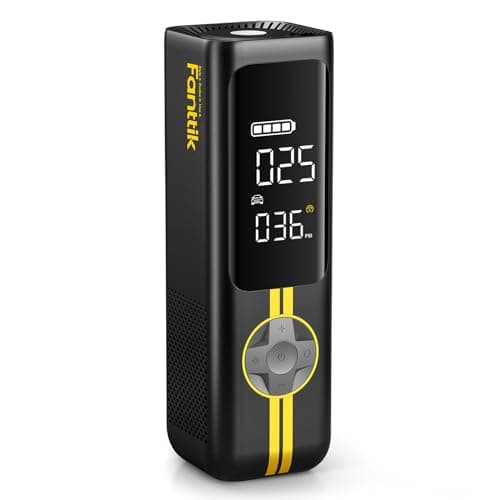
Fanttik X8 Apex
Fanttik · Best for cordless top-ups from a glovebox
A self-contained cordless inflator small enough to live in a door pocket, with a backlit digital gauge and a preset target pressure.
Published specifications
- Maximum pressure
- 150 PSI source
- Internal battery
- 28.8 Wh lithium-ion source
- Stated gauge accuracy
- ±1 PSI source
- Stated runtime
- Up to 40 minutes continuous source
- Stated fill time
- 56 seconds, 215/55 R17 from 28 to 33 PSI source
- Operating temperature
- 14 to 113 °F (-10 to 45 °C) source
- Weight
- 1.74 lb source
- Recharging
- USB-C, 15 W maximum source
- Work light
- 40 lumens source
- Preset modes
- 4 — bicycle, motorcycle, car, ball; PSI, kPa and bar source
- Warranty
- 12 months source
What works
- No cable to the car at all — it runs off its own internal battery
- Small enough that it stays in the vehicle, which is most of the battle
- Preset-and-stop pressure control avoids the overshoot you get chasing an analogue gauge
What does not
- An internal battery is one more thing to keep charged, and cold weather cuts into it
- Cordless inflators this size heat up on large tires; expect to work in stages
- Manufacturer duty-cycle figures for this class are not consistently published
Skip it if
Not the pick for light-truck or RV tires. Small cordless units are built for top-ups, not for taking a 35-inch tire from flat to 60 PSI.
#ad Affiliate link · Price as of October 16, 2026
2. Most important item you will not think of
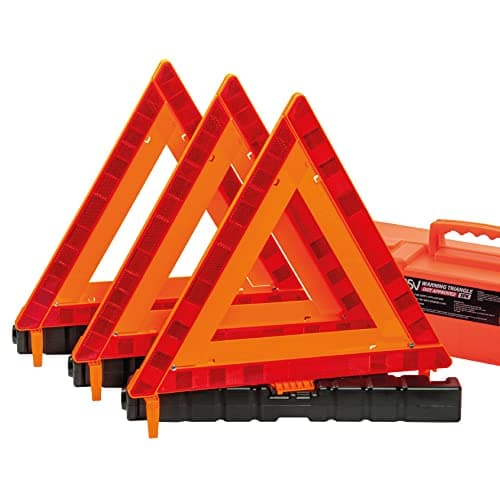
DSV Standard Warning Triangles, 3-Pack
DSV Standard · Best for being seen before anything else
The cheapest insurance in the trunk against the thing that actually hurts you: three DOT-approved folding triangles with weighted bases, in a carry case. Before you open the hood on a shoulder, you want traffic to know you are there.
This manufacturer does not publish a full specification table for this model on its own site. Rather than repeat figures we cannot source, the assessment below is limited to what the product category and the retailer listing genuinely establish.
What works
- Works without batteries, in any weather, for as long as you own the car
- Folds flat into its own case, so it costs almost no trunk space
- Three of them, which is what lets you mark a proper warning distance behind the vehicle
- Visible far enough back to give traffic time to move over
What does not
- Only useful if you actually get out and place it, which takes a deliberate habit
- Plastic bases crack if they live loose under heavier gear
Skip it if
Not a substitute for hazard lights or for getting clear of the roadway. Placement matters more than the product.
#ad Affiliate link · Price as of October 16, 2026
3. Best ready-made starting point
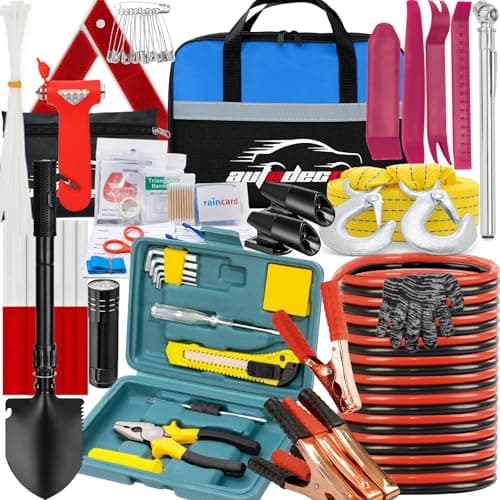
AUTODECO Roadside Emergency Kit
AUTODECO · Best for a ready-made starting point
A pre-assembled kit is the fastest way to stop having no kit. This one covers the bag, jumper cables, a folding shovel and a basic first-aid set. Treat it as a base to upgrade, not a finished answer.
This manufacturer does not publish a full specification table for this model on its own site. Rather than repeat figures we cannot source, the assessment below is limited to what the product category and the retailer listing genuinely establish.
What works
- Removes the excuse — one purchase and there is something in the trunk tonight
- The bag and organization are usually better than what you would improvise
- Covers the small consumables nobody buys on their own: gloves, ties, tape, first aid
What does not
- The jumper cables and flashlight in pre-built kits are the first things worth replacing
- Advertised item counts include individual bandages, which inflates the apparent value
- No jump starter and no inflator in the box — the two things that actually get you moving
Skip it if
Not sufficient on its own. If you buy one, budget for a jump starter and an inflator alongside it, because the kit will include neither.
#ad Affiliate link · Price as of October 16, 2026
4. Best if you are towing
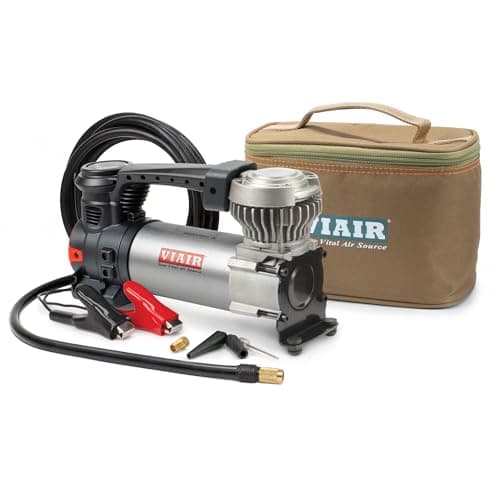
VIAIR 88P Portable Compressor
VIAIR · Best for truck, suv and off-road tires
A battery-clamp compressor built for the tire sizes socket-powered units cannot handle without stopping to cool down.
Published specifications
- Maximum working pressure
- 120 PSI source
- Air flow
- 1.97 CFM at 0 PSI source
- Duty cycle
- 25 minutes at 30 PSI source
- Supply
- 12 V, battery clamps source
- Maximum amp draw
- 20 A source
- Inrush current
- 45 A at 0 PSI source
- Ingress protection
- IP53 source
- Operating temperature
- -4 to 158 °F source
- Tire size rating
- Up to 33 in source
- Weight
- 4.75 lb source
- Power cord / air hose
- 10 ft / 16 ft source
What works
- Connects to the battery terminals rather than the 12 V socket, so socket fuse current is not the limit
- Built for larger tires and repeated fills — the duty cycle is the whole reason to buy it
- Metal body and a real air hose rather than a molded plastic assembly
What does not
- The battery-clamp connection means popping the hood every time
- Bigger and heavier than any glovebox inflator
- Overkill, and slower to set up, for a routine cold-morning top-up
Skip it if
Not the pick if you drive a sedan and just want to correct 4 PSI once a month. That is what a socket inflator is for.
#ad Affiliate link · Price as of October 16, 2026
Key takeaways
- Get fully off the road before you look at the tire — the traffic is the real hazard.
- Hazards on before you slow, triangles well behind, everyone out on the passenger side.
- Most road trip tire problems are slow leaks, which an inflator solves on the spot.
- Never inflate a tire with a sidewall cut, a bulge or visible cords.
- Inflate to the door placard figure, not the maximum on the sidewall.
- Check your spare's pressure at home — and check whether you even have one.
How we sourced this
Every figure on this page came from one of the following. Where a manufacturer or regulator does not publish a number, we say so rather than estimate it.
Common questions
- Can you drive on a flat tire to the next exit?
- At low speed, briefly, if the alternative is stopping somewhere unsafe — a wheel rim is cheaper than standing in a live lane. But driving any distance on a genuinely flat tire destroys the tire and can damage the wheel and suspension, so treat it as an emergency move to reach a safe spot, not as a way to reach a town.
- Will a tire inflator fix a flat tire on a road trip?
- It fixes the common case, which is a tire that is low from a slow leak or a small puncture. Inflate it, then check it after twenty miles. If it holds, you can reach a shop. If it is soft again quickly, the leak is too big and you need the spare or recovery.
- Should I leave a nail in the tire?
- Yes, until a shop can look at it. A nail or screw still in the tread is partly sealing the hole it made. Pulling it out turns a slow leak into a fast one, usually at the worst moment.
- What if the car has no spare tire?
- Many newer vehicles ship with a sealant kit instead. A sealant canister will get a small puncture mobile, with the caveat that it coats the inside of the tire and the TPMS sensor and complicates a proper repair. An inflator plus a plan for recovery is the more useful combination for a long trip.
- How far can you drive on a compact spare?
- Follow the limits on the spare's own label, which typically restrict both speed and distance — commonly around 50 mph and a limited range. It is a get-to-a-shop tire, not a replacement, and it also usually needs a much higher pressure than the tire it replaced.
More in Road Trip & Travel
What changes when the nearest parts store is four hours away, the pack has to survive a hot trunk, and the airline has an opinion about your lithium battery.
Read next
Guide
Road Trip Car Kit
What changes when help is four hours away: margin on the pack, terrain-specific additions, and the things worth leaving at home.
Head to head
Inflator vs Sealant
When air is enough, when you need sealant, what sealant does to a TPMS sensor and a future repair, and why most drivers should carry both.
Guide
Spare Tire PSI
Temporary-use spares, full-size spares and the reason the figure differs — plus how to check a spare you cannot easily reach.
Best for travel
Best for Travel
What changes when the inflator has to work away from your own car: power sources you cannot count on, weight and bulk that have to be carried, and airline rules on lithium.
Found something out of date, or a figure you can source better than we did? Tell us — corrections get read first. Our methodology explains how picks are made, and contact is one click away.