Tire Inflators
How to use a portable tire inflator
Seven steps. Most of the difficulty is in the chuck, and most of the mistakes are in the target pressure.
Disclosure: we earn a commission if you buy through the Amazon links on this page, at no extra cost to you. Commission never decides a verdict or a ranking position — read our editorial policy and affiliate disclosure.
How we assessed these: the figures here come from manufacturer pages and NHTSA publications, cited inline. We do not publish measured fill times or gauge-deviation figures, because we do not measure them.
Short answer
Find your placard pressure, check the tires cold, screw the chuck fully onto the valve stem, set the target, and let the auto-shutoff stop it. Work in rotation across the tires on a small unit so it does not overheat, and re-check with a separate gauge.
The sequence
Find the target pressure first
Open the driver's door and read the Tire and Loading Information label on the B-pillar. Note whether front and rear differ. Do not use the number on the tire sidewall — that is the tire's maximum, often 15-20 PSI higher. The full explanation is here.
Work on cold tires
Parked a few hours, or driven less than about a mile. Driving heats the air and raises the reading, so setting to the placard figure while warm leaves you underinflated once things cool.
Set up the power source
For a socket unit, start the engine so you are drawing from the alternator rather than the battery. For a cordless unit, confirm it actually has charge before you unscrew anything — a flat inflator and a flat tire is a bad combination.
Remove the valve cap and keep it somewhere
A pocket, not the ground beside the wheel. Caps keep grit out of the valve, and the one you lose is the valve that starts weeping later.
Seat the chuck properly
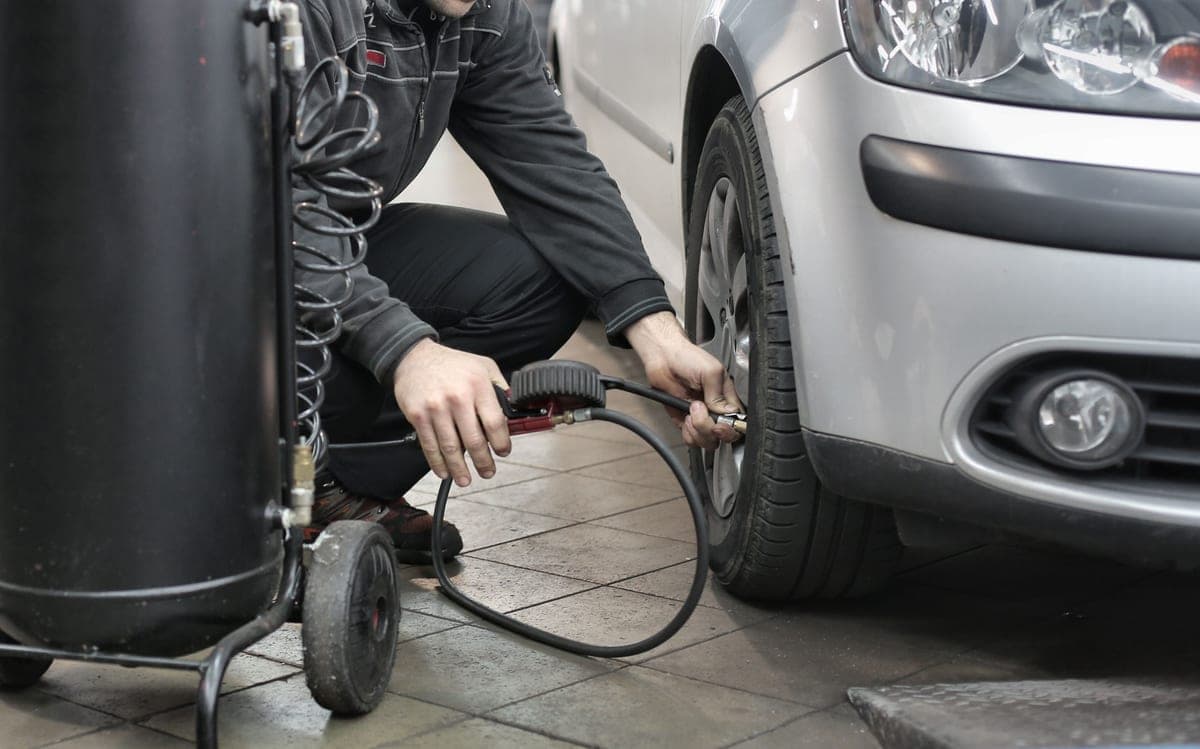
A threaded chuck screws onto the valve stem — turn it until it is firm, not just touching. A clamp-on chuck needs pushing squarely on and latching. Either way, listen: a hiss means air is escaping and the gauge will read low. This step causes most of the frustration people have with inflators.
Set the target and run it
Enter the placard figure and let the auto-shutoff do the work. Without a preset, check in short bursts rather than running continuously and overshooting — letting air back out is wasted work and wasted run time.
Verify, replace the cap, and move on
Check with a separate gauge if you have one, especially until you know your inflator's offset. Replace the valve cap. Then the next tire.
On a small inflator, work in rotation
If your unit is a pocket cordless or a basic socket inflator and the tires are meaningfully low, do a partial fill on each tire in turn rather than taking one to target and then starting the next. Each tire gets closer while the others give the motor a break, and you are much less likely to hit a thermal cut-out. See duty cycle.
If the tire will not hold air
You have a puncture rather than a slow leak, and an inflator alone will not solve it. Three situations:
- It holds pressure for a while, then drops. A slow leak. Inflate and drive to a shop — you have time, but do not ignore it.
- It drops immediately. The tire is not sealing. This is a plug, sealant or spare job. Inflator vs sealant covers the choice and what sealant does to a TPMS sensor.
- There is visible sidewall damage, a bulge, or the tire has been driven on flat. Do not reinflate and drive on it. A sidewall is not repairable and a run-flat-damaged tire can fail at speed.
What to use
1. Simplest to use correctly
AstroAI 12V Tire Inflator
AstroAI · Best for the cheapest inflator still worth owning
A plain 12 V socket-powered inflator with a digital gauge and auto-shutoff — the baseline that covers a car's tires with no battery to maintain.
This manufacturer does not publish a full specification table for this model on its own site. Rather than repeat figures we cannot source, the assessment below is limited to what the product category and the retailer listing genuinely establish.
What works
- Powered from the 12 V socket, so it works whenever the car does
- Nothing to keep charged, which means it is never flat when the tire is
- Digital preset shutoff at the target pressure
What does not
- The cord limits where you can work, and reaching a rear tire can be tight
- Small-motor inflators in this tier run hot; large tires need rest intervals
- Gauge accuracy in this class varies unit to unit, so verify against a separate gauge
Skip it if
Not the pick if you regularly air down and back up for trails, or run light-truck tires. That is dedicated-compressor work.
#ad Affiliate link · We show no price here; Amazon shows the current one
2. Best chuck and gauge
DEWALT DCC020IB 20V MAX Inflator
DEWALT · Best for anyone already on dewalt 20v batteries
Three power sources in one body — 20V MAX battery, 12 V socket or 110 V wall — with a digital gauge and auto-shutoff, which is what makes an inflator usable everywhere.
Published specifications
What works
- The 12 V socket option means a dead tool battery never leaves you stranded
- A threaded chuck screws onto the valve stem instead of clamping — the difference between a solid seal and a hissing one
- Set-and-walk-away auto-shutoff at your target pressure
- High-volume mode handles air mattresses and inflatables, not just tires
What does not
- Sold as a bare tool — battery, charger and AC adapter are separate purchases
- Bigger and heavier than a pocket 12 V inflator, so it wants trunk space
Skip it if
Not the pick if you own no DEWALT batteries and only ever top up car tires. A plain 12 V inflator is smaller and cheaper for that job.
#ad Affiliate link · We show no price here; Amazon shows the current one
Raw specifications: DEWALT’s own page for the DEWALT DCC020IB 20V MAX Inflator.
Key takeaways
- Get the target from the door-jamb placard, not the sidewall.
- Check and set cold, before driving.
- Seat the chuck until it stops hissing — this is where most of the difficulty lives.
- On small units, fill tires in rotation to avoid a thermal cut-out.
- A tire that drops immediately needs a plug, sealant or the spare, not more air.
How we sourced this
Every figure on this page came from one of the following. Where a manufacturer or regulator does not publish a number, we say so rather than estimate it.
Common questions
- How do you use a portable tire inflator?
- Read the target pressure from the door-jamb placard, work on cold tires, screw the chuck fully onto the valve stem until it stops hissing, set the target pressure and let the auto-shutoff stop the pump. Verify with a separate gauge and replace the valve cap.
- Should the engine be running when using a tire inflator?
- For a socket- or clamp-powered unit, yes — that way you are drawing from the alternator rather than discharging the battery. It matters more the longer the fill takes, and it matters most if the battery is already weak.
- How long does it take to inflate a tire with a portable inflator?
- A 4-5 PSI top-up on a car tire is roughly a minute on most units. A car tire from flat is several minutes. A light-truck tire from flat can exceed a small unit's run time and need cooling breaks. The variable is air throughput, not the maximum-pressure rating.
- Why is air escaping while I inflate?
- The chuck is not seated. A threaded chuck needs screwing on until firm; a clamp-on chuck needs pushing squarely on and latching. A hiss means you are losing air as fast as you add it, and the gauge will read low as a result.
More in Tire Inflators
The cheapest tool that prevents the second-most-common roadside stop. Here is which type fits your tires, and the two specs that actually matter.
Read next
Guide
What PSI Should My Tires Be?
The single most common tire mistake, fixed in two minutes: placard versus sidewall, checking cold, and what cold weather does to the reading.

Head to head
Inflator vs Sealant
When air is enough, when you need sealant, what sealant does to a TPMS sensor and a future repair, and why most drivers should carry both.
Guide
Gauge Accuracy
Why built-in gauges drift, how to check yours against a reference, and why we will not publish per-model deviation numbers we have not measured.
Best Portable Tire Inflators
Best Portable Tire Inflators
Our main inflator roundup: socket, cordless, tool-battery and battery-clamp units, matched to the tires you actually run.
Found something out of date, or a figure you can source better than we did? Tell us — corrections get read first. Our methodology explains how picks are made, and contact is one click away.