Tire Inflators
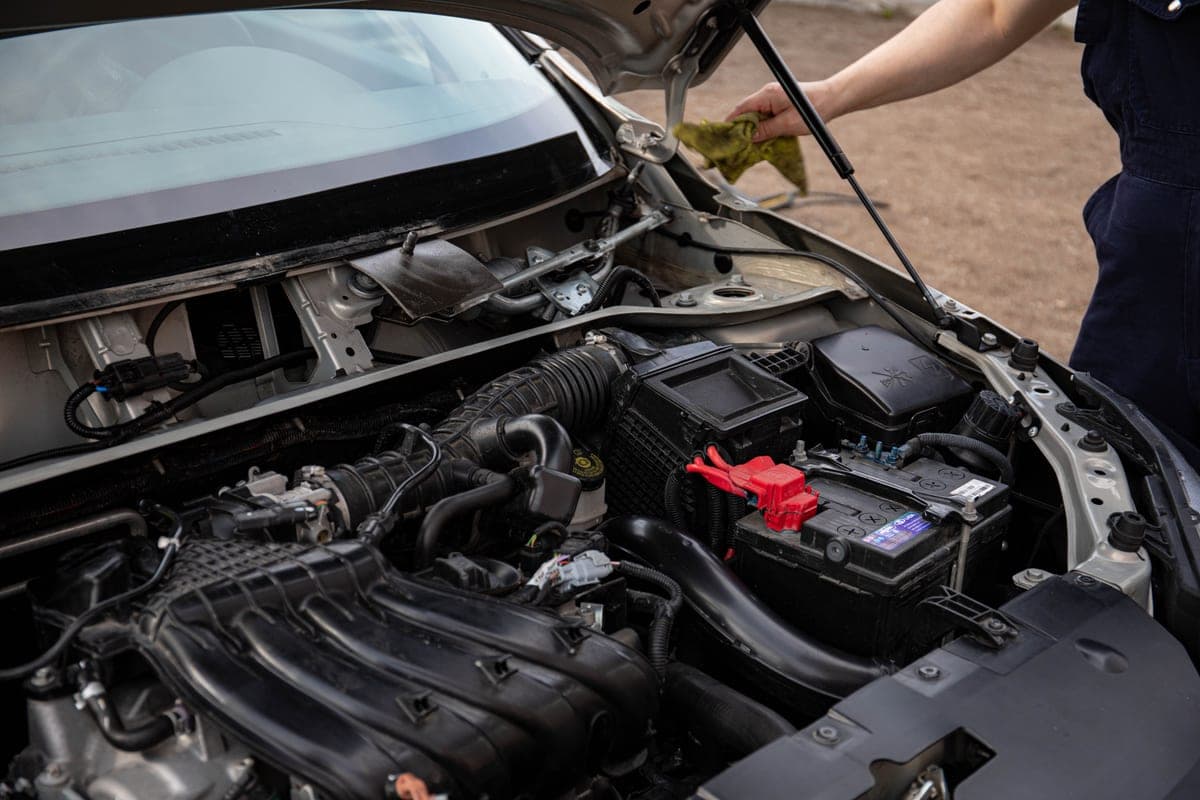
Does a tire inflator drain your car battery?
It draws real current. Whether that matters depends entirely on one decision you make before you start.
Disclosure: we earn a commission if you buy through the Amazon links on this page, at no extra cost to you. Commission never decides a verdict or a ranking position — read our editorial policy and affiliate disclosure.
How we assessed these: picks are selected from manufacturer specifications, current retailer listings and published owner feedback — not from hands-on testing of every unit. Where a manufacturer does not publish a figure, it is left out rather than estimated.
Short answer
Yes, a 12-volt inflator draws real current from the battery — VIAIR publishes 20 amps maximum for the 88P and 30 amps for the 400P. One four-tire top-up with the engine running costs a healthy battery nothing, because the alternator covers it. With the engine off and an older battery, repeated use can leave you unable to start.
The honest version of this answer has two halves, and most pages on the subject only give you one. The current draw is genuinely significant — these are electric motors, not phone chargers. But the run time is short, and that is what decides whether the draw matters. A few amp-minutes taken out of a battery that holds dozens of amp-hours is noise.
The published numbers, which are higher than people expect
| Unit | Supply | Maximum draw | Inrush current | What that implies |
|---|---|---|---|---|
| Fanttik X8 Apex | Own 28.8 Wh battery | None from the car | None | Zero load on the vehicle |
| AstroAI 12V inflator | 12 V accessory socket | Not published | Not published | Socket-fused, so limited by design |
| DEWALT DCC020IB | 20V MAX, 12 V DC or 110 V AC | Not published | Not published | Can be run off a tool battery or the wall |
| VIAIR 88P | 12 V, battery clamps | 20 A | 45 A at 0 PSI | Too much for an accessory socket circuit |
| VIAIR 400P | 12 V or 24 V, battery clamps | 30 A at 12 V | 81 A at 0 PSI | Clamps are mandatory, not a preference |
Figures are each manufacturer's own published specifications; rows marked not published are left as such rather than estimated. Inrush current is the brief spike at start-up, which is why a unit that runs at 20 A still needs headroom well above that.
The VIAIR figures are the useful ones because VIAIR actually publishes them. Twenty amps continuous with a 45-amp inrush is exactly why the 88P ships with battery clamps rather than a socket plug: an accessory socket circuit is not built to pass that, which is the real reason some inflators come with clamps and others do not. How many watts a tire inflator uses works the same figures in watts, and our VIAIR 88P review covers what that draw buys in duty cycle and tire size.
Why one top-up costs you nothing
Put the numbers together. A typical top-up of four tires by a few PSI each is a matter of a couple of minutes of running time per tire. Even at 20 amps, ten minutes of total run time is a little over three amp-hours — against a car battery with a capacity measured in the dozens of amp-hours, and with the alternator replacing it in real time if the engine is running.
The scenario that goes wrong is different in kind, not degree: taking a tire from genuinely flat to full, on a battery that was already marginal, with the engine off, and then wanting to start the car afterwards. That is twenty or thirty minutes of continuous draw from a battery that had nothing spare, and it is how people end up needing a jump after fixing a tire. How long a tire inflator takes sets out realistic fill times.
Two things people get wrong about the socket
- Many accessory sockets are dead with the ignition off. This is the most common reason an inflator appears not to work at all, and it is the car behaving as designed rather than a fault. Turn the ignition on, or better, start the engine.
- The in-line fuse in the plug is the weak point, and that is deliberate. It is there to fail before the car's wiring does. A blown fuse after a long fill is a sign the unit is working near its limit, not a sign the car has a problem. Tire inflator not working covers the diagnosis.
The cordless route, and what it trades away
A cordless inflator sidesteps the question completely. The Fanttik X8 Apex carries a 28.8 watt-hour internal battery, which draws nothing at all from the car, and Fanttik publishes up to 40 minutes continuous runtime and a 56-second fill for a 215/55 R17 tire from 28 to 33 PSI. For top-ups that is plenty, and it means you can inflate a tire on a bicycle, a trailer or a car that will not start.
The trade is that you now have a battery to keep charged, and cold weather cuts into it — which is precisely when a tire is most likely to be low. Small cordless units also heat up on large tires and want to work in stages. 12-volt versus cordless tire inflators is the full comparison, and the best cordless tire inflators is the field.
When the drain question is actually a battery question
If running an inflator for five minutes leaves your car reluctant to start, the inflator is not the problem — you have found a battery that was already near the end. A healthy battery shrugs off a few amp-hours. One that does not has very little reserve left, and the inflator simply happened to be the thing that revealed it.
Read resting voltage before you blame the tool: 12.6 volts or a little above after the car has sat is a full battery, and anything below 12.0 is deeply discharged. How to tell if a car battery is bad covers the test, and if the answer is a tired battery, the best car battery chargers covers the fix.
What we would buy
1. Best way to avoid the question entirely
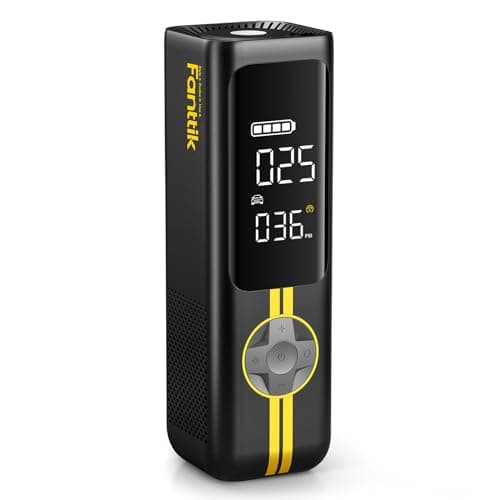
Fanttik X8 Apex
Fanttik · Best for cordless top-ups from a glovebox
A self-contained cordless inflator small enough to live in a door pocket, with a backlit digital gauge and a preset target pressure.
Published specifications
- Maximum pressure
- 150 PSI source
- Internal battery
- 28.8 Wh lithium-ion source
- Stated gauge accuracy
- ±1 PSI source
- Stated runtime
- Up to 40 minutes continuous source
- Stated fill time
- 56 seconds, 215/55 R17 from 28 to 33 PSI source
- Operating temperature
- 14 to 113 °F (-10 to 45 °C) source
- Weight
- 1.74 lb source
- Recharging
- USB-C, 15 W maximum source
- Work light
- 40 lumens source
- Preset modes
- 4 — bicycle, motorcycle, car, ball; PSI, kPa and bar source
- Warranty
- 12 months source
What works
- No cable to the car at all — it runs off its own internal battery
- Small enough that it stays in the vehicle, which is most of the battle
- Preset-and-stop pressure control avoids the overshoot you get chasing an analogue gauge
What does not
- An internal battery is one more thing to keep charged, and cold weather cuts into it
- Cordless inflators this size heat up on large tires; expect to work in stages
- Manufacturer duty-cycle figures for this class are not consistently published
Skip it if
Not the pick for light-truck or RV tires. Small cordless units are built for top-ups, not for taking a 35-inch tire from flat to 60 PSI.
#ad Affiliate link · Price as of October 17, 2026
2. Best plain socket inflator
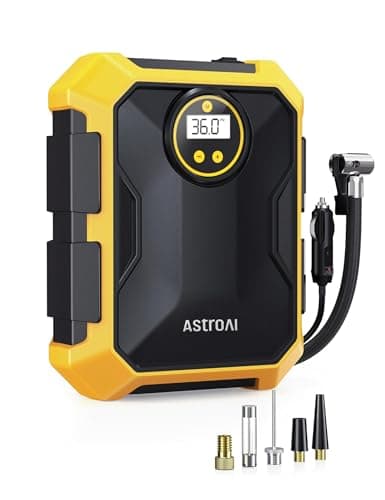
AstroAI 12V Tire Inflator
AstroAI · Best for the cheapest inflator still worth owning
A plain 12 V socket-powered inflator with a digital gauge and auto-shutoff — the baseline that covers a car's tires with no battery to maintain.
This manufacturer does not publish a full specification table for this model on its own site. Rather than repeat figures we cannot source, the assessment below is limited to what the product category and the retailer listing genuinely establish.
What works
- Powered from the 12 V socket, so it works whenever the car does
- Nothing to keep charged, which means it is never flat when the tire is
- Digital preset shutoff at the target pressure
What does not
- The cord limits where you can work, and reaching a rear tire can be tight
- Small-motor inflators in this tier run hot; large tires need rest intervals
- Gauge accuracy in this class varies unit to unit, so verify against a separate gauge
Skip it if
Not the pick if you regularly air down and back up for trails, or run light-truck tires. That is dedicated-compressor work.
#ad Affiliate link · Price as of October 17, 2026
3. Best when you need real output
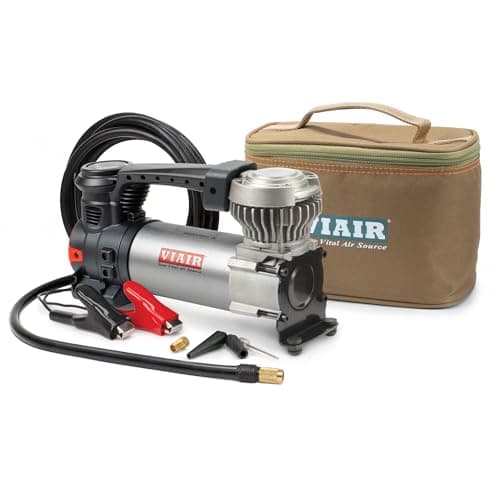
VIAIR 88P Portable Compressor
VIAIR · Best for truck, suv and off-road tires
A battery-clamp compressor built for the tire sizes socket-powered units cannot handle without stopping to cool down.
Published specifications
- Maximum working pressure
- 120 PSI source
- Air flow
- 1.97 CFM at 0 PSI source
- Duty cycle
- 25 minutes at 30 PSI source
- Supply
- 12 V, battery clamps source
- Maximum amp draw
- 20 A source
- Inrush current
- 45 A at 0 PSI source
- Ingress protection
- IP53 source
- Operating temperature
- -4 to 158 °F source
- Tire size rating
- Up to 33 in source
- Weight
- 4.75 lb source
- Power cord / air hose
- 10 ft / 16 ft source
What works
- Connects to the battery terminals rather than the 12 V socket, so socket fuse current is not the limit
- Built for larger tires and repeated fills — the duty cycle is the whole reason to buy it
- Metal body and a real air hose rather than a molded plastic assembly
What does not
- The battery-clamp connection means popping the hood every time
- Bigger and heavier than any glovebox inflator
- Overkill, and slower to set up, for a routine cold-morning top-up
Skip it if
Not the pick if you drive a sedan and just want to correct 4 PSI once a month. That is what a socket inflator is for.
#ad Affiliate link · Price as of October 17, 2026
Key takeaways
- A 12-volt inflator draws real current — VIAIR publishes 20 A for the 88P and 30 A for the 400P.
- Short run times mean one top-up costs a healthy battery almost nothing.
- The failure case is a long fill, engine off, on a battery that was already marginal.
- Run the engine while you inflate and the question disappears entirely.
- Clamp-fed inflators use clamps because their draw exceeds what an accessory socket is built to pass.
- A cordless inflator draws nothing from the car, at the cost of another battery to keep charged.
How we sourced this
Every figure on this page came from one of the following. Where a manufacturer or regulator does not publish a number, we say so rather than estimate it.
Common questions
- Should the engine be running when I use a tire inflator?
- Yes, outdoors. With the engine running the alternator supplies the inflator and the battery is effectively untouched, which removes any question of drain. The exception is a closed garage, where you should not run an engine at all — use a cordless inflator there instead.
- How many amps does a tire inflator draw?
- It varies by class and most makers do not publish it. VIAIR does: 20 amps maximum with a 45-amp inrush for the 88P, and 30 amps at 12 volts with an 81-amp inrush for the 400P. Socket-powered units draw less because the socket's fuse limits them by design.
- Can a tire inflator kill a car battery?
- Only in combination with a long fill, the engine off, and a battery that was already weak. A single top-up takes a few amp-hours at most from a battery holding dozens. If five minutes of inflating leaves the car unable to start, the battery was the problem before you started.
- Why does my inflator stop working when the car is off?
- Because many vehicles cut power to the accessory socket with the ignition off. That is a design decision, not a fault. Turn the ignition to accessory or start the engine and the socket comes alive.
More in Tire Inflators
The cheapest tool that prevents the second-most-common roadside stop. Here is which type fits your tires, and the two specs that actually matter.
Read next
Guide
Power Draw
Published amp draws and what they work out to in watts, why clamp-on compressors exist at all, and what it means for running one off a power station.
Head to head
12V vs Cordless
Socket power versus an internal battery, compared on reliability, convenience, cold-weather output and what happens when the car battery is also dead.
Troubleshooting
Not Working?
Won't turn on, runs without inflating, or quits halfway through. The causes in order of likelihood, and which ones mean the unit is actually broken.
Guide
Storing an Inflator in the Car
What a hot trunk and a freezing one do to a 12-volt pump versus a lithium cordless unit, and the storage choices that keep either one working.
Found something out of date, or a figure you can source better than we did? Tell us — corrections get read first. Our methodology explains how picks are made, and contact is one click away.