Tire Inflators
Can you leave a tire inflator in the car?
An inflator that lives at home has never saved anyone. The real question is which type survives living in a trunk.

Disclosure: we earn a commission if you buy through the Amazon links on this page, at no extra cost to you. Commission never decides a verdict or a ranking position — read our editorial policy and affiliate disclosure.
How we assessed these: picks are selected from manufacturer specifications, current retailer listings and published owner feedback — not from hands-on testing of every unit. Where a manufacturer does not publish a figure, it is left out rather than estimated.
Short answer
Yes, and you should — an inflator kept at home cannot help you on a shoulder. A socket-powered inflator with no internal battery tolerates vehicle storage best. A cordless lithium unit also lives in a car fine, but keep it out of direct sun and expect heat to shorten its battery life.
The whole reason this site exists is the gap between owning a tool and having it when the problem happens. A tire inflator in a garage is a tool you own. A tire inflator in the trunk is a tool you have. So the useful framing of this question is not whether you may leave it in the car, but what kind to buy if that is where it is going to live — because the two main types age very differently in a vehicle.
What a car actually does to equipment
A parked car in summer sun becomes significantly hotter than the air outside it, and a trunk holds that heat for hours after the car is in shade. In winter the same space goes well below freezing and stays there. Add vibration, humidity and the occasional spilled bottle, and a vehicle is a harsher environment than a shelf by a wide margin.
| Type | Heat | Cold | Verdict for in-car storage |
|---|---|---|---|
| 12 V socket inflator | Plastic housings suffer in sustained sun | No stored energy to lose | The easiest type to leave in a car |
| Clamp-fed compressor | Metal body, generally robust | No stored energy to lose | Built for it — VIAIR publishes IP53 on the 88P |
| Cordless lithium inflator | Heat permanently shortens cell life | Cold cuts available capacity when you need it | Fine, but keep it shaded and charged |
| Lead-acid jump-and-inflate box | Self-discharge accelerates in heat | Reduced output when cold | Needs a charging schedule or it is flat |
Ingress-protection ratings are the manufacturer's published figures where they exist. The heat and cold assessments are our reading of how each technology behaves, not a manufacturer claim.
The pattern is clear and it is about stored energy. A pump with no battery has nothing to degrade: leave it in the trunk for three years and it works, because the only thing holding energy is the car's own battery, which is being maintained by the alternator. Anything with its own cells is on a slow clock, and heat speeds that clock up.
The case for the plain socket inflator
This is the honest reason the cheapest category is often the right one for permanent in-car storage. A socket-powered unit is never flat when the tire is, because its power source is the car. There is nothing to remember, nothing to charge, and no cell chemistry quietly aging in a hot trunk.
Its limitations are real but they are not storage limitations: the cord restricts where you can work, small-motor units in this tier run hot on large tires and need rest intervals, and gauge accuracy varies unit to unit so a separate gauge is worth carrying. Is a portable tire inflator worth it weighs the category as a whole, and the best portable tire inflators is the field.
If it is cordless, treat the battery like a battery
A cordless inflator in a car is a lithium cell in a car, and the rules are the same as for a jump pack. Heat is the main enemy: sustained high temperatures permanently reduce capacity, which is why a cordless unit left on a parcel shelf in the sun for two summers will not hold what it did when new. Cold is a temporary problem rather than a permanent one, but it bites at the worst time — pressure drops on cold mornings, which is exactly when the cell has least to give.
- Store it low and shaded. Under a seat or in a side compartment, not on the dash or the parcel shelf. Jump starter storage and heat puts the same argument in more detail for packs.
- Charge it on a calendar. Every three months and after every use, which for most people means pairing it with some other quarterly habit so it is not a decision.
- Expect less in winter. Fanttik publishes up to 40 minutes continuous runtime for the X8 Apex; plan on less when the unit is cold, and work in stages on big tires.
- Keep the USB-C cable with it. A cordless inflator and no cable is a paperweight. Fanttik publishes USB-C recharging at up to 15 W, which means your phone charger will do.
Where in the car it should actually go
Four decisions that keep it working
Low, not high
Heat stratifies and sun hits the upper surfaces hardest. A footwell or a side bin is cooler than a parcel shelf by a useful margin.
Secured, not loose
A 4.75 lb metal compressor loose in a trunk is both a projectile in a crash and a thing that wears through its own hose. Use the case it came in and strap or wedge it.
With everything it needs
Hose, adapters, power lead, fuse spare, valve cap with a core tool. Kits get separated over time and the missing piece is always discovered at the roadside.
Somewhere you can reach with a flat tire
If retrieving it means unloading the whole trunk in the rain, you have bought a garage tool. Keep it in a side compartment or on top.
What else belongs beside it
An inflator alone covers a slow leak and a cold-morning top-up, which is most of what goes wrong. It does not cover a flat battery, which is the other half of the roadside problem, and it does not cover a tire that has been cut rather than deflated. A compact jump pack and a basic kit with a light and a warning triangle round it out — the roadside emergency kit checklist is the full list, and tire inflator versus sealant covers the damaged-tire case.
What we would buy
1. Best type to leave in the car
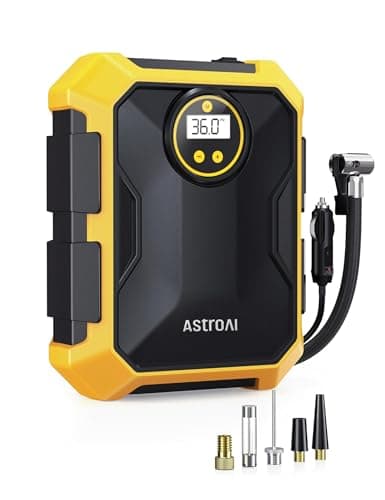
AstroAI 12V Tire Inflator
AstroAI · Best for the cheapest inflator still worth owning
A plain 12 V socket-powered inflator with a digital gauge and auto-shutoff — the baseline that covers a car's tires with no battery to maintain.
This manufacturer does not publish a full specification table for this model on its own site. Rather than repeat figures we cannot source, the assessment below is limited to what the product category and the retailer listing genuinely establish.
What works
- Powered from the 12 V socket, so it works whenever the car does
- Nothing to keep charged, which means it is never flat when the tire is
- Digital preset shutoff at the target pressure
What does not
- The cord limits where you can work, and reaching a rear tire can be tight
- Small-motor inflators in this tier run hot; large tires need rest intervals
- Gauge accuracy in this class varies unit to unit, so verify against a separate gauge
Skip it if
Not the pick if you regularly air down and back up for trails, or run light-truck tires. That is dedicated-compressor work.
#ad Affiliate link · Price as of October 17, 2026
2. Best built to live in a vehicle
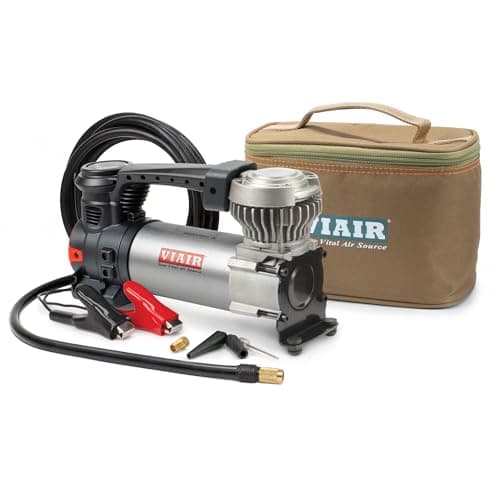
VIAIR 88P Portable Compressor
VIAIR · Best for truck, suv and off-road tires
A battery-clamp compressor built for the tire sizes socket-powered units cannot handle without stopping to cool down.
Published specifications
- Maximum working pressure
- 120 PSI source
- Air flow
- 1.97 CFM at 0 PSI source
- Duty cycle
- 25 minutes at 30 PSI source
- Supply
- 12 V, battery clamps source
- Maximum amp draw
- 20 A source
- Inrush current
- 45 A at 0 PSI source
- Ingress protection
- IP53 source
- Operating temperature
- -4 to 158 °F source
- Tire size rating
- Up to 33 in source
- Weight
- 4.75 lb source
- Power cord / air hose
- 10 ft / 16 ft source
What works
- Connects to the battery terminals rather than the 12 V socket, so socket fuse current is not the limit
- Built for larger tires and repeated fills — the duty cycle is the whole reason to buy it
- Metal body and a real air hose rather than a molded plastic assembly
What does not
- The battery-clamp connection means popping the hood every time
- Bigger and heavier than any glovebox inflator
- Overkill, and slower to set up, for a routine cold-morning top-up
Skip it if
Not the pick if you drive a sedan and just want to correct 4 PSI once a month. That is what a socket inflator is for.
#ad Affiliate link · Price as of October 17, 2026
3. Best cordless, with the heat caveat
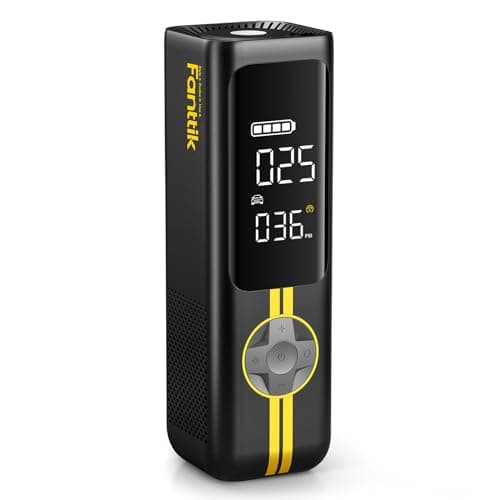
Fanttik X8 Apex
Fanttik · Best for cordless top-ups from a glovebox
A self-contained cordless inflator small enough to live in a door pocket, with a backlit digital gauge and a preset target pressure.
Published specifications
- Maximum pressure
- 150 PSI source
- Internal battery
- 28.8 Wh lithium-ion source
- Stated gauge accuracy
- ±1 PSI source
- Stated runtime
- Up to 40 minutes continuous source
- Stated fill time
- 56 seconds, 215/55 R17 from 28 to 33 PSI source
- Operating temperature
- 14 to 113 °F (-10 to 45 °C) source
- Weight
- 1.74 lb source
- Recharging
- USB-C, 15 W maximum source
- Work light
- 40 lumens source
- Preset modes
- 4 — bicycle, motorcycle, car, ball; PSI, kPa and bar source
- Warranty
- 12 months source
What works
- No cable to the car at all — it runs off its own internal battery
- Small enough that it stays in the vehicle, which is most of the battle
- Preset-and-stop pressure control avoids the overshoot you get chasing an analogue gauge
What does not
- An internal battery is one more thing to keep charged, and cold weather cuts into it
- Cordless inflators this size heat up on large tires; expect to work in stages
- Manufacturer duty-cycle figures for this class are not consistently published
Skip it if
Not the pick for light-truck or RV tires. Small cordless units are built for top-ups, not for taking a 35-inch tire from flat to 60 PSI.
#ad Affiliate link · Price as of October 17, 2026
Key takeaways
- Leave it in the car — an inflator in the garage has never helped anyone on a shoulder.
- Units with no internal battery cope best, because there is no stored energy to degrade.
- Heat permanently shortens lithium cell life; cold temporarily reduces what it can deliver.
- Store it low and shaded, secured, and with every adapter and cable it needs.
- The spare tire bay is the coolest and best-protected space in most vehicles.
- Charge a cordless unit quarterly or it will be flat the morning a tire is.
How we sourced this
Every figure on this page came from one of the following. Where a manufacturer or regulator does not publish a number, we say so rather than estimate it.
Common questions
- Is it bad to leave a tire inflator in a hot car?
- It is fine for a socket-powered unit with no internal battery. For a cordless inflator, sustained heat permanently reduces the lithium cell's capacity, so keep it low and out of direct sun. The alternative — leaving it at home — guarantees it is not there when you need it.
- Can a tire inflator freeze in the car?
- The pump itself is unharmed by cold, though plastic becomes more brittle. A cordless unit's battery delivers less when cold, which matters because tire pressure drops on cold mornings. Keeping it charged gives you margin for exactly that case.
- Where is the best place to store a tire inflator in a car?
- Low, shaded, secured and reachable. The spare tire bay under the trunk floor is the coolest and most protected space in most vehicles and already holds tire equipment. Avoid the dash and the parcel shelf, where sun and heat are worst.
- Will a tire inflator left in the car still work after a year?
- A socket-powered one almost certainly will, because nothing in it stores energy. A cordless one will work but with reduced capacity if it has been through a hot summer, and it will be flat if nobody charged it — which is the usual failure, not the heat.
More in Tire Inflators
The cheapest tool that prevents the second-most-common roadside stop. Here is which type fits your tires, and the two specs that actually matter.
Read next
Head to head
12V vs Cordless
Socket power versus an internal battery, compared on reliability, convenience, cold-weather output and what happens when the car battery is also dead.
Guide
Storage and Heat
Why a hot trunk permanently costs a lithium pack capacity, where to store it instead, and the one case where lead-acid genuinely wins.
Guide
Is It Worth It?
The honest case for owning one: what it genuinely fixes, what it cannot, and why the routine top-up matters more than the emergency you bought it for.
Guide
Inflators and Battery Drain
Published amp-draw figures for socket and clamp-fed inflators, what they cost a car battery in practice, and the one habit that makes the question disappear.
Found something out of date, or a figure you can source better than we did? Tell us — corrections get read first. Our methodology explains how picks are made, and contact is one click away.