Tire Inflators
VIAIR 88P review
The inflator that connects to the battery instead of the socket — and publishes the numbers almost nobody else in this category will.
Disclosure: we earn a commission if you buy through the Amazon links on this page, at no extra cost to you. Commission never decides a verdict or a ranking position — read our editorial policy and affiliate disclosure.
How we assessed these: this assessment is built from VIAIR's published specifications for the 88P, the current retailer listings and published owner feedback. We have not bench-tested this unit, and we publish no measured fill times or gauge comparisons of our own.
Short answer
Buy the 88P if you run tires up to 33 inches and want a compressor that is not limited by the accessory socket's fuse: 120 PSI, 1.97 CFM at 0 PSI, a published 25 minutes at 30 PSI, and a -4 to 158 degrees F operating range. Skip it if you drive a sedan and want a glovebox tool — this one needs the hood open.
Most of this category is a plastic box with a cigarette-socket plug and a spec sheet that says 150 PSI and nothing else. The 88P is the other kind of product: a metal-bodied 12 V compressor with battery clamps, a real air hose, and a manufacturer willing to publish amp draw, inrush current, duty cycle, ingress protection and an operating-temperature range. Whether you need it comes down to one question about your tires, which we get to below.
What VIAIR publishes
| Specification | Figure |
|---|---|
| Maximum working pressure | 120 PSI |
| Air flow | 1.97 CFM at 0 PSI |
| Duty cycle | 25 minutes at 30 PSI |
| Supply | 12 V, battery clamps |
| Maximum amp draw | 20 A |
| Inrush current | 45 A at 0 PSI |
| Ingress protection | IP53 |
| Operating temperature range | -4 to 158 degrees F |
| Noise | 81 dB at 0 PSI |
| Weight | 4.75 lb |
| Power cord length | 10 ft |
| Air hose length | 16 ft |
| Tire size rating | Up to 33 in |
| Gauge | 120 PSI dial gauge |
| In the box | Brass tire chuck, dual battery clamps, 3-piece inflation tips kit, Presta valve adapter, carry bag |
Every figure above is from VIAIR's published 88P specifications, read on 2026-10-12. VIAIR's own store lists the unit as available; it is also stocked through Amazon and automotive retailers, which is where our buy link points.
Read that sheet next to almost any socket inflator's and the difference is not the headline pressure — 120 PSI is lower than the 150 PSI many pocket units claim. The difference is that every figure a buyer could use to predict behavior is actually there.
The duty cycle is the reason to buy it
Twenty-five minutes at 30 PSI is the single most useful number on the sheet, and it is the one that small inflators almost never publish. Duty cycle is how long the unit can run before it has to stop and shed heat, and it is the spec that decides whether a job gets done in one pass or four. Tire inflator duty cycle explained covers why the figure exists and how to read a percentage rating against a minutes rating.
What it buys you in practice is the ability to do all four tires without waiting. A socket inflator asked to take four light-truck tires from 25 PSI to 40 PSI will get hot, and in the better designs it will protect itself by stopping. The 88P is specified to keep going for a usefully long time at the pressure range passenger and light-truck tires actually live in.
Note that it is a minutes-at-a-pressure figure, not a percentage. VIAIR's larger 400P publishes 33 percent at 100 PSI instead, which is a different kind of statement for a unit aimed at airing back up from trail pressures. The two are not directly comparable, and anyone telling you one is strictly better is reading past the units.
120 PSI is enough, and 1.97 CFM is the number that matters
Pressure ratings are the most misread figure in this category. 120 PSI is the highest pressure the pump can reach before it stalls; it says nothing about how fast air moves. Passenger tires run 30 to 36 PSI and light-truck tires rarely exceed 65 to 80 PSI, so a 120 PSI ceiling is headroom you will not visit. Tire inflator PSI ratings explained takes the whole 80-to-300 PSI marketing ladder apart.
The figure that predicts how long you stand there is air flow, and VIAIR publishes 1.97 CFM at 0 PSI. Two caveats, both important. First, that is free-flow, measured against no back pressure — actual flow falls as tire pressure rises, which is true of every compressor and is why the number is quoted at 0 PSI. Second, we publish no measured fill times of our own, because we have not timed this unit. What CFM is good for is comparison: 1.97 against the 2.30 CFM VIAIR publishes for the 400P tells you the 400P moves more air, and that is a legitimate use of the spec.
Why it has clamps instead of a plug
The 88P draws up to 20 amps with a 45-amp inrush spike at 0 PSI. A vehicle's accessory socket circuit is typically fused at 15 or 20 amps and frequently shared with other outlets, so feeding this compressor through a cigarette plug would either blow the fuse or run the circuit at its limit for twenty minutes. The clamps are not a status symbol; they are the honest consequence of the motor.
That has a real cost. Every use starts with popping the hood and finding the terminals, which is a minute you do not spend with a socket inflator, and it is awkward in the dark or in the rain. It also means the engine should be running — the alternator supplies the compressor and the battery is left alone, which matters most in winter when a cold battery has the least reserve. Does a tire inflator drain your battery covers that arithmetic, and how many watts a tire inflator uses converts the amp figures.
The 33-inch rating, and what it actually means
VIAIR rates the 88P for tires up to 33 inches. That covers essentially every passenger car, crossover and stock half-ton pickup, plus a lot of mildly lifted trucks. It does not cover 35-inch and larger off-road tires, RV tires, or anything that wants to be taken from genuinely flat to 60-plus PSI repeatedly.
The rating is about work, not about whether the chuck fits. A bigger tire holds more air, so the same compressor spends longer and gets hotter filling it, and above the rating you are asking the unit to do a job it will do slowly and at the edge of its thermal limits. If that is your use case, the best tire inflators for trucks and SUVs and RV tire inflators are the right pages, and the 400P is the VIAIR that belongs there.
Cold, water and the specs nobody else publishes
The -4 to 158 degrees F operating range is unusual enough to be worth dwelling on. Practically nothing in the portable-inflator category publishes a temperature range, which means that when you buy one you have no manufacturer statement at all about whether it is expected to work on a January morning. A -4 degrees F floor covers the large majority of US winters, and it is the main reason this unit leads our cold-weather roundup.
IP53 is the other quietly useful figure: protection against dust and against water sprayed at up to 60 degrees from vertical. That is rain and road spray, not immersion. Do not leave it in a puddle, and do not assume a sealed box.
The 81 dB at 0 PSI noise figure is also published, and it is loud — conversation-stopping, and worth knowing before you use it outside a motel room at six in the morning.
The hose and chuck are a bigger deal than the spec sheet implies
Sixteen feet of air hose plus a 10-foot power cord means one hookup at the battery reaches all four corners of most vehicles. Anyone who has used a pocket inflator with a two-foot tail knows the alternative: unplug, walk around, re-plug, four times, and discover that the rear valve stem is at the far side of its reach.
The chuck is solid brass and screws onto the valve stem rather than clamping to it, which seals without a hand holding it in place. A Presta adapter and a three-piece tips kit come in the bag, so bicycles and inflatables are covered. Air fittings explained is worth a read if you plan to add a different chuck or an extension.
Where it falls short
- No automatic shutoff and no digital preset. This is the real omission. The 88P has a dial gauge and an inline deflator button; you watch the needle and stop when you reach the number. A digital preset is the single most useful convenience feature in this category, and the 88P does not have one. The best tire inflators with a gauge is the page to read if that is a priority.
- Popping the hood every time. The clamps are technically correct and practically tedious, especially for a 3 PSI monthly top-up.
- 4.75 lb plus a bag. It is a trunk tool, not a door-pocket tool, and the carry bag is the difference between a tidy trunk and a tangle of hose.
- Loud. 81 dB at 0 PSI is VIAIR's own figure.
- No published warranty term on the product page. VIAIR's 88P page does not state a warranty period, so we do not quote one. Check the listing you buy from.
- Overkill for a sedan. If all you ever do is correct 4 PSI once a month on a commuter car, a socket inflator with a preset does that job faster and lives in the glovebox.
Who should buy it, and who should not
Buy it if you run light-truck or SUV tires up to 33 inches, if you do all four tires at once rather than one at a time, if you live somewhere cold enough that a published temperature range is reassuring, or if you have ever had a socket inflator stop on you halfway through the third tire. Buy the 400P instead if you air down for trails, run 35-inch tires, or want the 25-foot hose and the 150 PSI ceiling.
Do not buy it if you want one thing in a glovebox that handles a monthly check on a sedan. That is what the AstroAI-class socket inflators and cordless units are for, and the convenience genuinely matters more than the duty cycle at that scale. Also do not buy it expecting a preset — if set-and-walk-away is what you want, this is the wrong unit at any price.
Verdict
The 88P is the compressor you buy when you have decided the tires are bigger than the socket. It publishes the figures that matter — duty cycle, amp draw, operating range, ingress protection — and that transparency is rare enough in this category to count as a feature. The missing preset is a real gap and the hood-popping is a real annoyance, and neither changes the fact that this is the most predictable 12 V compressor at its size.
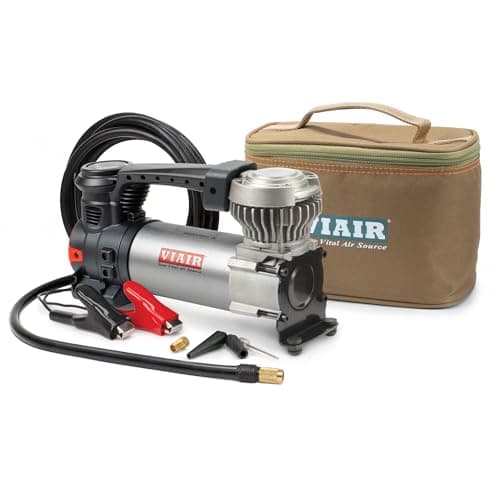
1. Best clamp-fed portable compressor
VIAIR 88P Portable Compressor
VIAIR · Best for truck, suv and off-road tires
A battery-clamp compressor built for the tire sizes socket-powered units cannot handle without stopping to cool down.
Published specifications
- Maximum working pressure
- 120 PSI source
- Air flow
- 1.97 CFM at 0 PSI source
- Duty cycle
- 25 minutes at 30 PSI source
- Supply
- 12 V, battery clamps source
- Maximum amp draw
- 20 A source
- Inrush current
- 45 A at 0 PSI source
- Ingress protection
- IP53 source
- Operating temperature
- -4 to 158 °F source
- Tire size rating
- Up to 33 in source
- Weight
- 4.75 lb source
- Power cord / air hose
- 10 ft / 16 ft source
What works
- Connects to the battery terminals rather than the 12 V socket, so socket fuse current is not the limit
- Built for larger tires and repeated fills — the duty cycle is the whole reason to buy it
- Metal body and a real air hose rather than a molded plastic assembly
What does not
- The battery-clamp connection means popping the hood every time
- Bigger and heavier than any glovebox inflator
- Overkill, and slower to set up, for a routine cold-morning top-up
Skip it if
Not the pick if you drive a sedan and just want to correct 4 PSI once a month. That is what a socket inflator is for.
#ad Affiliate link · Price as of October 16, 2026
Key takeaways
- 120 PSI, 1.97 CFM at 0 PSI, 25 minutes at 30 PSI, 20 A maximum draw — all VIAIR's own published figures.
- The published -4 to 158 degrees F operating range is almost unique in this category.
- Battery clamps exist because 20 A with a 45 A inrush is more than an accessory socket should pass.
- Rated for tires up to 33 inches; above that, the 400P is the right VIAIR.
- No digital preset or automatic shutoff — you watch the dial gauge and stop.
- 16 ft of hose plus a 10 ft cord reaches all four tires from one hookup.
- At 4.75 lb and 81 dB it is a trunk tool, not a glovebox one.
How we sourced this
Every figure on this page came from one of the following. Where a manufacturer or regulator does not publish a number, we say so rather than estimate it.
Common questions
- Does the VIAIR 88P have an automatic shutoff?
- No. It has a 120 PSI dial gauge and an inline deflator, and you stop it yourself when the needle reaches your target. If a digital preset with auto-stop is what you want, this is the wrong unit — that feature is the 88P's clearest omission.
- What size tires can the VIAIR 88P handle?
- VIAIR rates it for tires up to 33 inches, which covers passenger cars, crossovers and stock half-ton pickups. For 35-inch and larger tires, or for airing back up from trail pressures, the 400P publishes 2.30 CFM, a 33 percent duty cycle at 100 PSI and a 25-foot hose.
- Why does the 88P use battery clamps instead of a 12 V plug?
- Because VIAIR publishes a 20-amp maximum draw with a 45-amp inrush spike at 0 PSI, and a vehicle accessory socket is typically fused at 15 or 20 amps. The clamps let the compressor draw what it needs without running the socket circuit at its limit.
- Is the VIAIR 88P good in cold weather?
- It is the best-documented option we know of for cold, because VIAIR publishes a -4 to 158 degrees F operating range and almost no other portable inflator publishes any range at all. It also has no internal lithium battery to lose capacity overnight.
- How fast is the VIAIR 88P?
- VIAIR publishes 1.97 CFM at 0 PSI, which is free-flow air delivery measured against no back pressure; real flow falls as tire pressure rises. We publish no measured fill times because we have not timed this unit, and any page quoting an exact seconds-per-tire figure should tell you how it measured it.
More in Tire Inflators
The cheapest tool that prevents the second-most-common roadside stop. Here is which type fits your tires, and the two specs that actually matter.
Read next
Best for Cold Weather
Best for Cold Weather
Published operating-temperature ranges, why a lithium pack is the wrong power source in January, and the inflators that still do the job on a frozen driveway.
Guide
Duty Cycle Explained
What duty cycle means, why it decides whether an inflator can handle large tires, and what to infer when the manufacturer stays silent.
Best for Trucks & SUVs
For Trucks & SUVs
Battery-clamp compressors and heavy-duty units for light-truck and off-road tires, with the duty-cycle reasoning spelled out.
Head to head
Inflator vs Air Compressor
The tank is the dividing line: continuous small-volume work versus stored air for tools. Which one belongs in your trunk and which in your garage.
Found something out of date, or a figure you can source better than we did? Tell us — corrections get read first. Our methodology explains how picks are made, and contact is one click away.