Battery Chargers
The best lithium battery chargers
The spec that matters is an explicit, selectable lithium mode — because the repair and desulfation settings that help a tired lead-acid battery are the ones that damage a lithium pack.

Disclosure: we earn a commission if you buy through the Amazon links on this page, at no extra cost to you. Commission never decides a verdict or a ranking position — read our editorial policy and affiliate disclosure.
How we assessed these: picks are selected from manufacturer specifications, current retailer listings and published owner feedback — not from hands-on testing of every charger on every battery chemistry. We publish no measured charge curves, because we do not measure them.
Short answer
For most lithium batteries, buy the NOCO GENIUS10: 10 amps, an explicitly published lithium mode, and a 230 amp-hour capacity range. For a single powersports pack the GENIUS2 is the correct size, and for a house bank you want to configure precisely, the Victron Blue Smart IP65 carries a dedicated Li-ion profile.
Quick picks
Tap any row to jump to the full write-up. Scoring criteria are published in full on our methodology page.
| # | Product | Best for | Our read | Price |
|---|---|---|---|---|
| 1 | 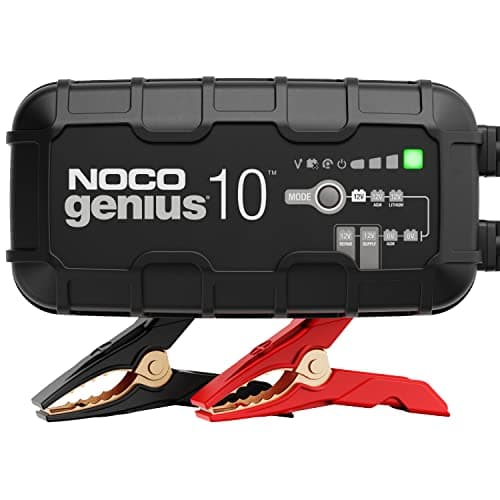 NOCO GENIUS10 Best overall for lithium | Several vehicles or a deep-cycle bank | 10 A, a published lithium mode, and a 230 Ah capacity range | $99.87View on Amazon #ad Affiliate link · Price as of October 20, 2026 |
| 2 | 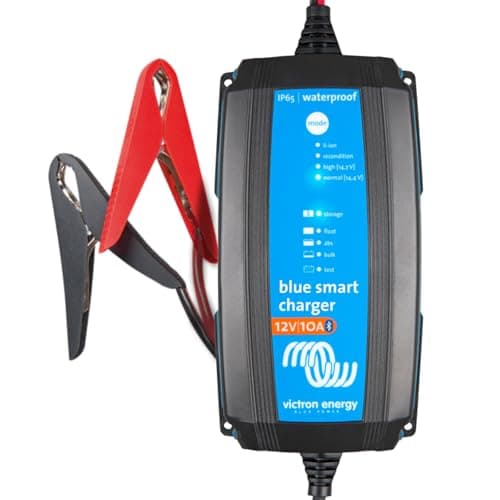 Victron Blue Smart IP65 12V 10A Best for a bank you want to set precisely | A lithium house bank you want to set precisely | 8 pre-programmed profiles including Li-ion, chosen in an app | Check price on Amazon #ad Affiliate link · Amazon shows the current price |
| 3 | 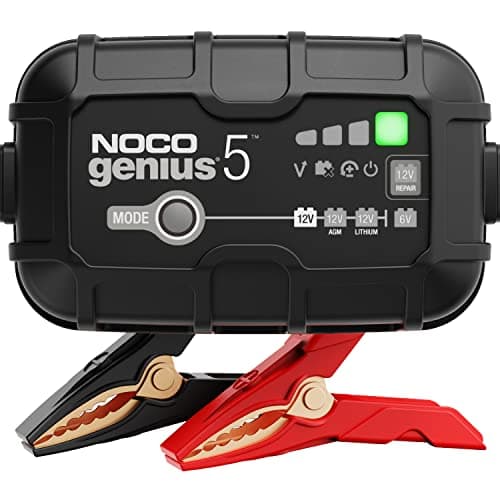 NOCO GENIUS5 Best for one lithium starting battery | One car, charging and maintaining | 5 A, up to 120 Ah, lithium mode, 1.5 lb | $69.95View on Amazon #ad Affiliate link · Price as of October 20, 2026 |
| 4 | 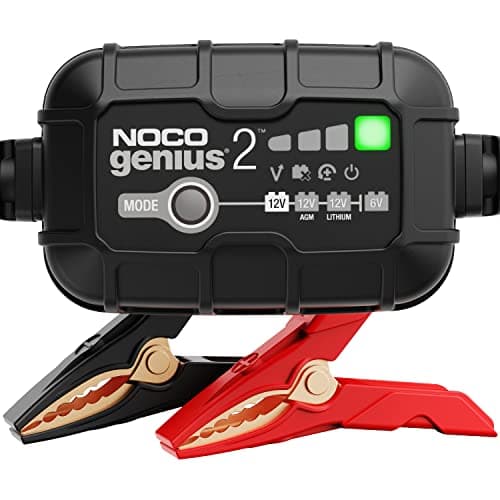 NOCO GENIUS2 Best for powersports LiFePO4 | Motorcycles, ATVs and lawn equipment | 2 A and a 40 Ah range — the right size for a bike pack | $49.95View on Amazon #ad Affiliate link · Price as of October 20, 2026 |
Lithium iron phosphate batteries have quietly taken over the parts of a vehicle that are not the starting battery: powersports packs, RV house banks, trolling-motor batteries, dual-battery setups in trucks. The charger question that follows is not which brand, but whether the charger can charge that chemistry at all — and a surprising number of perfectly good chargers cannot, or can only do it by accident.
This page is the lithium half of a question our main car battery charger picks deliberately leaves open. If your battery is a conventional flooded, AGM or EFB starting battery, that page is the one you want. If the label says LiFePO4, lithium iron phosphate, or lithium-ion, read on — and if you are choosing between OPTIMA's two AGM lines rather than charging a lithium pack, RedTop versus YellowTop is the page you want.
Why a lithium battery needs a different charger
A lead-acid charger is built around the way lead-acid batteries behave. It bulk-charges to a target voltage, holds that voltage through an absorption stage while the current tails off, then drops to a float voltage that sits there indefinitely, replacing self-discharge. Some chargers add a reconditioning or desulfation stage that deliberately applies a higher voltage to break down sulfate crystals on the plates.
A LiFePO4 pack does not want most of that. It takes a constant current up to its charge voltage and then wants the current to stop, not to be held at an elevated voltage for hours and not to be trickled at a float voltage forever. It has no sulfation to recondition, so a desulfation stage is not a bonus feature — it is a high-voltage pulse applied to a chemistry that has no use for it, in front of a battery management system that will usually just disconnect rather than take it.
So the single thing that makes a charger a lithium charger is a mode that changes the profile deliberately: charge at the rated current, finish at the lithium voltage, stop. Everything else on this page is secondary to that.
The criteria we buy on
- An explicit, published lithium or LiFePO4 mode — selected by the user, not inferred by the charger. If the manufacturer does not say the word, assume it is not there.
- An amp rating matched to the pack. Lithium tolerates a higher charge rate than lead-acid, but the pack's own data sheet sets the ceiling and the BMS enforces it.
- A published capacity range, where the maker gives one, so you are not guessing whether the charger can finish the battery.
- No mode that can be applied to a lithium pack by accident. A mode button you can land on the wrong setting is a real risk on a battery that costs several times what a lead-acid one does.
- An enclosure rated for where the charger will actually live — a locker, an engine bay, a dock box. IP65 is the figure to look for.
- Clamps and ring terminals in the box, because a house bank is usually a permanent install and a starting battery is not.
| Charger | Charging current | Lithium support | Published capacity range | Voltages |
|---|---|---|---|---|
| NOCO GENIUS10 | 10 A DC | 12 V lithium mode, per NOCO | Up to 230 Ah | 6 V and 12 V |
| Victron Blue Smart IP65 12V 10A | 10 A | Dedicated Li-ion setting, selected in VictronConnect | Not published as an Ah range | 12 V |
| NOCO GENIUS5 | 5 A DC | 12 V lithium mode, per NOCO | Up to 120 Ah | 6 V and 12 V |
| NOCO GENIUS2 | 2 A DC | 12 V lithium mode, per NOCO | Up to 40 Ah | 6 V and 12 V |
Figures are each maker's own published specifications, linked in Sources. Where a maker does not publish an amp-hour range, the cell says so rather than carrying our estimate.
Sizing the charger to the pack
The rule of thumb that works for lead-acid — roughly a tenth of the amp-hour rating — is a conservative floor for lithium rather than a target. LiFePO4 cells will generally accept a much higher charge current than lead-acid cells of the same capacity, which is why a 100 amp-hour lithium bank can be refilled in a few hours rather than overnight.
What decides the number is not the chemistry in the abstract but two published figures: the maximum charge current on your battery's own data sheet, and the current limit the battery management system will allow. Both are specific to the pack, and both override anything a charger review can tell you. Buy the charger that fits inside those numbers, then size up only if the recharge time is genuinely too slow for how you use the vehicle.
In practice that puts a single lithium powersports or motorcycle pack on 2 amps, a lithium starting battery or small house battery on 5, and a real house bank on 10 or more. What amp battery charger do I need works through the same arithmetic for lead-acid, and the sizing logic carries over.
The modes to keep away from a lithium battery
This is the part of the category that costs people money, so it is worth being blunt about. On a multi-chemistry charger, the following are lead-acid features and should never be pointed at a LiFePO4 pack: a desulfation, recondition or repair mode; a 6-volt mode; a long-term float or trickle setting intended to hold a lead-acid battery at voltage for months. Battery desulfation, explained covers what that mode is actually for.
Two more habits to break. An old unregulated charger — the kind with a needle gauge and no modes at all — has no business near a lithium battery, because it has no way to stop. And a lead-acid-only maintainer left on a lithium pack over a winter is not maintaining it; at best the BMS refuses the charge, at worst the pack is held somewhere it should not sit. Battery charger versus maintainer is the distinction that matters here.
Why the GENIUS10 is the default answer
NOCO publishes three things on the GENIUS10 that together make it the easiest charger to recommend here: 10 amps of output, a 230 amp-hour capacity range, and distinct chemistry modes including 12-volt lithium. That combination covers the great majority of real lithium jobs — a house battery, a dual-battery setup, a trolling-motor pack — without being so large that it is wasted on a starting battery.
The honest limits are the mode button and the mains cord. The modes are selected by pressing through them, which means the discipline of checking the display before you walk away is on you. And it is a plug-in charger, so a bank parked away from power needs a solar maintainer instead. If the same charger also has to handle a conventional AGM starting battery, the GENIUS5 versus GENIUS10 comparison is the sizing decision in detail.
When Victron is the better buy
The Victron Blue Smart IP65 takes a different approach: eight pre-programmed charge profiles, including a dedicated Li-ion setting, selected in the VictronConnect app over Bluetooth rather than by pressing a button on the case. For a lithium house bank that is a meaningful advantage — you can confirm which profile is active, watch what the charger is doing, and keep the setting from being changed by somebody who meant to charge a lead-acid battery.
The trade-offs are real too. Victron does not publish an amp-hour capacity range for these chargers the way NOCO does, so sizing is on you and your battery's data sheet. Setup assumes a phone. And it is sold mainly through marine and solar channels, so availability on general retail moves around. For an RV or boat bank, that is a price worth paying; for one lithium motorcycle battery it plainly is not.
The picks
1. Best overall for lithium
NOCO GENIUS10
NOCO · Best for several vehicles or a deep-cycle bank
Twice the current of the GENIUS5 and nearly twice the capacity range — 10 amps up to 230 Ah, which is where RV, marine and multi-vehicle households land.
Published specifications
What works
- 10 A halves the charge time on a flat car battery against a 5 A unit
- The 230 Ah range covers deep-cycle RV and marine batteries the GENIUS5 cannot
- Same -4 °F cold rating and 3-year warranty as the smaller GENIUS units
What does not
- 10 A into a small motorcycle battery is more current than it wants — use a 1 A or 2 A unit there
- Heavier and pricier than a GENIUS5 for a household with one car
Skip it if
Not the right charger for a single motorcycle, ATV or lawn-tractor battery. Small batteries want small current.
#ad Affiliate link · Price as of October 20, 2026
Raw specifications: NOCO’s own page for the NOCO GENIUS10.
2. Best for a bank you want to set precisely
Victron Blue Smart IP65 12V 10A
Victron Energy · Best for a lithium house bank you want to set precisely
The charger for a LiFePO4 bank whose numbers you actually know: 10 amps, eight pre-programmed profiles including lithium, and Bluetooth configuration from a phone instead of a blind mode button.
Published specifications
- Charge current
- 10 A (12 V model) source
- Charge profiles
- 8 pre-programmed profiles for lithium, AGM, gel and flooded source
- Lithium support
- Dedicated Li-ion setting, selected in the VictronConnect app source
- Configuration
- Bluetooth, via VictronConnect for Android and iOS source
- Ingress protection
- IP65 source
- Protection
- Overtemperature, short-circuit and reverse-polarity source
- Warranty
- 5-year standard source
What works
- A dedicated Li-ion profile you select deliberately, not a mode you hope you pressed
- The app shows what the charger is doing, which is the only way to confirm a lithium bank is being finished properly
- 10 amps suits a single LiFePO4 house battery of real size, not just a powersports pack
- IP65 and a 5-year warranty for a charger that lives in a locker or an engine bay
What does not
- Victron does not publish an amp-hour capacity range for this charger the way NOCO does, so sizing is on you
- Setup assumes a phone and the VictronConnect app - there is less to do from the unit itself
- Sold mainly through marine and solar channels, so Amazon availability moves around
Skip it if
Overkill for one lithium motorcycle battery. A 2-amp charger with a lithium mode does that job for a fraction of the outlay and no app.
#ad Affiliate link · Amazon shows the current price
Raw specifications: Victron Energy’s own page for the Victron Blue Smart IP65 12V 10A.
3. Best for one lithium starting battery
NOCO GENIUS5
NOCO · Best for one car, charging and maintaining
The single most useful charger for one vehicle: 5 amps, 6 V and 12 V, batteries up to 120 Ah, and it can be left connected indefinitely.
Published specifications
What works
- 5 A recharges a car battery overnight and then holds it — one unit does both jobs
- Rated down to -4 °F, so it works in an unheated garage
- The 77-inch cable reaches from a wall outlet to most engine bays without an extension
- 3-year warranty, against 1 year on the jump-starter line
What does not
- 5 A is slow for a deeply discharged large battery — a 100 Ah battery is an all-nighter
- The 120 Ah ceiling rules out larger deep-cycle banks
Skip it if
Not enough charger if you are reviving deep-cycle RV or marine batteries. Step up to the GENIUS10 and its 230 Ah range.
#ad Affiliate link · Price as of October 20, 2026
Raw specifications: NOCO’s own page for the NOCO GENIUS5.
4. Best for powersports LiFePO4
NOCO GENIUS2
NOCO · Best for motorcycles, atvs and lawn equipment
A 2-amp maintainer for the small batteries a car charger would cook: motorcycles, ATVs, mowers and anything that sits for months.
Published specifications
What works
- 2 A is the right order of magnitude for a 10-20 Ah powersports battery
- Safe to leave connected through a whole off-season
- Light and small enough to live on a shelf beside the bike
What does not
- The 40 Ah ceiling makes it a maintainer for a car battery, not a recovery charger
- Recharging a flat car battery at 2 A takes most of a weekend
Skip it if
Not the charger to buy if your actual problem is a flat car battery you need back tonight. That is a 5 A or 10 A job.
#ad Affiliate link · Price as of October 20, 2026
Raw specifications: NOCO’s own page for the NOCO GENIUS2.
Key takeaways
- The only feature that makes a charger a lithium charger is an explicit, user-selected lithium or LiFePO4 mode.
- A desulfation, recondition or repair mode is a lead-acid feature and must never be applied to a lithium pack.
- Lithium accepts a higher charge current than lead-acid, but the pack's data sheet and its BMS set the ceiling — not the charger.
- The GENIUS10 publishes 10 A, a 230 Ah range and a 12 V lithium mode, which covers most real lithium jobs.
- A single powersports LiFePO4 pack wants about 2 amps, not 10.
- Victron's advantage is a profile you can select and verify in an app; its limit is that no capacity range is published.
- Most lithium batteries publish a minimum charge temperature at or near freezing — check yours before charging in an unheated space.
- A lead-acid-only maintainer left on a lithium pack all winter is not maintaining it.
How we sourced this
Every figure on this page came from one of the following. Where a manufacturer or regulator does not publish a number, we say so rather than estimate it.
Common questions
- Can I charge a LiFePO4 battery with a normal car battery charger?
- Only if it has an explicit lithium mode and you select it. A lead-acid profile holds an elevated absorption voltage and then floats indefinitely, which is not what a LiFePO4 pack wants, and a desulfation or repair stage should never be applied to one at all.
- What is the best charger for a lithium battery?
- The NOCO GENIUS10 for most lithium batteries: 10 amps, a published 12-volt lithium mode and a 230 amp-hour capacity range. For a single powersports pack the 2-amp GENIUS2 is the right size, and for a configurable house bank the Victron Blue Smart IP65 carries a dedicated Li-ion profile.
- What amp charger do I need for a 100Ah lithium battery?
- Around 10 amps is a sensible starting point, and lithium will usually accept considerably more. The deciding figures are the maximum charge current on your battery's data sheet and the limit its battery management system enforces — stay inside both.
- Do lithium batteries need a special charger to maintain them over winter?
- They need a charger that stops rather than one that floats. A lead-acid trickle charger left on a LiFePO4 pack for months is the wrong tool; either use a charger with a lithium mode and let it finish, or disconnect and store the pack at a partial state of charge per the maker's instructions.
- Can you charge a lithium battery in freezing weather?
- Generally no. Battery makers publish a minimum charging temperature that is usually at or just above freezing, because charging below it damages the cells, and many packs include a BMS that blocks the attempt. Check your own battery's data sheet before charging in an unheated garage.
- Will a lithium mode charger also charge my AGM battery?
- Yes — the chargers here are multi-chemistry, so an AGM or flooded profile is a mode selection away. The discipline is to check the selected mode every time rather than assume it kept the last setting.
More in Battery Chargers
A jump pack gets you moving. A charger is how you stop needing one. This is the home half of the problem.
Read next
Best Car Battery Chargers
Best Car Battery Chargers
Our main charger roundup: 1 A to 10 A units matched to battery capacity, with published cold ratings and warranties.
Best for a deep-cycle bank
Best for Deep Cycle
Chosen on published capacity range and chemistry support — the two figures that separate a deep-cycle charger from a car charger with ambition.
Guide
What Amp Do I Need?
Charge current sizing by battery capacity, with the 10% guideline shown in full and manufacturer capacity ranges to verify against.
Guide
Desulfation Explained
What sulfation is, what a repair or desulfation mode actually does, how much it recovers, and the batteries you should not use it on.
Found something out of date, or a figure you can source better than we did? Tell us — corrections get read first. Our methodology explains how picks are made, and contact is one click away.