Tire Inflators
The best portable air compressors
A tire inflator tops a tire up. A portable compressor airs four of them back up after a trail, and the specification that separates them is duty cycle.
Disclosure: we earn a commission if you buy through the Amazon links on this page, at no extra cost to you. Commission never decides a verdict or a ranking position — read our editorial policy and affiliate disclosure.
How we assessed these: picks are selected from manufacturers' published specifications, stated duty cycles and current retailer listings — not from hands-on fill-time testing of every unit. We publish no measured fill times or gauge deviations, because we do not measure them.
Short answer
For airing up after you have deliberately aired down, buy the VIAIR 400P: 150 PSI, 2.30 CFM at 0 PSI, a published 33 percent duty cycle at 100 PSI and 25 feet of air hose, which reaches all four corners from one hookup. For truck and SUV tires without the trail use, the VIAIR 88P does the same job for less and is rated to 33-inch tires. The budget pick is the AstroAI 12V inflator — genuinely fine for car tires off the accessory socket, and not a compressor in the continuous-duty sense, which this page is mostly about.
Quick picks
Tap any row to jump to the full write-up. Scoring criteria are published in full on our methodology page.
| # | Product | Best for | Our read | Price |
|---|---|---|---|---|
| 1 | 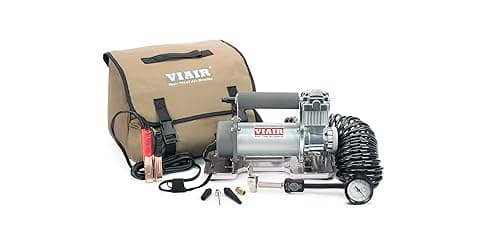 VIAIR 400P Portable Compressor Best overall | Airing back up after a trail | 150 PSI, 2.30 CFM, published 33 percent at 100 PSI | $226.00View on Amazon #ad Affiliate link · Price as of November 10, 2026 |
| 2 | 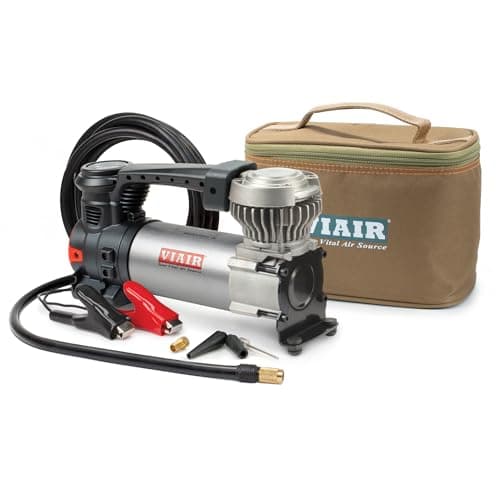 VIAIR 88P Portable Compressor Best for most trucks and SUVs | Truck, SUV and off-road tires | 1.97 CFM, 25 min at 30 PSI, rated to 33-inch tires | $89.89$103.95View on Amazon #ad Affiliate link · Price as of November 10, 2026 |
| 3 | 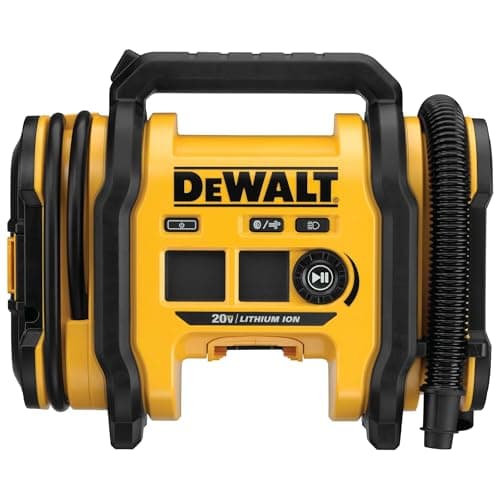 DEWALT DCC020IB 20V MAX Inflator Best for mixed jobs | Anyone already on DEWALT 20V batteries | High-volume and high-pressure modes on three power sources | $127.90$179.00View on Amazon #ad Affiliate link · Price as of November 10, 2026 |
| 4 | 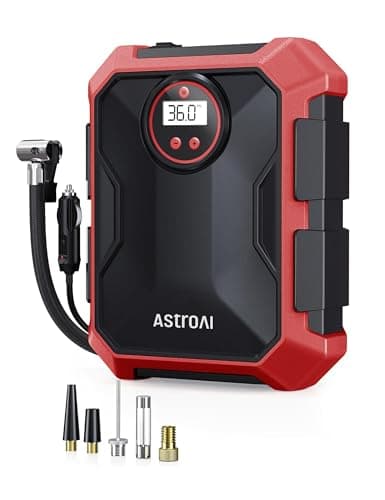 AstroAI 12V Tire Inflator Budget pick | The cheapest inflator still worth owning | Socket-powered, fine for car tires, not for continuous work | $26.59$27.99View on Amazon #ad Affiliate link · Price as of November 10, 2026 |
The words "tire inflator" and "portable air compressor" get used interchangeably in listings, and the distinction that actually matters is not the name. It is whether the unit is built to run for a long stretch without stopping to cool down.
A tire inflator is designed for a burst: a few pounds into one tire, then it rests. A portable compressor is designed for a session: four tires from 18 PSI back to 40, one after another, which can be fifteen minutes of continuous running. Both plug into a car. Only one survives the second job. Tire inflator vs air compressor covers the distinction in more depth.
Duty cycle is the specification that defines the category
Duty cycle is the proportion of time a compressor can run against the time it must rest, usually stated at a given pressure. VIAIR publishes it for both units here, in two different forms: the 88P as 25 minutes at 30 PSI, and the 400P as 33 percent at 100 PSI. Almost nothing else in this category publishes it at all.
That absence is the most useful signal in the whole market. A maker that publishes a duty cycle is telling you what the unit is built for. A maker that does not is leaving you to find out, and the way you find out is a hot motor halfway around the vehicle. Tire inflator duty cycle explained covers how to read the figure and why pressure matters so much to it.
| Unit | Max pressure | Air flow | Duty cycle | Weight | Hose length |
|---|---|---|---|---|---|
| AstroAI 12V Tire Inflator | 100 PSI (listing) | Not published | Not published | Not published | Not published |
| DEWALT DCC020IB | Not published | Not published | Not published | Not published | Not published |
| VIAIR 88P | 120 PSI | 1.97 CFM at 0 PSI | 25 minutes at 30 PSI | 4.75 lb | 16 ft air hose |
| VIAIR 400P | 150 PSI | 2.30 CFM at 0 PSI | 33 percent at 100 PSI | 10.40 lb | 25 ft air hose |
VIAIR publishes full specification sheets for both of its units. DEWALT publishes modes and power sources for the DCC020IB but no airflow, pressure or duty-cycle figure, and AstroAI publishes only a listing specification — so those cells say so rather than carrying an estimate.
CFM is what makes the session shorter
Cubic feet per minute at 0 PSI is the headline airflow figure, and the gap between the two VIAIR units — 1.97 against 2.30 — looks small until you multiply it across four large tires. Airflow also falls as pressure rises, which is why the duty-cycle figure is quoted at a stated pressure rather than in the abstract.
What CFM does not do is let you skip the ingress and temperature ratings. VIAIR publishes IP53 for the 88P and IP54 for the 400P, and an operating range down to minus 4 degrees Fahrenheit on the 88P. If the unit lives in a truck bed or gets used in dust and rain, those numbers are the ones that decide how long you own it.
Inrush current, and why the socket is not an option
Both VIAIR units connect with battery clamps, and the published inrush figures explain why: 45 amps at 0 PSI for the 88P, 81 amps for the 400P. A 12-volt accessory socket fused at 15 or 20 amps cannot supply that, and the result of trying is a blown fuse rather than a slow fill.
This is the practical dividing line between the two halves of this category. If you want socket convenience, you are buying an inflator and accepting its limits — see best 12V tire inflators. If you want continuous-duty airflow, you are popping the hood.
The picks
1. Best overall
VIAIR 400P Portable Compressor
VIAIR · Best for airing back up after a trail
A step up from the 88P for people who air down deliberately: 150 PSI, a published 33 percent duty cycle at 100 PSI, and a 25-foot hose that reaches all four corners.
Published specifications
- Maximum working pressure
- 150 PSI source
- Air flow
- 2.30 CFM at 0 PSI source
- Duty cycle
- 33% at 100 PSI source
- Supply
- 12 V or 24 V, battery clamps source
- Maximum amp draw
- 30 A at 12 V, 15 A at 24 V source
- Inrush current
- 81 A at 0 PSI (PN 40043) source
- Ingress protection
- IP54 source
- Weight
- 10.40 lb source
- Power cord / air hose
- 8 ft / 25 ft source
What works
- Battery-clamp connection, so the 12 V socket's fuse is not the ceiling on throughput
- A published duty cycle — 33 percent at 100 PSI — which almost nothing in this category gives you
- 25 feet of air hose reaches every corner of a vehicle from one hookup
- Metal construction and a real air hose rather than a molded plastic assembly
What does not
- 10.40 lb and the bulk that goes with it — dedicated recovery-gear territory, not a glovebox tool
- 30 A at 12 V rules out any accessory socket; it is battery clamps or nothing
- Slower to set up than a socket inflator for a routine cold-morning top-up
Skip it if
Overkill for a car that needs 4 PSI once a month. That is a socket inflator's job, and this is a lot of equipment to carry for it.
#ad Affiliate link · Price as of November 10, 2026
2. Best for most trucks and SUVs
VIAIR 88P Portable Compressor
VIAIR · Best for truck, suv and off-road tires
A battery-clamp compressor built for the tire sizes socket-powered units cannot handle without stopping to cool down.
Published specifications
- Maximum working pressure
- 120 PSI source
- Air flow
- 1.97 CFM at 0 PSI source
- Duty cycle
- 25 minutes at 30 PSI source
- Supply
- 12 V, battery clamps source
- Maximum amp draw
- 20 A source
- Inrush current
- 45 A at 0 PSI source
- Ingress protection
- IP53 source
- Operating temperature
- -4 to 158 °F source
- Tire size rating
- Up to 33 in source
- Weight
- 4.75 lb source
- Power cord / air hose
- 10 ft / 16 ft source
What works
- Connects to the battery terminals rather than the 12 V socket, so socket fuse current is not the limit
- Built for larger tires and repeated fills — the duty cycle is the whole reason to buy it
- Metal body and a real air hose rather than a molded plastic assembly
What does not
- The battery-clamp connection means popping the hood every time
- Bigger and heavier than any glovebox inflator
- Overkill, and slower to set up, for a routine cold-morning top-up
Skip it if
Not the pick if you drive a sedan and just want to correct 4 PSI once a month. That is what a socket inflator is for.
#ad Affiliate link · Price as of November 10, 2026
3. Best for mixed jobs
DEWALT DCC020IB 20V MAX Inflator
DEWALT · Best for anyone already on dewalt 20v batteries
Three power sources in one body — 20V MAX battery, 12 V socket or 110 V wall — with a digital gauge and auto-shutoff, which is what makes an inflator usable everywhere.
Published specifications
What works
- The 12 V socket option means a dead tool battery never leaves you stranded
- A threaded chuck screws onto the valve stem instead of clamping — the difference between a solid seal and a hissing one
- Set-and-walk-away auto-shutoff at your target pressure
- High-volume mode handles air mattresses and inflatables, not just tires
What does not
- Sold as a bare tool — battery, charger and AC adapter are separate purchases
- Bigger and heavier than a pocket 12 V inflator, so it wants trunk space
Skip it if
Not the pick if you own no DEWALT batteries and only ever top up car tires. A plain 12 V inflator is smaller and cheaper for that job.
#ad Affiliate link · Price as of November 10, 2026
Raw specifications: DEWALT’s own page for the DEWALT DCC020IB 20V MAX Inflator.
4. Budget pick
AstroAI 12V Tire Inflator
AstroAI · Best for the cheapest inflator still worth owning
A plain 12 V socket-powered inflator with a digital gauge and auto-shutoff — the baseline that covers a car's tires with no battery to maintain.
This manufacturer does not publish a full specification table for this model on its own site. Rather than repeat figures we cannot source, the assessment below is limited to what the product category and the retailer listing genuinely establish.
What works
- Powered from the 12 V socket, so it works whenever the car does
- Nothing to keep charged, which means it is never flat when the tire is
- Digital preset shutoff at the target pressure
What does not
- The cord limits where you can work, and reaching a rear tire can be tight
- Small-motor inflators in this tier run hot; large tires need rest intervals
- Gauge accuracy in this class varies unit to unit, so verify against a separate gauge
Skip it if
Not the pick if you regularly air down and back up for trails, or run light-truck tires. That is dedicated-compressor work.
#ad Affiliate link · Price as of November 10, 2026
Key takeaways
- The real difference between an inflator and a portable compressor is continuous-duty capability, not the name on the box.
- Duty cycle is the defining specification, and almost nobody publishes it — which makes the makers who do the short list.
- CFM at 0 PSI sets how long a session takes; airflow drops as pressure rises, so duty cycle is quoted at a pressure.
- Published inrush current is why real compressors use battery clamps: 45 A and 81 A are not socket-fuse territory.
- Ingress and temperature ratings decide how long a unit survives living in a truck bed.
- A compressor does not fix a leak; pair it with a plug kit.
How we sourced this
Every figure on this page came from one of the following. Where a manufacturer or regulator does not publish a number, we say so rather than estimate it.
Common questions
- What is the difference between a tire inflator and a portable air compressor?
- Duty cycle. An inflator is built for short bursts and rests between tires; a portable compressor is built to run continuously long enough to air up a whole vehicle. The names are used interchangeably in listings, so compare published duty-cycle figures instead.
- What CFM do I need in a portable air compressor?
- For tires, roughly 2 CFM at 0 PSI is enough to air up a vehicle in a sensible session, which is where both VIAIR units sit. Higher CFM shortens the session; it does not change what the unit can do.
- Can a portable air compressor run air tools?
- Not usefully. The units on this page are built for tires and inflatables, with no tank to store volume. Running an impact wrench needs a tank-fed compressor, which is a different product entirely.
- Why do portable compressors use battery clamps instead of the 12V socket?
- Because of inrush current. VIAIR publishes 45 amps at 0 PSI for the 88P and 81 amps for the 400P, and an accessory socket is typically fused at 15 to 20 amps.
- Is a 150 PSI compressor better than a 120 PSI one?
- Only if you need the pressure. Car and light-truck tires rarely exceed 50 PSI, so the higher figure mostly matters for heavy-truck tires or air lockers. Duty cycle and CFM matter more for tire work.
More in Tire Inflators
The cheapest tool that prevents the second-most-common roadside stop. Here is which type fits your tires, and the two specs that actually matter.
Read next
Head to head
Inflator vs Air Compressor
The tank is the dividing line: continuous small-volume work versus stored air for tools. Which one belongs in your trunk and which in your garage.
Guide
Duty Cycle Explained
What duty cycle means, why it decides whether an inflator can handle large tires, and what to infer when the manufacturer stays silent.
Head to head
88P vs 400P
VIAIR's published duty cycle, air flow and amp draw set side by side, with the tire sizes and voltages each compressor is actually rated for.
Best for Off-Road
Best for Off-Road
Battery-clamp compressors built for repeated large-volume fills, and why the 12 V socket is the ceiling you have to get past.
Found something out of date, or a figure you can source better than we did? Tell us — corrections get read first. Our methodology explains how picks are made, and contact is one click away.