Battery Chargers
The best golf cart battery chargers
Two physical facts pick this charger before any feature does: how many volts your pack is, and which socket is on the cart. Get either wrong and nothing else matters.

Disclosure: we earn a commission if you buy through the Amazon links on this page, at no extra cost to you. Commission never decides a verdict or a ranking position — read our editorial policy and affiliate disclosure.
How we assessed these: picks are selected from current retailer listings, manufacturer-published specifications where they exist and published owner feedback — not from hands-on testing of every unit. Golf cart chargers are the one category on this site where no pick has a manufacturer specification sheet to cite, so every figure below is attributed to the listing it came from and nothing is estimated.
Short answer
Check two things before you shop: the pack voltage (count the batteries and read their labels — six 6-volt batteries is a 36-volt cart, six 8-volt is 48-volt) and the shape of the charging socket on the cart. Then buy a charger that matches both. For a 48-volt EZGO that is the FORM 48 V 15-amp unit; for a 48-volt Club Car, the MODZ Max48 with the 3-pin round plug.
Golf cart chargers are the least brand-driven purchase on this site. There is no equivalent of picking NOCO over a no-name charger on features, because a charger with the wrong plug on the end of the cable is not a worse choice — it is simply not a choice. It will not connect. So this page is organized around the connector and the voltage first, and the usual charger criteria second.
Quick picks
Tap any row to jump to the full write-up. Scoring criteria are published in full on our methodology page.
| # | Product | Best for | Our read | Price |
|---|---|---|---|---|
| 1 | 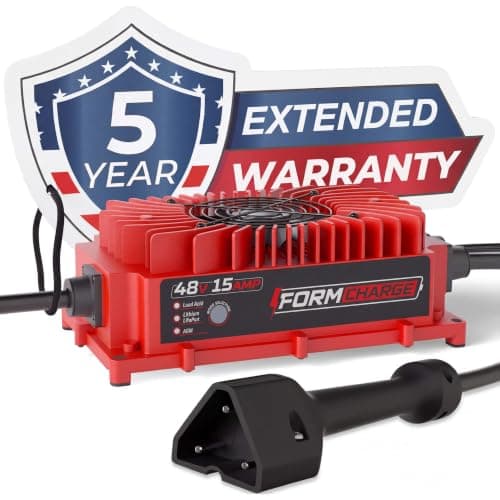 FORM 48 Volt Charger for EZGO RXV & TXT Best for a 48 V EZGO | A 48 V EZGO RXV or TXT | 15 amps with the EZGO plug already fitted | $249.95View on Amazon #ad Affiliate link · Price as of November 10, 2026 |
| 2 | 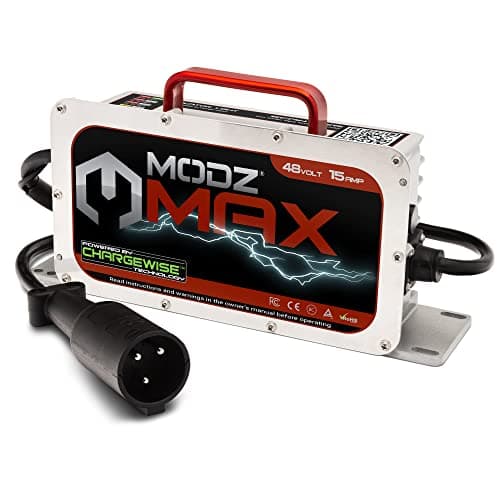 MODZ Max48 Club Car Charger Best for a 48 V Club Car | A 48 V Club Car DS or Precedent | The 3-pin round plug, and built to stay connected | $284.95View on Amazon #ad Affiliate link · Price as of November 10, 2026 |
| 3 | 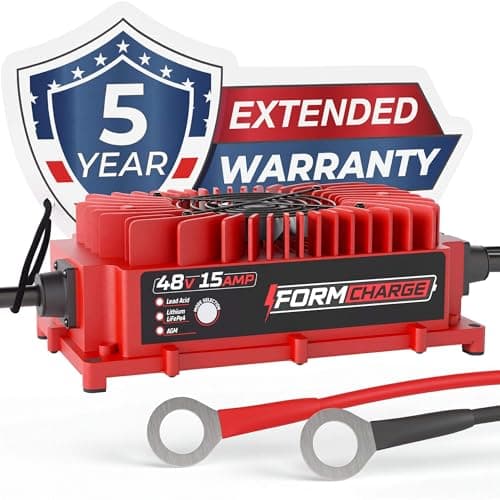 FORM 48 Volt Onboard Charger Best for a dead onboard computer | A dead onboard computer, or a lithium conversion | Ring terminals bolt straight to the pack | $249.95View on Amazon #ad Affiliate link · Price as of November 10, 2026 |
| 4 | 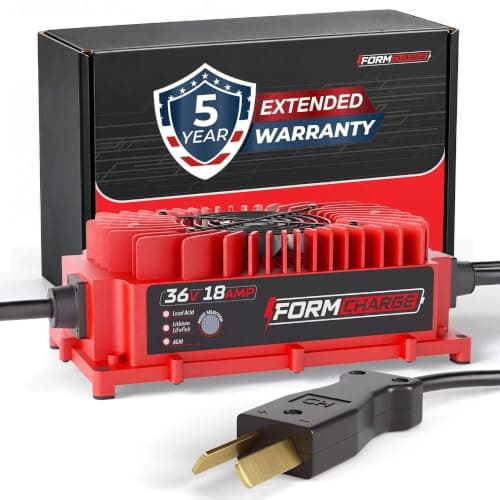 FORM 36 Volt Charger, Crowfoot Plug Best for an older 36 V cart | An older 36 V cart on a crowfoot plug | 18 amps on the crowfoot plug most lists ignore | $229.95View on Amazon #ad Affiliate link · Price as of November 10, 2026 |
Start here: the two checks that decide everything
Count the batteries and read one label. A golf cart pack is a string of batteries wired in series, and the arithmetic is simple: six 6-volt batteries is a 36-volt cart, six 8-volt batteries is a 48-volt cart, and four 12-volt batteries is also 48 volts. The voltage is printed on every battery. This is the single most common ordering mistake in the category, and it is a thirty-second check with the seat lifted.
Then look at the socket, not the badge on the cart. Club Car, EZGO and Yamaha each use their own receptacle, and the same manufacturer changed connectors across model years. The MODZ Max48 listing specifies a 3-pin round plug for 48-volt Club Car DS and Precedent carts running six 8-volt batteries. FORM sells the same internal charger terminated four different ways — an EZGO RXV and TXT version, a Yamaha G29 Drive version, a crowfoot version for older carts, and a ring-terminal version with no plug at all. Buying FORM means choosing the right one of those, not choosing FORM.
How we chose these
The right plug, sold as its own listing. We favored sellers who ship a specific plug fitted to the cable over universal chargers with an adapter bag, because an adapter adds a connection that can work loose or arc in a damp carport. All four picks here come terminated for a specific installation.
Charge current that finishes overnight. The arithmetic is the same as anywhere else on this site: divide the amp-hours you need to replace by the charger's amps, then add roughly 20% for charging inefficiency. Your pack's amp-hour rating is on the battery label. The picks here are listed at 15 amps (48-volt models) and 18 amps (the 36-volt model), which is enough to take a cart from a day's use back to full while you sleep. What amp battery charger do I need sets out that calculation properly.
A maintenance stage you can leave connected. A cart that sits from October to April is in exactly the situation that kills lead-acid batteries, and it is a far more expensive situation than a car battery because you are replacing six batteries rather than one. Every pick here is listed as safe to leave plugged in, dropping to a maintenance mode at full charge. Charger versus maintainer explains why that distinction matters, and how long you can leave a battery maintainer on answers the question directly.
Weather sealing, because this charger does not live indoors. Golf cart chargers sit in carports, barns and open garages, plugged in for months. Both FORM and MODZ list an IP67 rating against water and dust. That is a listing claim rather than a tested one, but it is a specific claim, and we preferred units that make it over units that do not.
Honesty about what is published. This is the category's real problem and the reason this page reads differently from the rest of the site. Neither FORM nor Golf Cart King publishes a downloadable specification sheet of the kind NOCO, Battery Tender and ODYSSEY all publish. There is no manufacturer table to cite, so there is no specification table on any pick here. Every figure on this page is attributed to the current Amazon listing, and where a figure is not stated we leave it out rather than estimate it. If published numbers are how you prefer to decide, that constraint is worth knowing before you read on.
Matching the charger to the cart
| Cart | Pack | Connector | Our pick | Listed current |
|---|---|---|---|---|
| EZGO RXV or TXT, 48 V | Six 8 V or four 12 V | EZGO 3-pin / D-style | FORM 48 V for EZGO | 15 A |
| Club Car DS or Precedent, 48 V | Six 8 V | 3-pin round | MODZ Max48 | 15 A |
| Yamaha G29 Drive or Drive 2, 48 V | Six 8 V or four 12 V | 3-pin leaf | FORM 48 V for Yamaha | 15 A |
| Older Club Car, EZGO or Yamaha, 36 V | Six 6 V | Crowfoot | FORM 36 V crowfoot | 18 A |
| Any cart with a failed onboard computer | As built | None — ring terminals | FORM 48 V Onboard | 15 A |
| Lithium-converted cart, 48 V | LiFePO4 pack | Varies | FORM 48 V Onboard | 15 A |
Connector names and current ratings in this table are taken from each product's current Amazon listing title and bullet text, read on 2026-11-02. Pack configurations reflect what the listings state they fit. No figure here comes from a manufacturer specification sheet, because none of these sellers publishes one. Confirm the connector against the listing photograph and your own cart before ordering. The Yamaha-specific FORM unit is named here for completeness of the decision table; the picks below cover the four installations we would actually buy.
The picks
1. Best for a 48 V EZGO
FORM 48 Volt Charger for EZGO RXV & TXT
FORM · Best for a 48 v ezgo rxv or txt
A 15-amp 48-volt charger with the EZGO plug already on the cable, a weather-sealed case and a maintenance mode you can leave connected between rounds — the straightforward replacement for a dead OEM unit.
This manufacturer does not publish a full specification table for this model on its own site. Rather than repeat figures we cannot source, the assessment below is limited to what the product category and the retailer listing genuinely establish.
What works
- Ships with the EZGO plug fitted, so there is no adapter to source and no guessing at the connector
- Listed at 15 amps on 48 volts, which recharges a cart overnight rather than over two days
- Drops to a maintenance mode at full charge, so it can stay plugged in through the off-season
- IP67 case and an internal protective coating, which matters for a charger that lives in a carport
- 24-month warranty from a US-based seller, stated on the listing
What does not
- FORM publishes no manufacturer specification sheet, so every figure here comes from the listing rather than a citable spec table
- The Amazon bullet text is shared across FORM's plug variants and still says Club Car on this EZGO listing, so buy by the title and the plug picture
- Needs a working onboard computer on carts that use one; a cart with a dead OBC needs the ring-terminal model instead
- Costs more than the unbranded 48-volt chargers that sit beside it in the results
Skip it if
Wrong charger for a Club Car with the 3-pin round receptacle, for a Yamaha, or for any 36-volt cart. The plug and the voltage are physical constraints, not preferences — check both before ordering.
#ad Affiliate link · Price as of November 10, 2026
2. Best for a 48 V Club Car
MODZ Max48 Club Car Charger
MODZ · Best for a 48 v club car ds or precedent
The Club Car answer: a 15-amp 48-volt unit with the 3-pin round plug, an IP67 rating and soft-switch circuitry built so the cart can stay plugged in without the batteries paying for it.
This manufacturer does not publish a full specification table for this model on its own site. Rather than repeat figures we cannot source, the assessment below is limited to what the product category and the retailer listing genuinely establish.
What works
- The 3-pin round plug fits 48-volt Club Car DS and Precedent carts running six 8-volt batteries, stated explicitly on the listing
- IP67 rated against water, dust and vibration, which is the right specification for a charger stored outdoors
- Soft-switch design is listed as safe to leave connected, the behavior you actually want between rounds
- 7 lb with a carry handle and 16 feet of total cable, so it reaches without an extension cord
What does not
- The listing states plainly that it does no diagnostics and will not recover a damaged battery, so a bad pack has to be replaced first
- Golf Cart King publishes no downloadable specification sheet, so the figures here are listing-sourced rather than from a citable table
- 18-month warranty, shorter than FORM's 24 months
- The most expensive charger on this page
Skip it if
Not the one if your Club Car has the older 36-volt pack or if you own an EZGO or Yamaha. It is built around one plug and one voltage, and it will not adapt to another.
#ad Affiliate link · Price as of November 10, 2026
3. Best for a dead onboard computer
FORM 48 Volt Onboard Charger
FORM · Best for a dead onboard computer, or a lithium conversion
The same 15-amp 48-volt charger terminated in ring terminals instead of a cart plug, so it bolts straight to the pack — which is the fix when the onboard computer has failed or the cart no longer has a stock receptacle.
This manufacturer does not publish a full specification table for this model on its own site. Rather than repeat figures we cannot source, the assessment below is limited to what the product category and the retailer listing genuinely establish.
What works
- Ring terminals bypass the cart's charging receptacle and onboard computer entirely, which is the standard workaround for a failed OBC
- Listed as supporting lead-acid, AGM and lithium LiFePO4 packs, so it survives a lithium conversion
- Same 15 amps on 48 volts and the same maintenance mode as the plug-in FORM units
- IP67 case and a 24-month warranty, stated on the listing
What does not
- You have to mount it and wire it to the pack, which is more work than plugging a cable into a receptacle
- Bypassing the onboard computer also bypasses whatever interlocks it provided
- No manufacturer specification sheet exists to cite, so all figures here are from the listing
- Confirm the charge profile your lithium pack's BMS expects before buying; lithium chemistries are not interchangeable
Skip it if
Skip it if your cart's stock receptacle and onboard computer both work. In that case the plug-in version of the same charger is less work for the same money.
#ad Affiliate link · Price as of November 10, 2026
4. Best for an older 36 V cart
FORM 36 Volt Charger, Crowfoot Plug
FORM · Best for an older 36 v cart on a crowfoot plug
The 36-volt half of the problem, which most charger roundups skip: 18 amps on the crowfoot connector that older Club Car, EZGO and Yamaha carts use, with the same weather sealing and maintenance mode as FORM's 48-volt units.
This manufacturer does not publish a full specification table for this model on its own site. Rather than repeat figures we cannot source, the assessment below is limited to what the product category and the retailer listing genuinely establish.
What works
- Covers 36-volt carts, the fitment that disappears from most charger lists even though plenty of older carts are still in service
- Listed at 18 amps, the highest charge current of the four chargers here
- Crowfoot plug suits older Club Car, EZGO and Yamaha carts, per the listing title
- Maintenance mode, IP67 sealing and a 24-month warranty, with a 60-month extension offered
What does not
- No manufacturer specification sheet to cite, so the figures here are listing-sourced
- FORM's shared bullet text names the EZGO D-style plug on this crowfoot listing, so verify the connector against the photograph
- A 36-volt charger is useless the day you convert the cart to 48 volts, which is a common upgrade
- Crowfoot connectors corrode; if yours is green, replace the receptacle at the same time
Skip it if
Wrong charger for any 48-volt cart, and wrong for a 36-volt cart with a D-style or 3-pin receptacle. Count the batteries and look at the socket before you order.
#ad Affiliate link · Price as of November 10, 2026
The onboard computer problem, and when to bypass it
Many Club Car and EZGO carts put an onboard computer between the charging receptacle and the battery pack. It is meant to manage charging and log run time, and when it works you never think about it. When it fails, the symptom is a cart that will not accept a charge at all — the charger either does nothing or clicks and stops, and the batteries themselves are fine.
FORM's plug-in listings state that their chargers are designed to work with both functioning and non-OBC carts, and that listing also points buyers with a suspected faulty computer toward the ring-terminal onboard model instead. That is unusually direct advice from a seller and it matches the standard workaround: terminate at the pack and leave the computer out of the charging path entirely.
Be clear about the trade, though. Bypassing the onboard computer also discards whatever protection and interlocking it was providing, and it means mounting and wiring a charger rather than plugging a cable into a socket. Do it because the computer has failed, not to save money on a working cart. And before you conclude the computer is the fault, check the pack — how to tell if a car battery is bad applies to golf cart batteries too, and a multimeter across each battery in the string finds a single dead cell in a couple of minutes.
One weak battery takes the whole pack down
This is the fact that separates a golf cart from a car, and it changes how you should think about charging. Six batteries in series all carry the same current, so the weakest one sets the behavior of the string. A single battery with a shorted cell will make a healthy pack look dead, and no charger on this page can fix it — the MODZ listing says so explicitly, stating that it performs no diagnostics and will not repair a damaged or defective battery.
So the order of operations matters. Measure each battery individually at rest before you spend money on a charger. If five read as expected and one reads low, you have a battery problem wearing a charger problem's clothes. Replacing one battery in an otherwise matched set is a compromise rather than a fix, because the new battery will be pulled down toward the others, but it is a cheaper compromise than a full set.
What a good charger does do is stop the pack from arriving at that state. Lead-acid batteries sulfate when they sit partly discharged, and a cart left over winter sits partly discharged for months. Battery desulfation, explained is honest about how much of that a repair mode recovers, which is some of it and not all of it. Prevention is the whole game here, and prevention means leaving a maintainer connected.
Charge times, without the guesswork
The calculation is the same one the rest of this site uses, and it needs one number from your own cart. Read the amp-hour rating from a battery label, work out roughly how much of it you used, divide by the charger's amps, then add about 20% for inefficiency. A pack that needs 80 amp-hours replaced takes a little over six hours at 15 amps on that basis, which is why 15 amps is a comfortable overnight figure rather than a fast one.
What you should not do is assume a bigger charger is strictly better. Golf cart batteries are deep-cycle, and deep-cycle batteries prefer a complete, unhurried charge to a fast one — the finish stage is what actually matters for their life. Starting versus deep-cycle batteries covers why those are genuinely different products, and the best deep-cycle battery chargers is the page for 12-volt deep-cycle banks that are not golf carts. How long to charge a car battery has the full arithmetic and the worked table.
If the cart has been converted to lithium
Lithium conversions are now common, and they change the charger requirement completely. A LiFePO4 pack needs a lithium charge profile and a charger that cooperates with the pack's battery management system; a lead-acid profile is the wrong voltage curve and the BMS may simply refuse it. FORM lists lead-acid, AGM and LiFePO4 support on both the EZGO and the onboard models, which is why the onboard unit is our pick for a converted cart.
Verify the specific numbers your pack's manufacturer asks for before buying anything, though. Lithium is not one chemistry with one charge profile, and "lithium compatible" on a listing is not the same as matching the voltage and current your BMS expects. The best lithium battery chargers covers the 12-volt side of this question in detail, including why the charge profile matters more than the amperage.
What about leaving it plugged in all winter
Yes, with a modern multi-stage charger — and this is the single highest-value habit for a cart owner, because a set of six batteries is a far larger bill than a car battery. All four picks here are listed as safe to leave connected, transitioning to a maintenance mode once the pack is full.
The thing not to do is leave an old unregulated charger connected for months. A charger with no float stage never stops pushing current, and over a winter it will cook water out of the cells. Can you overcharge a car battery covers what that damage looks like and why a modern multi-stage unit cannot do it. If your cart is parked somewhere without power, the best solar battery maintainers is the honest alternative, with clear limits on what a small panel can actually achieve.
What we would buy
A 48-volt EZGO RXV or TXT: the FORM 48 V unit with the EZGO plug, left connected through the off-season. A 48-volt Club Car DS or Precedent: the MODZ Max48, for the correct 3-pin round plug and the explicit plug-and-forget design, accepting the shorter 18-month warranty and the higher price. A cart whose onboard computer has died, or one converted to lithium: the FORM onboard model with ring terminals, wired to the pack. And an older 36-volt cart: the FORM 36 V crowfoot unit, which covers the fitment most charger roundups pretend does not exist.
If you came here for a 12-volt charger and landed on golf carts by accident, the best car battery chargers is the page you want, and the best battery charger for a lawn mower covers the other small-engine case where a car charger is the wrong size.
Key takeaways
- Voltage and connector decide this purchase before any feature does — count the batteries, photograph the socket.
- Six 6 V batteries is a 36 V cart; six 8 V is 48 V; four 12 V is also 48 V.
- Connector names are inconsistent between sellers, so match the listing photograph rather than the terminology.
- 15 A on a 48 V pack is a comfortable overnight charge, not a fast one — and deep-cycle batteries prefer unhurried.
- A single weak battery drags the whole series string down, and no charger here claims to fix that.
- No seller in this category publishes a specification sheet, so every figure on this page is listing-sourced.
- Leave a multi-stage charger connected through the off-season; a set of six batteries is an expensive thing to neglect.
Common questions
- How do I know if my golf cart is 36 volt or 48 volt?
- Lift the seat, count the batteries and read the voltage printed on one of them. Six 6-volt batteries is a 36-volt cart. Six 8-volt batteries is a 48-volt cart. Four 12-volt batteries is also 48 volts. It takes thirty seconds and it is the check that prevents the most common ordering mistake in this category.
- Will any 48 volt charger work on my golf cart?
- No. The voltage has to match and so does the plug. Club Car, EZGO and Yamaha each use a different receptacle, and the same brand changed connectors across model years. A 48-volt charger with the wrong plug cannot connect at all, so photograph your cart's socket and match it against the listing images before ordering.
- Can I leave my golf cart charger plugged in all winter?
- Yes, if it is a modern multi-stage charger that drops to a maintenance mode when the pack is full — all four picks on this page are listed as safe to leave connected. Do not leave an old unregulated charger on for months; with no float stage it keeps pushing current and will boil water out of the cells over a winter.
- My golf cart will not take a charge at all. Is the charger dead?
- Not necessarily. On carts with an onboard computer between the receptacle and the pack, a failed computer presents exactly this way while the batteries are fine. The standard workaround is a charger terminated in ring terminals that connects straight to the pack. Before assuming either, measure each battery in the string individually — one shorted cell makes a healthy pack look dead.
- How long does it take to charge a golf cart?
- Read the amp-hour rating on a battery label, estimate how much you used, divide by the charger's amps and add about 20% for inefficiency. A pack needing 80 amp-hours replaced takes a little over six hours at 15 amps. Overnight is the realistic expectation, and for deep-cycle batteries an unhurried complete charge is better than a fast partial one.
- Do golf cart chargers work on a lithium conversion?
- Only if they offer a lithium profile. A LiFePO4 pack needs a different voltage curve from lead-acid and has to cooperate with its own battery management system. FORM lists LiFePO4 support on its EZGO and onboard models. Check the exact voltage and current your pack's manufacturer specifies before buying, because "lithium compatible" on a listing is not the same as matching your BMS.
More in Battery Chargers
A jump pack gets you moving. A charger is how you stop needing one. This is the home half of the problem.
Read next
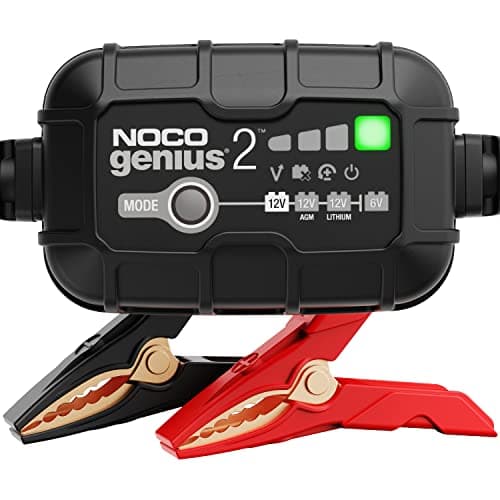
Best Lawn Mower Battery Chargers
Best Lawn Mower Chargers
Chargers sized for a 30 Ah U1 mower battery and a five-month off-season, with published capacity ranges, cold ratings and warranties.
Guide
What Amp Do I Need?
Charge current sizing by battery capacity, with the 10% guideline shown in full and manufacturer capacity ranges to verify against.
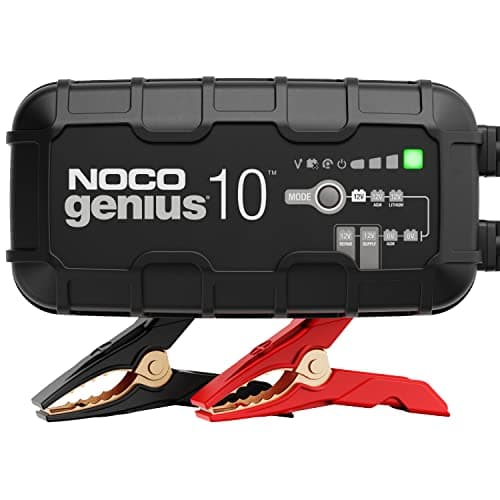
Best for a deep-cycle bank
Best for Deep Cycle
Chosen on published capacity range and chemistry support — the two figures that separate a deep-cycle charger from a car charger with ambition.
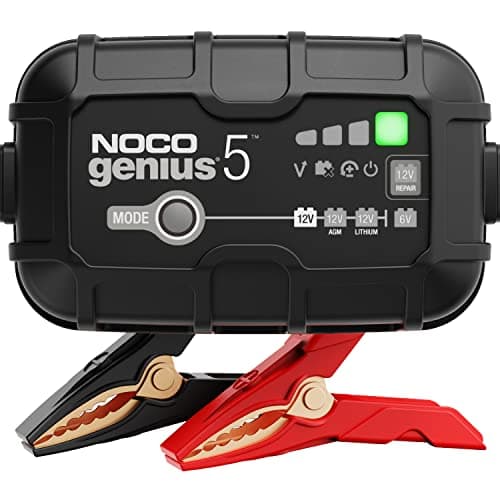
Head to head
NOCO vs Battery Tender
The two brands most people choose between, compared on their own published current, capacity ceilings and warranties — and the one question that settles it.
Best for a lithium battery
Best for Lithium
Chosen on a published lithium charge mode and an amp rating matched to the pack — with a clear list of the settings to keep away from a LiFePO4 battery.
Head to head
Charger vs Maintainer
The difference in one table, why the amp rating is the giveaway, and which one solves the problem you actually have.
Found something out of date, or a figure you can source better than we did? Tell us — corrections get read first. Our methodology explains how picks are made, and contact is one click away.