Trunk Kit
How to start a car that has been sitting
The jump pack is the last step, not the first. Everything that decides whether the car survives happens before you turn the key.

Disclosure: we earn a commission if you buy through the Amazon links on this page, at no extra cost to you. Commission never decides a verdict or a ranking position — read our editorial policy and affiliate disclosure.
How we assessed these: picks are selected from manufacturer specifications, current retailer listings and published owner feedback — not from hands-on testing of every unit. Where a manufacturer does not publish a figure, it is left out rather than estimated.
Short answer
Work in this order: inspect for rodent damage and leaks, read the battery's resting voltage, charge the battery with a proper charger rather than jumping it, bring the tires up to pressure, check oil and coolant, then crank in short bursts. Jumping it first is what turns a dead battery into a replacement battery.
A car that has sat for months is not simply a car with a flat battery. It is a car where several things have quietly changed at once, and the order you address them in decides whether you end up with a running car or a bill. The temptation is to clamp a jump pack on and find out. Resist it for twenty minutes.
Step one: look at it before you touch anything electrical
- Rodent damage. A parked car is a warm, sheltered nest site, and wiring insulation is nesting material. Open the hood and look at the harness, the air box and the top of the engine for shredded material, droppings or chewed insulation. This is the single most expensive thing on this list and the easiest to spot.
- Fluid on the ground. A puddle or a stain under the car tells you where to look before you add pressure or heat to the system.
- The battery case itself. Swelling, bulging, cracks or white crust on the terminals all mean stop. A swollen case or a battery that has sat flat through hard frost must not be charged.
- Tires that have gone down. Four soft tires are normal after months. A tire that is completely flat and has been sat on may have taken a set, and driving on it is how a sidewall fails.
- The exhaust and air intake. Nests and debris happen here too, and blocking either one makes a first start much worse than it needs to be.
Step two: read the battery before you decide anything
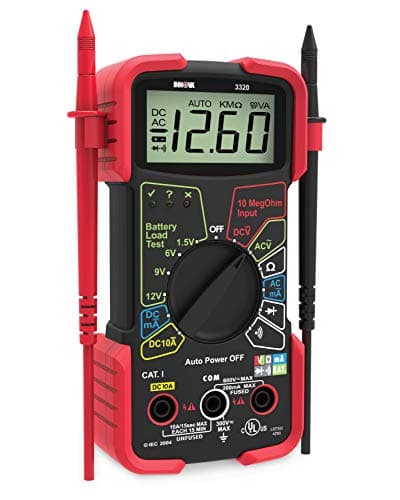
One multimeter reading tells you which situation you are in, and it takes a minute. Probe the battery posts with everything off and read the resting voltage.
| Reading | State | What to do |
|---|---|---|
| 12.6 V or above | Fully charged | Something other than the battery is the problem |
| 12.2 to 12.5 V | Partly discharged | Charge it, then reassess. It will probably be fine |
| 11.8 to 12.1 V | Deeply discharged | Charge it slowly and completely. Expect some capacity loss |
| Below 11.8 V | Very deeply discharged | Charge it, but plan for a replacement. Many chargers need a start-voltage sensor to engage at all |
| Below about 2 V | Effectively dead to most chargers | A charger with a force or repair mode may recover it; often it will not |
These are the standard working ranges for a 12-volt lead-acid battery. A battery that has been sitting at the bottom of this table for months has almost certainly lost permanent capacity to sulfation, whatever happens next.
How to tell if a car battery is bad covers the test in more detail, and battery desulfation explained covers what can and cannot be recovered after a long flat period.
Step three: charge it, do not jump it
This is the step people skip and it is the one that matters most. A jump pack gets the engine running, after which the alternator is asked to refill a deeply discharged battery — a job it is not designed for. An alternator is built to maintain a charged battery while running the car's loads, and forcing it to recover a flat battery is hard on the alternator and leaves the battery chronically short of full, which sulfates it further.
A 5-amp smart charger overnight does the job properly: a staged charge that finishes, with the chemistry respected and nothing cooked. NOCO publishes a start-voltage sensor on the GENIUS5 and GENIUS10, which is the feature that matters here — it is what lets a charger engage with a battery that has fallen below the voltage a simple charger will even recognize. How to charge a car battery covers the method, and how long to charge a car battery has the timing.
If the car has to move today and there is no time for a proper charge, a pack will start it — but treat that as borrowing against the battery, and put it on a charger that evening. The best battery charger for a dead battery covers the deep-recovery case.
Step four: the mechanical checks that take ten minutes
Before the engine turns over
Oil level and condition
Check the level, and look at the color on the dipstick. Oil that has sat for a year is still oil; oil that is milky or smells of fuel is a reason to stop and investigate.
Coolant level, with the engine cold
Look in the reservoir rather than opening a hot system. A low level after a long sit often means a slow leak that was invisible while the car was parked.
Tires up to the door placard figure
All four will be low. Set them to the figure on the Tire and Loading Information label in the driver's door jamb, not the maximum on the sidewall, and look for flat spots as you go.
Brakes, before you move
Rotors surface-rust over a long sit, and the first few stops will feel and sound rough. Test the pedal while stationary, then at walking pace in a safe space, before relying on them.
Fuel, if it has been a year or more
Gasoline degrades over months. A nearly empty tank topped with fresh fuel is better than running out the old. If the car has sat two years or more, this becomes a real job rather than a check.
Step five: crank it, properly
Turn the ignition to the on position first and leave it there for a few seconds so the fuel pump primes and the system wakes up. Then crank in short bursts — three to five seconds, then wait twenty or thirty seconds before trying again. Long continuous cranking heats the starter and, if you are on a pack, empties it.
If it catches, let it idle rather than revving it, and watch the gauges and the warning lights. If the oil pressure light stays on for more than a couple of seconds, shut it down. If it starts and runs rough for the first minute, that is usually normal as old fuel clears and the engine management relearns — but give it the full minute before you decide anything.
If it cranks but does not catch, the battery is not your problem any more and you are into fuel, spark or a mechanical fault. If it does not crank at all even with a charged battery or a pack connected, read jump starter not working and can you jump start a car with a bad alternator before assuming the car is the problem.
After it is running, finish the job
Drive it properly rather than letting it idle in the driveway. Twenty minutes or more of real driving does several things at once: it gets the oil hot enough to drive off moisture, it puts meaningful charge back into the battery in a way idling does not, and it scrubs the surface rust off the brake rotors.
Then decide how to stop this happening again. If the car is going to sit regularly, the fix is a maintainer on the battery or disconnecting it, not a pack in the trunk — see how long a car can sit before the battery dies and should you disconnect a car battery when storing.
What we would have on the bench

1. Best way to wake the battery properly
NOCO GENIUS5
NOCO · Best for one car, charging and maintaining
The single most useful charger for one vehicle: 5 amps, 6 V and 12 V, batteries up to 120 Ah, and it can be left connected indefinitely.
Published specifications
What works
- 5 A recharges a car battery overnight and then holds it — one unit does both jobs
- Rated down to -4 °F, so it works in an unheated garage
- The 77-inch cable reaches from a wall outlet to most engine bays without an extension
- 3-year warranty, against 1 year on the jump-starter line
What does not
- 5 A is slow for a deeply discharged large battery — a 100 Ah battery is an all-nighter
- The 120 Ah ceiling rules out larger deep-cycle banks
Skip it if
Not enough charger if you are reviving deep-cycle RV or marine batteries. Step up to the GENIUS10 and its 230 Ah range.
#ad Affiliate link · Price as of October 16, 2026
Raw specifications: NOCO’s own page for the NOCO GENIUS5.
2. Best first tool out of the box
INNOVA 3320 Digital Multimeter
INNOVA · Best for checking whether the battery is the problem
An auto-ranging meter is the difference between guessing and knowing whether you have a dead battery, a dead alternator or a parasitic drain.
This manufacturer does not publish a full specification table for this model on its own site. Rather than repeat figures we cannot source, the assessment below is limited to what the product category and the retailer listing genuinely establish.
What works
- Auto-ranging removes the main source of beginner error
- Reads resting and charging voltage, which is most of automotive electrical diagnosis
- Cheap enough that not owning one is hard to justify
What does not
- A voltage reading is not a load test — a battery can read 12.6 V and still fail under cranking load
- Entry-level leads are the weak point and are worth replacing
Skip it if
Not a scan tool. If you are chasing a check-engine light rather than an electrical fault, you want an OBD2 reader instead.
#ad Affiliate link · Price as of October 16, 2026

3. Best pack for when it still will not turn
NOCO Boost Plus GB40
NOCO · Best for most cars and small suvs
The default answer for a four- or six-cylinder car: 1,000 peak amps, 24 watt-hours, and light enough that it actually stays in the trunk.
Published specifications
What works
- 24 Wh sits far under the 100 Wh carry-on threshold, so flying with it needs no airline approval
- 2.45 lb and pocketable — the size that decides whether a tool is still in the trunk six months later
- IP65 enclosure, so a wet shoulder in the rain is not a problem
- Reverse-polarity protection means a backwards clamp does not spark
What does not
- 1,000 peak amps runs out of headroom above a 6.0 L gas engine
- The 3.0 L diesel ceiling rules out most modern diesel pickups
- 24 Wh is a small reserve — it is a jump starter, not a power bank substitute
Skip it if
Not the one to buy if you drive a diesel pickup or a big V8. You would be at the edge of its rating on a cold morning, which is exactly when you want margin.
#ad Affiliate link · Price as of October 16, 2026
Raw specifications: NOCO’s own page for the NOCO Boost Plus GB40.

4. Best for four tires that have been flat-spotting
AstroAI 12V Tire Inflator
AstroAI · Best for the cheapest inflator still worth owning
A plain 12 V socket-powered inflator with a digital gauge and auto-shutoff — the baseline that covers a car's tires with no battery to maintain.
This manufacturer does not publish a full specification table for this model on its own site. Rather than repeat figures we cannot source, the assessment below is limited to what the product category and the retailer listing genuinely establish.
What works
- Powered from the 12 V socket, so it works whenever the car does
- Nothing to keep charged, which means it is never flat when the tire is
- Digital preset shutoff at the target pressure
What does not
- The cord limits where you can work, and reaching a rear tire can be tight
- Small-motor inflators in this tier run hot; large tires need rest intervals
- Gauge accuracy in this class varies unit to unit, so verify against a separate gauge
Skip it if
Not the pick if you regularly air down and back up for trails, or run light-truck tires. That is dedicated-compressor work.
#ad Affiliate link · Price as of October 16, 2026
Key takeaways
- Inspect for rodent damage, leaks and a swollen battery case before you connect anything.
- Read resting voltage first — it tells you whether you have a flat battery or a finished one.
- Charge the battery rather than jumping it; an alternator is a poor recovery charger.
- A start-voltage sensor is the charger feature that matters on a deeply discharged battery.
- Oil, coolant, tires and brakes, in that order, before the engine turns over.
- Crank in three-to-five second bursts, then drive it for twenty minutes rather than idling.
How we sourced this
Every figure on this page came from one of the following. Where a manufacturer or regulator does not publish a number, we say so rather than estimate it.
- NOCO GENIUS5 published specifications
- NOCO GENIUS5 product page — start-voltage sensor, Force Mode, thermal sensor
- NOCO GENIUS10 product page — start-voltage sensor, Force Mode, pulse repair
- NOCO GB40 published specifications
- ODYSSEY Battery — frequently asked questions (winter storage, parasitic drain, maintainer use)
- NHTSA TireWise — tire safety ratings and awareness
Common questions
- How long can a car sit before it needs more than a jump start?
- Up to a few months, a charge and a tire top-up is usually all it needs. Past six months, treat fuel, brakes and fluids as part of the job. Past a year, assume the battery has lost permanent capacity and inspect carefully for rodent damage before cranking.
- Should I jump start a car that has been sitting, or charge the battery?
- Charge it. A jump gets the engine running but leaves the alternator trying to recover a deeply discharged battery, which it is not designed to do — the battery ends up chronically short of full and sulfates further. An overnight charge from a 5-amp smart charger does it properly.
- Can a car battery be saved after sitting for a year?
- Sometimes, partially. A full charge will recover most of what is recoverable, but a battery left discharged forms hard lead sulfate that a normal charge cannot reverse, so expect reduced capacity. A charger with a start-voltage sensor or repair mode gives you the best chance.
- What should I check before starting a car that has sat for months?
- Rodent damage to the wiring and air intake, fluid stains under the car, the battery case for swelling or cracks, oil and coolant levels, and tire pressures. Then read the battery's resting voltage. Only after all of that is it worth turning the key.
- Is it bad to let a car idle after a long sit?
- Idling is a poor way to finish the job. It puts very little net charge into the battery, does not get the oil hot enough to drive off moisture, and does nothing for rusted brake rotors. Drive it for twenty minutes or more instead.
More in Trunk Kit
What actually lives in the trunk, in the order it earns its space — and the pre-built kits that are a starting point rather than an answer.
Read next
Guide
How Long a Car Can Sit
Why a modern car flattens its battery in weeks rather than months, how parasitic drain and self-discharge stack up, and the two fixes that actually work.
How to
How to Charge a Battery
The full sequence with a portable charger: connection order, chemistry setting, what the stages mean, and when to remove the battery first.
Best for a Dead Battery
Best for a Dead Battery
Why ordinary chargers refuse a deeply discharged battery, which models detect down to 1 volt, and how to tell a flat battery from a failed one.
Guide
Is the Battery Bad?
The resting-voltage table, the cranking and charging checks, and how to tell a failed battery from a failing alternator or a parasitic drain.
Found something out of date, or a figure you can source better than we did? Tell us — corrections get read first. Our methodology explains how picks are made, and contact is one click away.