Tire Inflators
The best mini tire inflators
A mini inflator is bought for one reason — it is small enough that it is actually in the car. These are the ones worth that trade, and the honest limit of the whole tier.
Disclosure: we earn a commission if you buy through the Amazon links on this page, at no extra cost to you. Commission never decides a verdict or a ranking position — read our editorial policy and affiliate disclosure.
How we assessed these: picks are selected from manufacturers' and sellers' published product information, current retailer listings and the live price layer — not from hands-on fill-time testing of every unit. Where a figure is the seller's own claim rather than a published specification, this page says so.
Short answer
For most drivers the best mini tire inflator is the Fanttik X8 Apex: it is the only unit in this class that publishes a fill time (56 seconds to take a 215/55 R17 from 28 to 33 PSI), it has a backlit gauge and a preset target pressure, and it is small enough to live in a door pocket. The budget pick is the AstroAI L7S — a one-pound pump with the same auto shut-off behavior for a fraction of the money. If you want cordless convenience without the risk of a flat pump, the AstroAI 160 PSI unit carries a 12 V socket lead as a backup, and if you already own CRAFTSMAN V20 batteries the bare-tool CMCE521B is the cheapest way in. One honest caveat for the whole tier: none of these is the right tool for light-truck, RV or trailer tires.
Quick picks
Tap any row to jump to the full write-up. Scoring criteria are published in full on our methodology page.
| # | Product | Best for | Our read | Price |
|---|---|---|---|---|
| 1 | 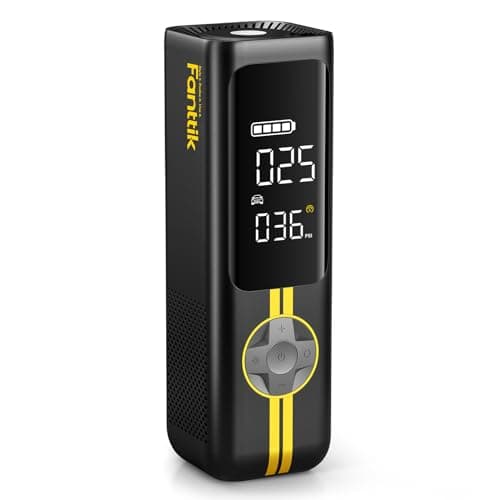 Fanttik X8 Apex Best overall | Cordless top-ups from a glovebox | Published 56-second fill, 28 to 33 PSI on a 215/55 R17 | $59.99$89.99View on Amazon #ad Affiliate link · Price as of November 28, 2026 |
| 2 | 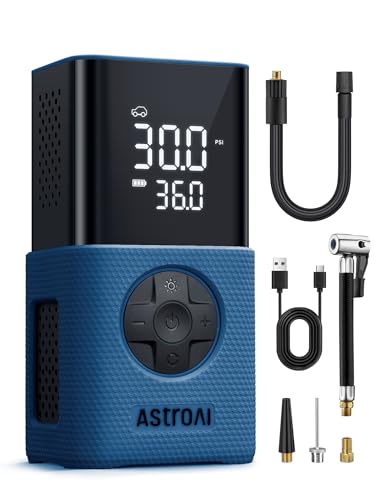 AstroAI L7S Cordless Tire Inflator Budget pick | The cheapest mini inflator worth owning | 1.01 lb and 150 PSI stated, with five preset modes | $23.73$34.99View on Amazon #ad Affiliate link · Price as of November 28, 2026 |
| 3 | 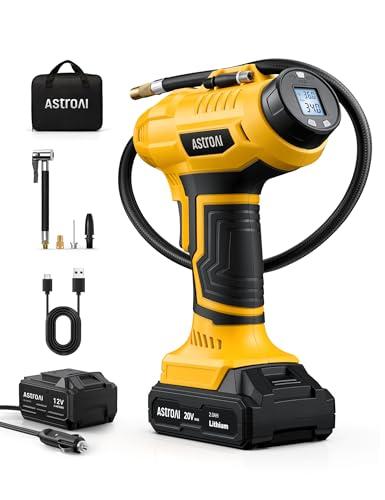 AstroAI 160 PSI Cordless Tire Inflator Best when mini runs out of air | Cordless now, 12 V socket as backup | 20 V pack plus a 12 V socket lead, 160 PSI stated | $52.24$65.99View on Amazon #ad Affiliate link · Price as of November 28, 2026 |
| 4 | 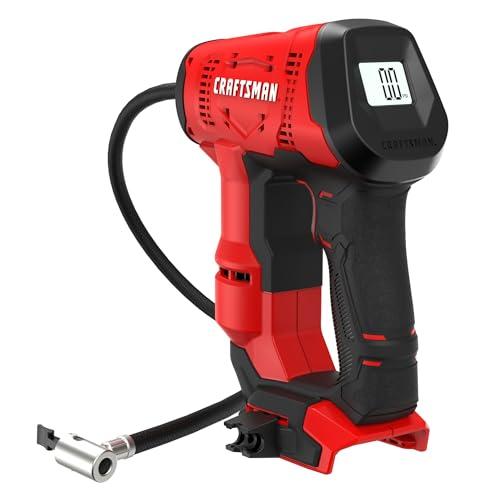 CRAFTSMAN V20 Cordless Tire Inflator (CMCE521B) Best for CRAFTSMAN V20 owners | Anyone already on CRAFTSMAN V20 batteries | Bare tool, 150 PSI, stated 2 PSI gauge accuracy | $39.00View on Amazon #ad Affiliate link · Price as of November 28, 2026 |
| 5 | 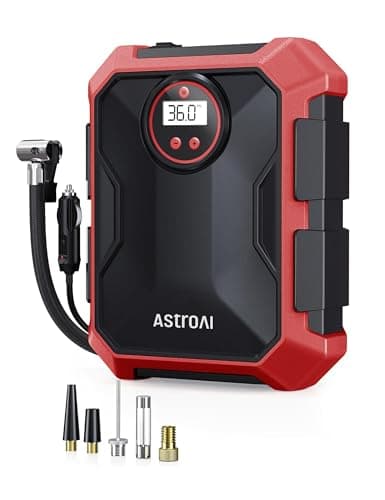 AstroAI 12V Tire Inflator The corded alternative | The cheapest inflator still worth owning | Socket-powered, so there is no battery to keep charged | $21.80$27.99View on Amazon #ad Affiliate link · Price as of November 28, 2026 |
A mini inflator is not a smaller version of a compressor. It is a different purchase with a different justification, and the justification is behavioral rather than technical: a tool that fits in the glove box is a tool that is with you when a tire is at 24 PSI in a parking garage at night. The four-pound compressor on the garage shelf is better at almost everything and it is not there.
That is the whole argument, and it is a good one. It is also why the usual inflator criteria get reordered on this page. Best portable tire inflators ranks on what the unit has to fill, and best cordless tire inflators ranks on power source — both of those pages lead with units that weigh several pounds. Here, weight and packed size come first, and everything else is judged against what you give up to get them.
What counts as mini, and why the line matters
There is no standard for the word, so this page uses a specific line: a self-contained unit that one hand can hold while the other holds the valve, which in practice means about a pound and a half or less with the battery in it. The AstroAI L7S is stated at 1.01 pounds and 5.31 x 2.71 x 2.04 inches. That is the class. A 20 V tool-platform inflator with a D-handle is a good product and it is not in that class, which is why the two bigger units below are framed as the step up rather than as rivals.
The line matters because the trade-off is real and physical. A small pump has a small cylinder and a small motor, and both of those things show up as heat and time once the tire pressure climbs. Every claim in this category is a maximum pressure, never a working pressure, and the gap between those two widens the smaller the pump gets.
The three figures that decide this
- Weight, with the battery. This is the specification that decides whether the tool is still in the vehicle in six months, which makes it the most important one on the page even though it has nothing to do with air.
- A published fill time, with the tire size and the pressure range stated. One unit here has one. A maximum PSI badge tells you nothing about how long you will be crouched at the wheel, because every pump in this tier can reach 150 PSI eventually and none of them should be asked to.
- What happens when the battery is flat. A cordless pump with no alternative power source is a brick on the morning it has self-discharged, which is why a 12 V socket lead is worth more than 10 extra PSI of claimed maximum.
| Unit | Power | Stated max pressure | Stated weight | Fill claim |
|---|---|---|---|---|
| Fanttik X8 Apex | Built-in battery, USB-C recharge | Not published | Compact handheld | 56 s, 215/55 R17 from 28 to 33 PSI |
| AstroAI L7S | Built-in 4,000 mAh battery | 150 PSI | 1.01 lb | Up to 8 tires per charge, 195/65R15 from 30 to 36 PSI |
| AstroAI 160 PSI cordless | 20 V pack plus 12 V socket lead | 160 PSI | Not published | Up to 4 vehicle tires per charge |
| CRAFTSMAN V20 CMCE521B | V20 platform battery (not included) | 150 PSI | Not published | Not published; stated 2 PSI gauge accuracy |
| AstroAI 12V socket inflator | 12 V socket, corded | Not published | Not published | Not published |
Fanttik's fill time is the manufacturer's published figure, linked in Sources. The other rows are each seller's own stated claims from its current listing, including the pressure maximums — none of these brands publishes a duty-cycle figure or a per-model specification table of the kind VIAIR provides, and we measured nothing ourselves. A maximum-pressure number is not a working pressure.
Read the fill-claim column and the useful comparison appears. Two units state how much work they do per charge in terms of real tires, which is the only form of that claim a buyer can use. The rest state a maximum pressure, which every unit in the class can technically reach. Where a figure is missing, this page leaves the cell empty rather than filling it from a competing affiliate site — that is the standard on every page here, and it costs the table some symmetry.
Why the Fanttik leads
Because it publishes the number that matters. Fanttik states 56 seconds to take a 215/55 R17 from 28 to 33 PSI — a specific tire, a specific pressure delta, a specific time. Every other brand in this tier quotes a maximum pressure and leaves the rest to your imagination, and a maximum pressure is the single least useful figure in the category. Five PSI on a real passenger tire in under a minute is the job this class actually gets asked to do.
It also gets the ergonomics right in a way that reads as obvious only after you have used a cheap pump in the dark: a backlit display, a preset target pressure with automatic shut-off, and four preset modes. Our Fanttik X8 Apex review goes into the detail, including the 15-watt USB-C recharge limit, which is the unit's real weakness — it is not quick to refill.
The budget pick does the same job for much less
The AstroAI L7S is the honest answer to the question most people are actually asking, which is whether the premium mini is worth it. At a stated 1.01 pounds it is the smallest unit here, it has the same preset-and-stop behavior, and AstroAI states that its 4,000 mAh battery refills up to eight 195/65R15 tires from 30 to 36 PSI on a charge. It is also the pick we would hand to someone who has never owned an inflator, because the consequence of it being cheap is that it gets bought rather than considered.
What you give up is the published fill time, any stated gauge accuracy, and any guidance on duty cycle. Those absences are the price of the tier, and they are worth saying out loud: with no stated accuracy figure, this is a tool for correcting a tire that is obviously low, not for setting pressures to a number. For that, a dial gauge is still the right instrument — best tire pressure gauges covers the ones calibrated to a standard.
When mini runs out of air
Two units here are the step up rather than part of the class, and they exist on this page because the mini tier has a hard ceiling. The AstroAI 160 PSI cordless pairs a 20 V pack with a 12 V socket lead, which removes the one failure that actually strands a cordless-inflator owner: a pump that self-discharged in a hot trunk since the last time anyone thought about it. AstroAI states a metal cylinder and temperature control, both of which are what a bigger body buys you.
The CRAFTSMAN CMCE521B is the cheapest route in for anyone already on the V20 platform, and CRAFTSMAN does something nobody else in this group does: it publishes a gauge-accuracy claim, a 2 PSI delta across the applications it tested. Read the model number carefully, though — it is a bare tool, with no battery and no charger in the box. For a V20 owner that is a bargain. For anyone else it is the most expensive option on the page once you add a battery and a charger, which is exactly why it is framed as a platform pick and not as a general recommendation.
The case for buying corded instead
It deserves a hearing, because the mini tier's advantage is availability and a corded inflator is the most available tool there is. A 12 V socket inflator has no cell to self-discharge, no charge schedule and nothing to go flat; it draws its power from the car, which by definition has a battery in it. The AstroAI socket inflator on this list is the version of that argument we would actually buy, and it is the cheapest item here.
The catch is that it is tethered to a socket, which means it is a car tool only — no bicycle in the garage, no air mattress at a campsite, no motorcycle parked where the car is not. And a 12 V socket is fused, usually at 15 amps, which caps how much pump you can run off it at all. Tire inflator vs air compressor is the fuller version of that limit, and best 12V tire inflators is the page if you decide corded is the right trade.
What the whole tier cannot do
This is the section that matters most, because the most common mistake in this category is buying a mini pump for a job it has no business doing. A one-pound inflator is for topping up: a passenger tire that has lost four or six PSI over a month, a bicycle, a motorcycle, a sports ball, an air mattress. It is not for taking a light-truck tire from flat to 60 PSI, it is not for an RV or trailer tire running 80 PSI, and it is not for airing four 35-inch tires back up at a trailhead.
The reason is throughput, not maximum pressure. A compressor's output falls as the pressure it is working against rises, and a small motor in a small body heats up while it is doing that. Ask a mini pump to do a compressor's work and the honest outcome is a long wait and a thermal cut-out. The right tools for those jobs are on best tire inflator for trucks and SUVs, best tire inflator for RV tires and best portable air compressors, and all of them weigh what they weigh for a reason.
One more limit worth naming: a mini inflator does not fix a puncture. It buys you time and distance on a slow leak, and on a nail that has sealed itself against the tread it can get you to a shop. A tire that goes flat again in ten minutes needs a plug kit or a tow — best tire plug kits covers the first, and flat tire on a road trip covers deciding between them at the roadside.
The picks
1. Best overall
Fanttik X8 Apex
Fanttik · Best for cordless top-ups from a glovebox
A self-contained cordless inflator small enough to live in a door pocket, with a backlit digital gauge and a preset target pressure.
Published specifications
- Maximum pressure
- 150 PSI source
- Internal battery
- 28.8 Wh lithium-ion source
- Stated gauge accuracy
- ±1 PSI source
- Stated runtime
- Up to 40 minutes continuous source
- Stated fill time
- 56 seconds, 215/55 R17 from 28 to 33 PSI source
- Operating temperature
- 14 to 113 °F (-10 to 45 °C) source
- Weight
- 1.74 lb source
- Recharging
- USB-C, 15 W maximum source
- Work light
- 40 lumens source
- Preset modes
- 4 — bicycle, motorcycle, car, ball; PSI, kPa and bar source
- Warranty
- 12 months source
What works
- No cable to the car at all — it runs off its own internal battery
- Small enough that it stays in the vehicle, which is most of the battle
- Preset-and-stop pressure control avoids the overshoot you get chasing an analogue gauge
What does not
- An internal battery is one more thing to keep charged, and cold weather cuts into it
- Cordless inflators this size heat up on large tires; expect to work in stages
- Manufacturer duty-cycle figures for this class are not consistently published
Skip it if
Not the pick for light-truck or RV tires. Small cordless units are built for top-ups, not for taking a 35-inch tire from flat to 60 PSI.
#ad Affiliate link · Price as of November 28, 2026
2. Budget pick
AstroAI L7S Cordless Tire Inflator
AstroAI · Best for the cheapest mini inflator worth owning
A one-pound handheld inflator with a 4,000 mAh battery, five preset modes and auto shut-off — the cheapest way to stop needing a power socket to add air.
This manufacturer does not publish a full specification table for this model on its own site. Rather than repeat figures we cannot source, the assessment below is limited to what the product category and the retailer listing genuinely establish.
What works
- AstroAI states 1.01 lb and 5.31 x 2.71 x 2.04 inches, which is genuinely glovebox and backpack sized
- Five preset modes (car, motorcycle, bicycle, ball, custom) and four pressure units, so it is not a car-only tool
- Auto shut-off at a preset pressure, which is the feature that makes a cordless inflator usable one-handed
- The listing states the 4,000 mAh battery refills up to eight 195/65R15 tires from 30 to 36 PSI on a charge
- Three-mode light (steady, SOS, strobe) and a silicone sleeve, which matters for a tool that lives loose in a door pocket
What does not
- AstroAI publishes no duty-cycle figure, so there is no stated limit on how long it can run before it needs to cool
- A 150 PSI badge on a one-pound pump is a maximum, not a working pressure — small pumps slow sharply as pressure rises
- No published accuracy tolerance for the gauge, unlike the dial gauges we recommend for setting pressures
Skip it if
Not the pick for light-truck, RV or trailer tires. A one-pound pump taking a 35-inch tire from flat to 60 PSI is the wrong tool, and a battery-clamp compressor is the right one.
#ad Affiliate link · Price as of November 28, 2026
3. Best when mini runs out of air
AstroAI 160 PSI Cordless Tire Inflator
AstroAI · Best for cordless now, 12 v socket as backup
The step up from a pocket pump: a 20 V battery pack with a 12 V socket lead in the same box, so a flat battery never means no air.
This manufacturer does not publish a full specification table for this model on its own site. Rather than repeat figures we cannot source, the assessment below is limited to what the product category and the retailer listing genuinely establish.
What works
- Dual power — a 20 V rechargeable pack plus a 12 V vehicle adapter, which removes the one real failure mode of cordless inflators
- AstroAI states a metal cylinder and intelligent temperature control, which is what separates this tier from the one-pound pumps
- 160 PSI stated maximum, the highest in this group, with a preset-and-stop digital gauge
- The listing states up to four standard vehicle tires on a full charge
- Ships with a storage bag and nozzle adapters for cars, motorcycles, bikes and balls
What does not
- Heavier and bulkier than a true mini — this is a two-hand tool with a handle, not a glovebox item
- No published duty cycle or CFM figure, so throughput cannot be compared with a VIAIR compressor's published numbers
- The 20 V pack is proprietary to this unit rather than part of a tool platform you already own
Skip it if
Skip it if the inflator never leaves the car. A plain 12 V socket inflator costs less, weighs less and has no battery to maintain.
#ad Affiliate link · Price as of November 28, 2026
4. Best for CRAFTSMAN V20 owners
CRAFTSMAN V20 Cordless Tire Inflator (CMCE521B)
CRAFTSMAN · Best for anyone already on craftsman v20 batteries
A bare-tool inflator for the V20 platform: 150 PSI, a digital gauge CRAFTSMAN rates to within 2 PSI, and no battery in the box.
This manufacturer does not publish a full specification table for this model on its own site. Rather than repeat figures we cannot source, the assessment below is limited to what the product category and the retailer listing genuinely establish.
What works
- CRAFTSMAN publishes a stated gauge accuracy — a 2 PSI delta across the applications it tested — which most inflators in this price range do not
- 150 PSI maximum pressure covers car, motorcycle, bicycle and sports-ball duty
- Runs on the V20 batteries a CRAFTSMAN owner already has charged, so there is no extra cell to maintain
- D-handle with rubber overmold, which is a better grip than the slab-sided mini pumps
What does not
- Tool only — no battery and no charger, so it is the most expensive option in this group for anyone not already on V20
- No 12 V socket lead, so a flat platform battery means no air at all
- No published duty cycle, and like every handheld pump it slows as pressure climbs
Skip it if
The wrong purchase if you own no CRAFTSMAN V20 batteries. Buying a bare tool plus a battery and charger costs more than a better self-contained inflator.
#ad Affiliate link · Price as of November 28, 2026
5. The corded alternative
AstroAI 12V Tire Inflator
AstroAI · Best for the cheapest inflator still worth owning
A plain 12 V socket-powered inflator with a digital gauge and auto-shutoff — the baseline that covers a car's tires with no battery to maintain.
This manufacturer does not publish a full specification table for this model on its own site. Rather than repeat figures we cannot source, the assessment below is limited to what the product category and the retailer listing genuinely establish.
What works
- Powered from the 12 V socket, so it works whenever the car does
- Nothing to keep charged, which means it is never flat when the tire is
- Digital preset shutoff at the target pressure
What does not
- The cord limits where you can work, and reaching a rear tire can be tight
- Small-motor inflators in this tier run hot; large tires need rest intervals
- Gauge accuracy in this class varies unit to unit, so verify against a separate gauge
Skip it if
Not the pick if you regularly air down and back up for trails, or run light-truck tires. That is dedicated-compressor work.
#ad Affiliate link · Price as of November 28, 2026
Key takeaways
- A mini inflator is bought for availability — the one in the glove box beats the better one on the shelf.
- Mini here means about a pound and a half or less, self-contained, one-handed.
- A published fill time with a stated tire size beats any maximum-PSI badge.
- Only one unit in this class publishes that fill time, which is why it leads.
- A 12 V socket lead is worth more than extra claimed pressure, because a flat pump is useless.
- The bare-tool platform pick is a bargain for V20 owners and the worst buy here for anyone else.
- No unit in this tier belongs anywhere near a light-truck, RV or trailer tire.
How we sourced this
Every figure on this page came from one of the following. Where a manufacturer or regulator does not publish a number, we say so rather than estimate it.
Common questions
- Are mini tire inflators any good?
- For topping up a passenger tire, a bicycle or a motorcycle, yes — and the good ones shut off automatically at a preset pressure. They are poor at high-volume work, because a small pump's output falls as pressure rises and the motor heats while it happens. Buy one for availability, not for throughput.
- How long does a mini tire inflator take to fill a tire?
- The only figure worth quoting is a published one: Fanttik states 56 seconds to take a 215/55 R17 from 28 to 33 PSI. Adding five or six PSI to a car tire is about a minute of work in this class. Taking the same tire from flat is a different proposition entirely and can take ten minutes or more, with cooling breaks.
- Can a mini tire inflator fill a truck tire?
- It can add a few PSI to one. It should not be asked to take a light-truck, RV or trailer tire from flat, because those tires hold far more air at far higher pressures. That is battery-clamp compressor work.
- Should I buy a cordless or a 12 V socket inflator?
- Cordless if the pump needs to leave the car — bicycles, a motorcycle, a campsite. Socket-powered if it never will, because a corded inflator has no battery to maintain and cannot be flat when you need it. The compromise is a cordless unit that also accepts a 12 V lead.
- How accurate are mini tire inflator gauges?
- Mostly unstated, which is the honest answer. CRAFTSMAN publishes a 2 PSI delta for its V20 unit; most brands in this tier publish nothing. Treat a mini inflator's display as a guide and set pressures with a gauge calibrated to a standard if the exact number matters.
- Where should I store a mini tire inflator?
- In the trunk rather than the glove box or the dash, because heat is what ages a lithium cell fastest and the cabin gets far hotter than the trunk. Top it up twice a year on a schedule — the failure mode of this whole category is a flat pump.
More in Tire Inflators
The cheapest tool that prevents the second-most-common roadside stop. Here is which type fits your tires, and the two specs that actually matter.
Read next
Best Cordless Inflators
Best Cordless
Cordless picks for glovebox convenience, and a clear account of what the internal battery costs you in cold weather and on big tires.
Best Portable Tire Inflators
Best Portable Tire Inflators
Our main inflator roundup: socket, cordless, tool-battery and battery-clamp units, matched to the tires you actually run.
Review
Fanttik X8 APEX Review
150 PSI, 28.8 Wh, plus or minus 1 PSI stated accuracy, 1.74 lb, 40 lm light, 12-month warranty. The door-pocket inflator.
Best Under $50
Best Inflators Under $50
The budget tier done honestly: what a cheap inflator does well, the two corners that get cut, and where it stops being enough.
Found something out of date, or a figure you can source better than we did? Tell us — corrections get read first. Our methodology explains how picks are made, and contact is one click away.